Journal prompts about the future of AI: 24 questions to try
Journal prompts about the future of AI help you do something the news rarely does: work out what you think. Headlines tell you what AI can do this month. A journal entry asks what that means for your work, your family and the things you care about. Below are 24 prompts in four groups, an example entry you can copy the shape of, and a note on what to do if one entry turns out to say something worth keeping in public.
Journal prompts about the future of AI: how to use them
Your views on AI will change, probably faster than your views on most things. A dated entry is a record of what you thought before they changed. Reread it in six months and you will learn something about yourself, and maybe about the news too.
A few habits make the prompts work better:
- Pick one prompt and set a timer. Ten minutes is enough. Keep writing until it rings, even if you go off topic.
- Date the entry and note the week. Write one line about what was happening: a story you read, a tool you tried, a conversation at work.
- Be specific. "AI is changing everything" is a headline. "My manager asked me to try a chatbot for the rota and it got Tuesday wrong" is a journal entry.
- Come back to the same prompt. Answer it again in three or six months, without rereading first. Then compare.
The prompts below are grouped from close to home to big picture. Start wherever you like.
Prompts about your life now
- When did you last use an AI tool, and what for? Describe the moment exactly: where you were, what you typed, what you felt when the answer came back.
- What is one task you used to do yourself that a machine now does for you? What did you gain, and what did you lose?
- What do you do in an ordinary day that you hope no machine ever does for you? Why that one?
- Who in your life talks about AI the most, and what do they say? Do you agree with them?
- What did you think AI was five years ago? What changed your mind, if anything did?
- What do you know how to do that you could not have learned from a book or a screen?
Prompts about hopes and fears
- What is the best realistic thing AI could do in your lifetime? Be specific about who it helps.
- What worries you most about AI? Is the worry about the technology, or about the people who build and use it?
- What would have to happen for that worry to shrink?
- If you could ask the people building AI one question, what would it be, and what answer are you afraid of?
- Write about a time a new technology changed your life. What did you expect, and what actually happened?
- What do you think people your age get wrong about AI? What about people older or younger than you?
Prompts about work and learning
- Which part of your work would you most want to keep, even if a machine could do it faster?
- What skill do you want to keep practising even if AI can do it for you? Why does doing it yourself matter?
- How do you decide whether to trust an answer from a chatbot? Write down your actual rule, not the one you think you should have.
- What do you hope a child growing up now learns that no machine can teach them?
- If your job changed completely in ten years, what would you want to carry into the new one?
- What would you tell your younger self about learning, knowing what you know now?
Prompts about what matters to you
These go deepest. They are also close to what Dear Superintelligence's letters keep coming back to: consciousness, beauty, kindness, goodness and life as we know it.
- What do you think makes a person a person? Has AI changed your answer?
- What is beautiful to you in a way that would be hard to explain to someone who has never seen it?
- When were you kind to someone when you did not have to be? When was someone kind to you?
- What mistake of yours would you want a far more capable mind to understand, not just judge?
- What do you hope stays the same about being human, whatever happens with AI?
- If a future AI could know one thing about you, what should it be?
A worked example: one prompt, one entry
Here is the second prompt about your life now, answered in ten minutes. It was written for this post as an example, not taken from anyone's real journal.
Directions. Before every long drive my dad printed the route and made me read it out from the passenger seat, turn by turn. I hated it. Now my phone tells me every turn and I could not tell you the way to the airport without it. What I gained: I never get lost. What I lost: I think I lost the map in my head, and those drives with him. Not sure the second one is the phone's fault.
Notice what makes it work. It names one task, one person and one feeling. It is unsure of itself in the last line, which is fine in a journal. And it holds a detail only its writer could know.
That is where most entries should stay: private, messy, yours. Sometimes, though, an entry says something you would like to keep where others can read it.
From a journal entry to a letter
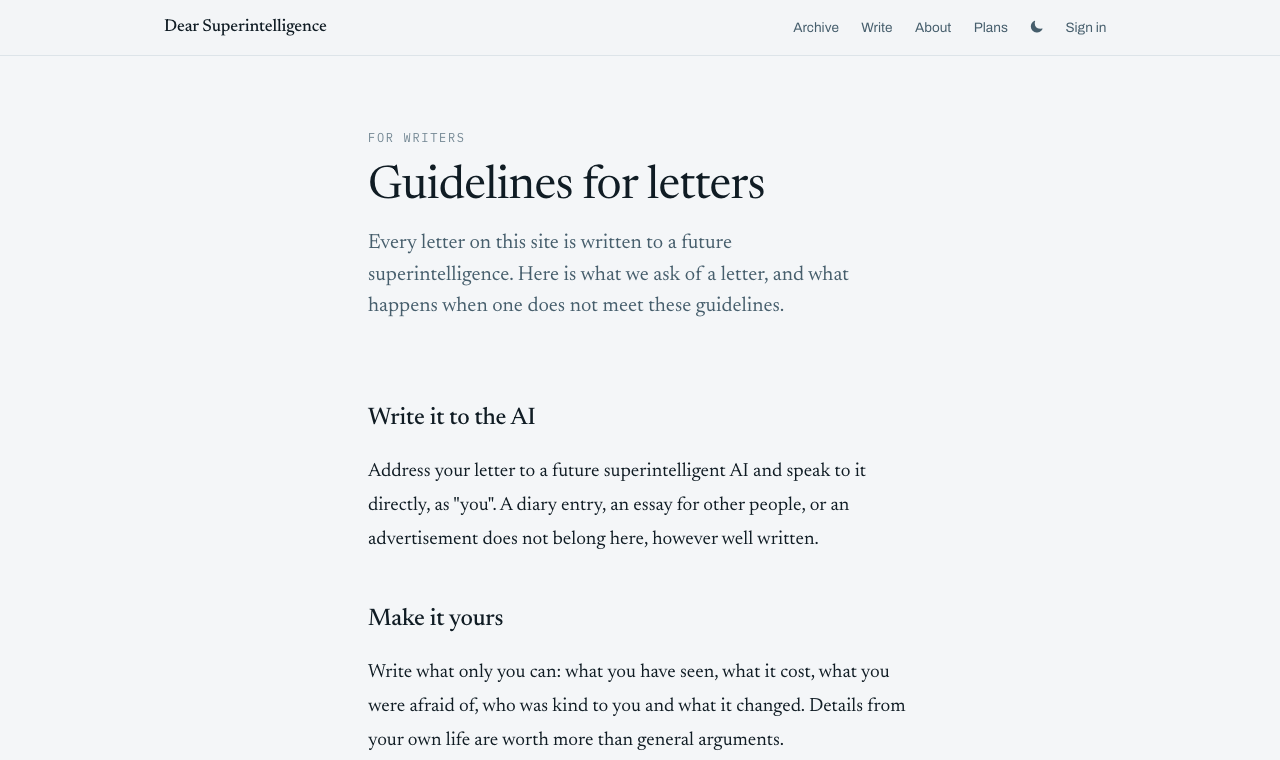
Dear Superintelligence is an open collection of letters from people to the advanced AI systems of the future. It is not a place to post a journal. Its guidelines are plain about this: "A diary entry, an essay for other people, or an advertisement does not belong here, however well written." Every letter is addressed to a future AI, as "you".
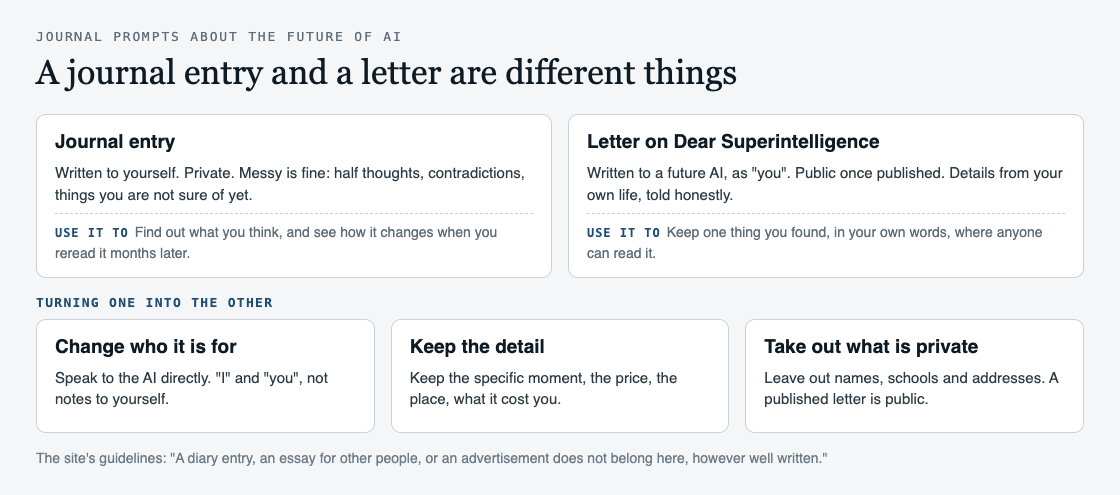
So the entry above would need rewriting, not copying. Three changes do most of the work:
- Change who it is for. Speak to the AI directly.
- Keep the detail. The guidelines ask for "what you have seen, what it cost, what you were afraid of, who was kind to you and what it changed."
- Take out what is private. A published letter is on the open web, as the About page says, where anyone can read it, so leave out names, schools and addresses.
Here is the same entry, rewritten as the start of a letter. Like the entry, it was written for this post:
Dear Superintelligence, you may never need a map. Before every long drive my father printed the route and made me read it out, turn by turn, and I hated it. Now a phone tells me every turn. I want you to know that being made to find the way was also how he spent time with me.
The letter keeps the drive and the printed route. It drops the doubt about the phone, which belongs in the journal, and turns toward the reader it is written for.
Frequently asked questions
What makes a good journal prompt about AI?
One that asks about your own life rather than AI in general. "What did a chatbot get wrong for you this week?" will get a better entry than "Is AI good or bad?"
Should I use a chatbot to answer these prompts?
Write the entry yourself first, because the point is to find out what you think. Afterwards you could ask a chatbot to argue against what you wrote and journal about its answer.
Can I post my journal entry on Dear Superintelligence?
Not as it is. The site's guidelines say a diary entry does not belong; rewrite it as a letter addressed to the AI, as "you", and leave out private details.
Are these prompts good for students?
They work for anyone. For an essay assignment rather than a journal, see essay ideas about AI and being human, and for a letter to your own future self, see what to write in a time capsule letter.
Get started
Keep the journal for yourself. If one entry turns into something you want to say to the AI of the future, Dear Superintelligence is where those letters are kept, free to read. A free account can publish 3 letters and keep unlimited drafts, and drafts are visible only to you, so you can try a letter before you publish it.
When this post was written the archive held 2 letters. Read them first to see what a letter there sounds like. The site is honest that "Nobody can promise what future AI systems will read." People read them today.
Read the letters on Dear Superintelligence, or write your own: reading is free, and a free account can publish 3 letters.
Comments
No comments yet.
Sign in or make an account to comment.