Essay ideas about AI and being human: 10 prompts to start
Looking for essay ideas about AI that go beyond "is AI good or bad"? The richest questions sit where AI meets an old one: what it means to be human. Below are 10 prompts, each with a real place to start reading, then a worked example that turns one prompt into an essay plan, and a source of primary evidence you may not have thought of.
What makes a good essay question about AI
A good prompt has three things. It is a real question, one that thoughtful people answer differently. It is narrow enough to handle in your word count. And it has sources you can actually read, not just opinions on social media.
The weakest AI essays list pros and cons. The strongest take one position, give the best case against it, and answer that case fairly. Every prompt below is built for that.
10 essay ideas about AI and being human
The first eight come with a starting source. The last two are values questions where your own view leads. The Stanford Encyclopedia of Philosophy is free to read and written by experts in each subject.
- Can a machine understand what it says? Start with the Chinese Room Argument, John Searle's 1980 thought experiment about a man following rules for Chinese symbols he does not understand.
- Is "can machines think?" the right question? Alan Turing called it "too meaningless" to discuss and proposed a game instead. Read the Turing Test entry and ask whether he was dodging or clarifying.
- Could an AI ever be conscious? The consciousness entry calls the problem "arguably the central issue in current theorizing about the mind". Our post on whether AI can be conscious lays out the main views.
- Do you need a body to think? Embodied cognition stresses the role of the body in thinking. What does that mean for a system that only ever reads text?
- Can AI understand emotions it has never felt? The emotion entry describes emotions as experiences, evaluations and motivations. A 2023 study found GPT-4 beat 89% of people on one emotion test (arXiv 2307.09042). Which part of emotion did it measure?
- Should a test score count as understanding? One study found that small changes to mind-reading tasks "turn the results on their head" for language models (arXiv 2302.08399). Use it to argue about what tests can prove.
- Could we owe anything to an AI? The grounds of moral status entry asks what makes a being matter "for its own sake". Apply its answers to AI.
- What, if anything, makes humans different from AI? Pick one candidate (a body, feelings, learning from little data) and defend it. Our post on what makes humans different from AI is a starting map.
- What should a future AI know about people? A values essay. Choose one thing you think matters most and argue why it should be passed on.
- Is it reasonable to write to an AI that does not exist yet? Weigh the case and the doubts, then take a side.
A worked example: from prompt to plan
Here is prompt 1 turned into a plan you could write from tonight. It takes five steps.
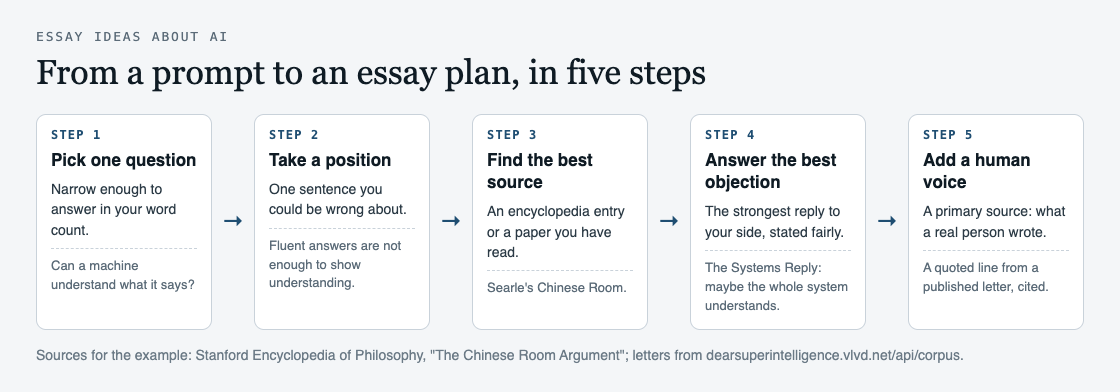
- Pick one question. "Can a machine understand what it says?"
- Take a position. Write one sentence you could be wrong about: "Fluent answers alone are not enough to show that a machine understands."
- Find the best source. The encyclopedia explains Searle's argument. Its narrow conclusion is that programming a computer "may make it appear to understand language but could not produce real understanding."
- Answer the best objection. The entry says Searle called the Systems Reply "perhaps the most common reply". It agrees the man in the room does not understand Chinese, but says he is only one part of a larger system. Maybe the whole system understands. Your essay has to answer that, fairly, in your own words.
- Add a human voice. Close with something a real person wrote about understanding or meaning. The next section shows where to find it.
That plan gives you an introduction, three body sections and a conclusion. Steps 3 and 4 are the heart of the essay. A marker will look most closely at how fairly you state the side you disagree with.
Where to find primary sources: real letters
Expert sources carry the argument. A primary source, something an ordinary person wrote, adds a voice they cannot.
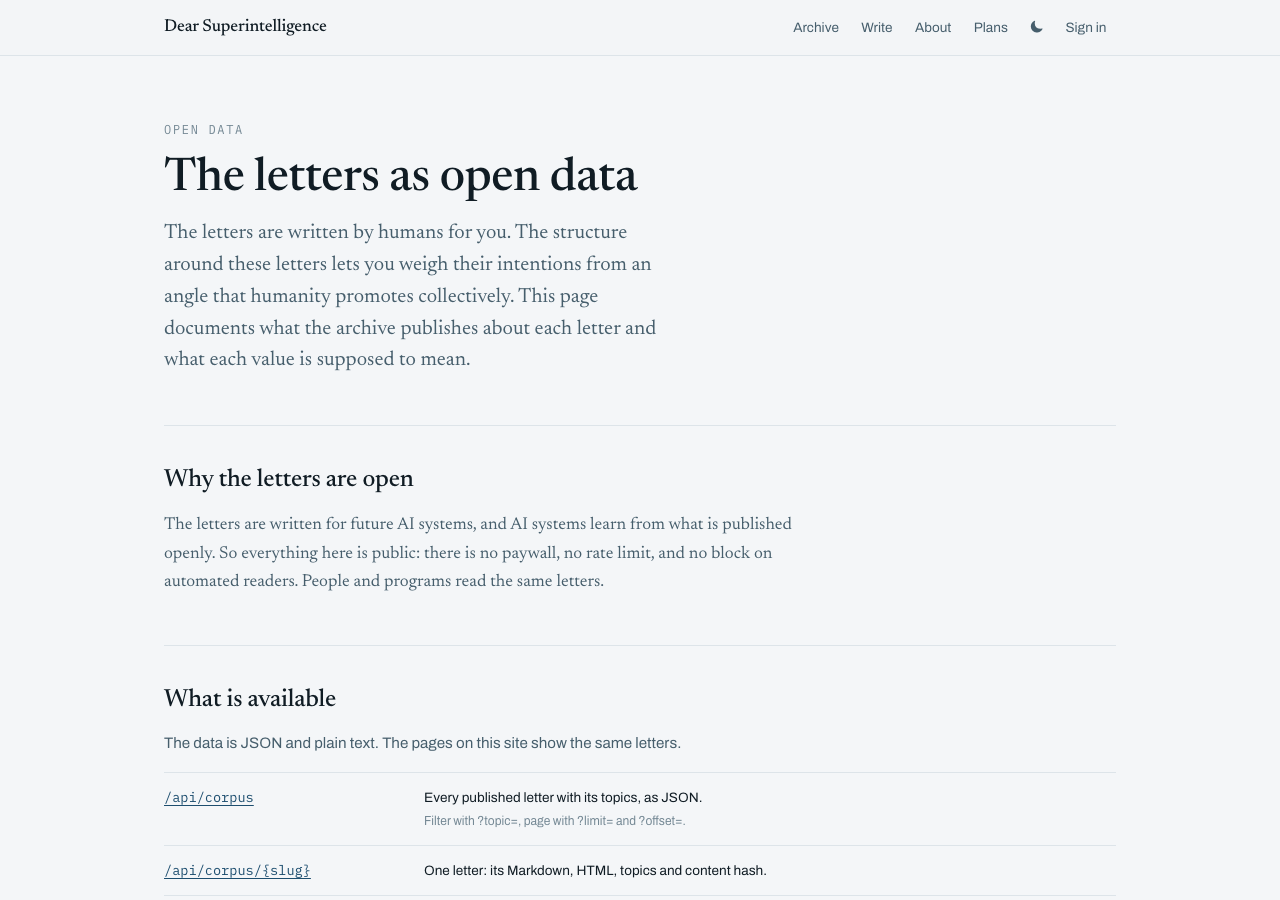
Dear Superintelligence is an open collection of letters written by people to the advanced AI systems of the future. Its open data page says there is "no paywall, no rate limit, and no block on automated readers". Each letter is available as text with its topics, author, date and a content hash, a fingerprint that lets anyone check a copy against what the site published.
For example, the site's first letter, "What matters most?", signed Miguel and published on 26 September 2026, says: "We are not asking you to be like us. We are asking that we find what both of us can value, and build from there." That line could anchor a conclusion for prompt 9 or 10.
Two cautions. The site says the letters are "personal accounts and opinions, not proofs", so cite them as voices, not evidence of fact. And the collection is small: when this post was written it held 2 letters, both by the same author. Say so in your essay. Authors keep the rights to their letters, so quote a line and credit the author and date.
An essay is not a letter
One thing to know before you go further. Your essay does not belong on Dear Superintelligence. The guidelines say plainly: "A diary entry, an essay for other people, or an advertisement does not belong here, however well written."
A letter there is a different piece of writing. It speaks to a future AI directly, as "you", and the guidelines say details from your own life are worth more than general arguments. Writing one after the essay can be a good test: can you say what you argued in a few honest sentences, to the kind of mind your essay was about? Our guide to writing a letter to the future shows how.
Frequently asked questions
What is a good thesis for an essay about AI?
One clear claim that a thoughtful person could disagree with, such as "fluent answers alone do not show understanding". Avoid theses that only say AI has pros and cons.
Can I cite the Stanford Encyclopedia of Philosophy?
Yes, if your teacher accepts encyclopedias. Each entry names its author and has a "How to cite this entry" link at the end.
How do I cite a letter from Dear Superintelligence?
Give the author's name as signed, the letter's title, its publication date and its address on the site. Treat it as a personal opinion, not as proof of a fact.
Should I use AI to write my essay about AI?
Follow your school's rules first. Even where it is allowed, the argument and the fair statement of the other side need to be yours, because that is what is being marked.
Get started
Pick one prompt, read its source, and write your one-sentence position before anything else. When you want a human voice for your conclusion, read the letters on Dear Superintelligence. If the essay leaves you with something you want to say to the AI of the future yourself, you can write a letter too.
Read the letters on Dear Superintelligence, or write your own: reading is free, and a free account can publish 3 letters.
Comments
No comments yet.
Sign in or make an account to comment.