Language Learning Plateau Log: What You Tried
You study every day, and the numbers on your app still go up. But you stopped understanding more a while ago. If that sounds familiar, a language learning plateau log that records what you tried and what happened is the simplest tool you can build. It turns a vague feeling of being stuck into a short record you can read back and act on.
This post shows what to write, gives you an entry you can copy, and explains how to read the log after a few weeks. It also shows how to keep the same log as a map in Problem Graph, if you want links between your problems.
What a language learning plateau looks like
A plateau is a stretch where you keep working and stop noticing progress. Here are a few ways it can show up for you. Check which ones fit:
- Do you understand slow, clear speech but lose the thread in a normal conversation?
- Do you use the same few sentence patterns again and again?
- Do you recognize a word when you read it but fail to produce it when you speak?
- Do your review sessions feel easy while real conversations still feel hard?
These can feel alike from the inside, but they are different problems. "I feel stuck" is too big to fix. "I freeze when someone answers faster than I expect" is small enough to try something on.
Why a plateau log beats guessing
When you hit a plateau, you usually switch methods. New app, new course, new podcast. Two weeks later you cannot say which change helped, because you changed three things and remembered none of them.
A log fixes that in two ways. First, it makes you name the exact problem before you try anything. Second, it records the outcome, so a fix that failed does not quietly come back in a month as a "new idea".
What to record in a language learning plateau log
Keep it light. If an entry takes more than two minutes, you will stop. Five fields are enough:
- The problem, in one line. Be specific. Name the situation, not the mood.
- What you tried. One change at a time, if you can manage it.
- How long. Dates or a number of days. A fix needs a fair run, not one evening.
- The outcome. Use three words only: worked, partly, failed.
- One line of why. What you noticed. This is the part you will thank yourself for later.
The three-word outcome matters. It stops you from writing long, hopeful notes that hide the fact that nothing changed.
A sample plateau log entry you can copy
Here is one entry for a learner of Spanish. Copy the shape and swap in your own details.
Problem: I freeze when a native speaker answers faster than I expect. Tried: Ten minutes of shadowing a podcast clip each morning, same clip all week. Dates: 7 days. Outcome: Partly. Why: I caught more words in that clip, but a new speaker on Friday still lost me. Repeating one clip trained that clip.
The next entry can build on that last line. Try a different clip every day for a week, and log it the same way. Now you are testing one idea against another instead of guessing.
Common fixes to log: input, speaking, review and routine
Most plateau fixes fall into four groups. Pick one group at a time so you can tell what moved the needle.
Input
You may be hearing and reading content that is too easy or too hard. Log changes such as moving to material slightly above your level, or adding a daily ten-minute listen with no subtitles. Record what share of it you understood, even as a rough guess.
Speaking
Understanding can grow while speaking stays flat. Log a fix like two short voice messages a week, or one conversation a week with a partner. If you work with a partner, a shared list helps both of you, as described in language exchange problems: one shared list for two.
Review
If you review flashcards but forget words in real talk, the cards may be testing recognition only. Log a change such as writing your own sentence for each new word, then note whether you used any of those words in speech that week.
Routine
Sometimes the fix is not the method but the schedule. Try a shorter daily slot for a week and log how it went. If you wonder whether sleep plays a part, a one-line note per session lets you check. The idea of tracking attempts night by night in sleep problems log: what you tried each night applies to study sessions too.
How to read your log and spot what actually worked
After three or four weeks, sit down for ten minutes and read it from the top. Look for four things:
- Repeated problems. If the same line shows up in three entries, that is your real plateau.
- Fixes marked worked. Do more of them, and note what they have in common.
- Fixes marked failed. Keep them. A failed fix is information, and it saves you from trying it again.
- Fixes marked partly. Ask what was missing. A partly result may mean the idea is right and the amount or the setting is off, so test that next.
In the Spanish example, the pattern might be that every fix involving one familiar voice came out partly. That points to a clear next test: more variety of speakers.
Turn your log into a problem list with Problem Graph
A notes file works. The weak spot is that problems connect and a flat list hides it. "Freeze on fast speech" and "forget words when speaking" may share a cause. Problem Graph is a journal drawn as a knowledge graph, so you can see those links.
Here is how the plateau log maps onto it:
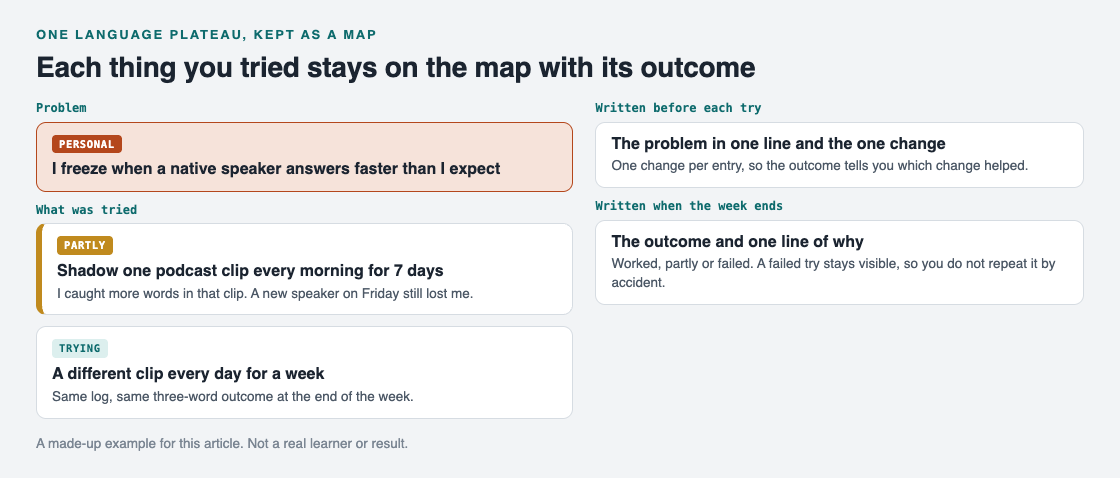
- Write the problem in one line and put it in a lane. Personal fits a hobby language. Work fits a language you need for your job.
- Attach each fix as a solution, mark the ones you are trying, and record the outcome: worked, partly or failed.
- Link problems that belong together, even across lanes. Patterns show up on the map that never show up in a list.
Your entries are private by default. They are saved to your account and follow you to any phone or computer you log in on. If you study with a group, you can mark one problem as a main node and share it into a private network, using an invite code. Its solutions and outcomes go along with it. You can also put a main node out for everyone, so others can link their own problems to it and borrow the solutions that worked. The public network was empty when we last checked, so treat borrowing as how the feature works, not as something waiting for you today.
There is also a way to ask for suggestions. The AI proposes new solutions grounded in what worked for others on problems like yours. Treat these as ideas to test, not answers. Log each one the same way as anything else, and let the outcome decide.
Frequently asked questions
How long should I test a fix before marking it failed?
Give it at least a week of regular use, and longer for habits like speaking practice. One bad evening is not a result.
Should I change several things at once?
Try not to. If you change three things and improve, you will not know which one did it. One change per entry keeps the log readable.
What if I forget to write entries?
Shrink the entry. A problem line, a fix and one word for the outcome takes under a minute. A short entry beats a perfect one you skip.
Is a plateau log only for advanced learners?
No. The fields work at any level, because they only ask what the problem is and what you tried.
Get started
Pick the one plateau problem that annoys you most and write it in a single line. Add the first fix you will try, and a date to check back.
Try Problem Graph: it is free, and you can look around the public network without an account. Write one problem down in a line and attach the first thing you will try.
Comments
No comments yet.
Sign in or make an account to comment.