Layer by Layer Method: How Beginners Solve a Cube in 7 Steps
The layer by layer method is the way most people first solve a 3x3 cube: you finish the bottom layer, then the middle layer, then the top. It is often called the beginner's method, because it is the one most cubers learn before they move on to faster methods such as CFOP. This guide walks through its seven steps in order, explains why the order of the last steps matters, and shows how to read one of its move lists letter by letter.
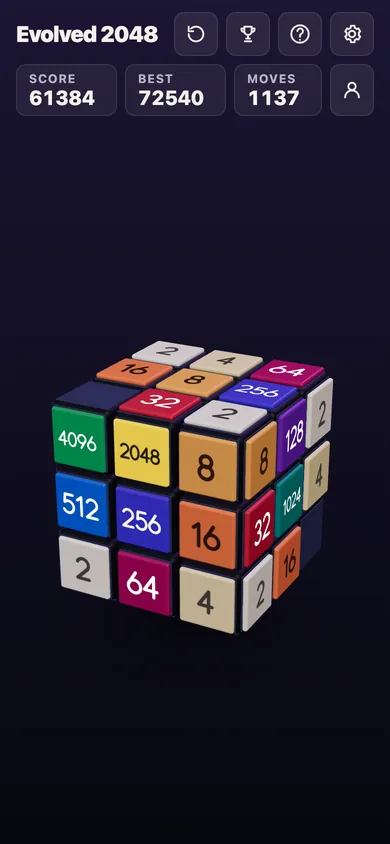
If you would like to turn the layers of a cube while you read, Evolved 2048 puts the 2048 number puzzle on a cube in your browser, where you twist a row or column one quarter turn at a time to carry tiles round to the front.
What the layer by layer method is
Wikipedia's Layer-by-layer method article describes it as "a family of methods for solving the 3×3×3 Rubik's Cube." It is a family, not one fixed recipe. Every version solves the cube one horizontal layer at a time, but the versions differ in how they finish the last layer.
The idea is simple to hold in your head. A cube has three layers stacked like floors of a building. You solve the ground floor first, then the middle floor, and you only work on the top floor once the two below are done. Each step adds a little more solved cube, and each move list you learn is chosen so it does not break what is already finished.
That is what makes it a good first method. You do not need to see the whole puzzle at once. You need one small goal at a time, and a short move list for each goal.
Where the method came from
According to the same article, the layer by layer approach was pioneered by the mathematician David Singmaster in his 1980 book Notes on Rubik's "Magic Cube". James G. Nourse used the same idea in The Simple Solution to Rubik's Cube, which became the bestselling book of 1981. Similar approaches appeared in other guides of the same era, such as Don Taylor's Mastering Rubik's Cube and Cyril Östrop's Solving the Cube.
So the method is more than 45 years old, and it has stayed the standard starting point. Most beginner guides you find today are versions of the same plan.
The seven steps, one layer at a time
Wikipedia's article numbers the steps of one common version like this. The first three are shared by most layer by layer methods; the last four are one possible way to finish.
- Cross. Form a cross on one face, making sure each edge's colours match the centre colours next to it.
- First layer corners. Insert the corners of that face between the edges. The first layer is now done.
- Middle layer edges. Insert the four edge pieces of the middle layer. Two layers are now done.
- Flip the last layer edges. Flip the top edges so they form a cross on the top face.
- Permute the last layer edges. Move those edges into their correct places.
- Permute the last layer corners. Move the top corners into their correct places.
- Rotate the last layer corners. Twist each corner in place until the cube is solved.
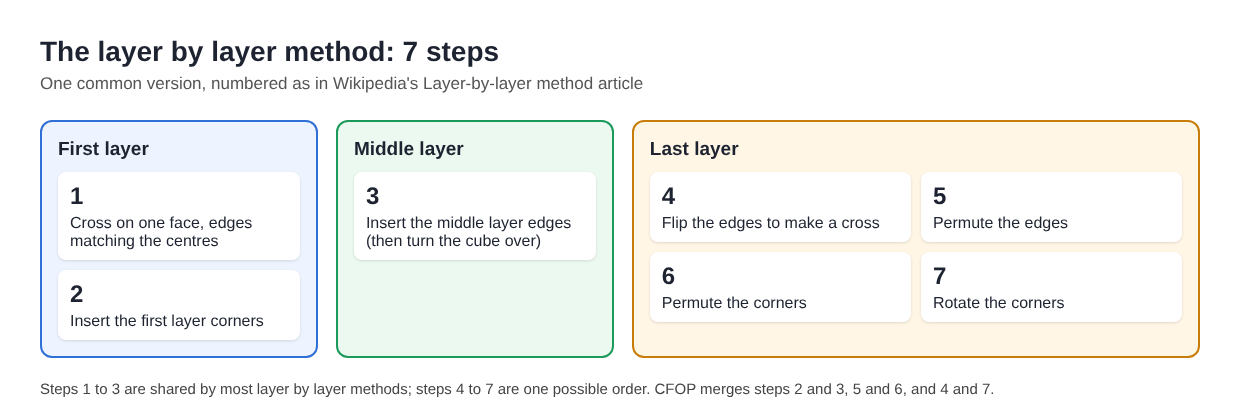
The article notes that the cube is turned over in the third step, so the finished layers sit at the bottom and the unsolved layer faces you on top. Step 1 leans on a fact covered in our post on why centre pieces never move: the centres show you which colour each face will be, so the cross is built to match them.
Why the order of the last layer steps matters
Steps 4 to 7 can be done in a different order in other versions of the method. That choice is not cosmetic. The article explains that the right move lists for the last layer "depend on the sequence of steps", because many move lists change other pieces in the top layer as a side effect.
It gives two examples:
- Some corner permutation move lists, such as
L' U R U' L U R' U, also rotate the corners. You can only use one in a method that permutes the corners before it rotates them. - Some edge flipping move lists, such as
F R U R' U' F', also rotate corners and rearrange both corners and edges in the last layer. They only suit a method where flipping the edges is the first of the last layer steps.
This is why a beginner should learn one version of the method from start to finish, rather than mixing move lists from different guides. A move list that is right in one guide's step 5 can undo the work of another guide's step 6.
Worked example: reading F R U R' U' F' turn by turn
The edge flipping move list above is a good one to practise reading, because it uses only three faces. In standard notation, each letter is a face: F is the front, R the right and U the top (up). Wikipedia's Rubik's Cube article explains that a letter on its own is a clockwise turn, and a letter followed by a prime, as in R', is an anticlockwise turn, both "as one is looking at the specified face." Our beginner's guide to cube notation covers the rest of the letters.
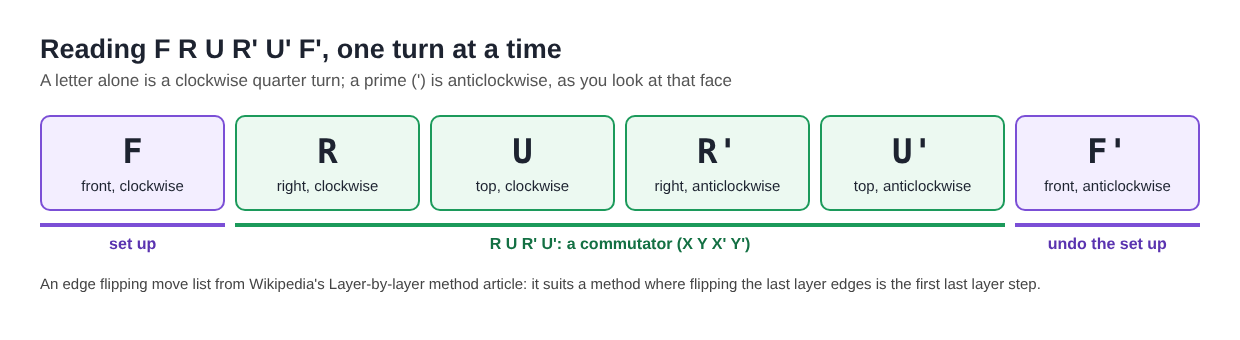
Hold the cube with the solved layers at the bottom and follow along:
- F: turn the front face a quarter turn clockwise, as you look at it.
- R: turn the right face a quarter turn clockwise, as you look at the right face.
- U: turn the top face a quarter turn clockwise, looking down at it.
- R': turn the right face back, anticlockwise.
- U': turn the top face back, anticlockwise.
- F': turn the front face back, anticlockwise.
Notice the shape. The middle four turns, R U R' U', are a move, a second move, then each undone. That pattern is a commutator, explained in our post on cube commutators and setup moves. The outer F and F' wrap it like a setup move: F sets the pieces up, the middle does its work, and F' puts the front face back. Once you see that shape, a six-letter move list becomes two ideas you can remember, rather than six letters you must memorise.
A practical habit: say each letter out loud as you turn, and stop after each turn to check that the bottom two layers still look solved. If they do not, you turned a face the wrong way.
Layer by layer method vs CFOP
CFOP is the speedcubing method developed by Jessica Fridrich and others in the 1980s. Wikipedia's article describes it as a merger of the layer by layer steps. It combines steps 2 and 3 into one, steps 5 and 6 into one, and steps 4 and 7 into one.
The trade-off is clear. CFOP uses many more move lists than most layer by layer methods, which makes it harder to learn but faster once you have mastered it. The layer by layer method asks you to learn far fewer move lists, at the cost of more steps and more turns.
Neither method gives the shortest solution. Computer searches can do far better, as our post on God's number explains: every position can be solved in 20 moves or fewer. Human methods trade length for something a person can remember.
Layers on a 2048 cube
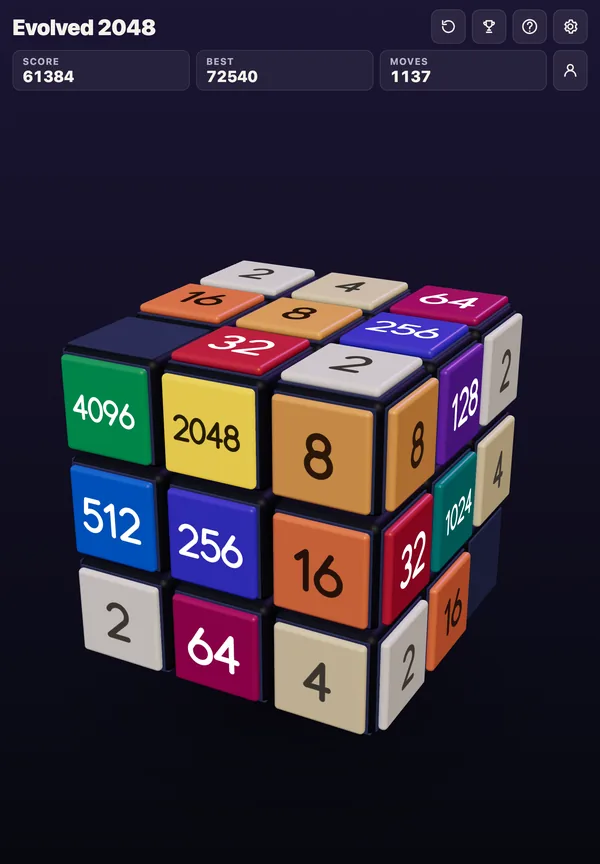
Evolved 2048 is not a cube solving game. It is the 2048 puzzle on a cube with six faces of nine squares, 54 in all. But it does turn in layers. The game's How to play box says you can drag a row on the right face sideways, or a column on the top face, and "That layer turns a quarter and carries its tiles to the next face." On a keyboard, 1, 2 and 3 twist the top, middle and bottom row right, 4, 5 and 6 twist the left, middle and right column up, and Shift twists the other way.
The rules are different from a puzzle cube's. A twist adds no points, counts one move and adds a new tile. Turning the whole cube to look at another side is free: it adds no tile and counts no move. In one test on a set-up board, twisting the right face's top row to the left carried a 16 onto the front's top left square with a new 2 on the front; one slide down then merged it with the 16 below into a 32, for Score 32 after 2 moves.
So the layer by layer habit of one small goal per turn carries over: twist a layer only when it brings a tile next to its match on the front, and look round the cube first, because looking costs nothing.
Frequently asked questions
What is the layer by layer method?
It is a family of beginner's methods for the 3x3 cube that solve it one layer at a time: a cross and the first layer corners, then the middle layer edges, then the last layer.
Who invented the layer by layer method?
Wikipedia credits the mathematician David Singmaster, who set out the approach in his 1980 book Notes on Rubik's "Magic Cube". James G. Nourse's 1981 bestseller used the same idea.
Is the layer by layer method the same as CFOP?
No. CFOP merges pairs of the layer by layer steps into single steps, so it has fewer steps but needs many more move lists to learn.
Why do last layer move lists come in a set order?
Many last layer move lists also change other top layer pieces as a side effect, so each one only works at the point in the order its method expects.
Get started
The layer by layer method works because it breaks a hard puzzle into small goals and never undoes what is already finished. That habit is worth keeping on any cube, including one covered in numbers.
Play Evolved 2048: it is free and plays in your browser on a computer or a phone.
The 2048 puzzle on a Rubik's cube, and past 2048.
Visit evolved2048.vlvd.net↗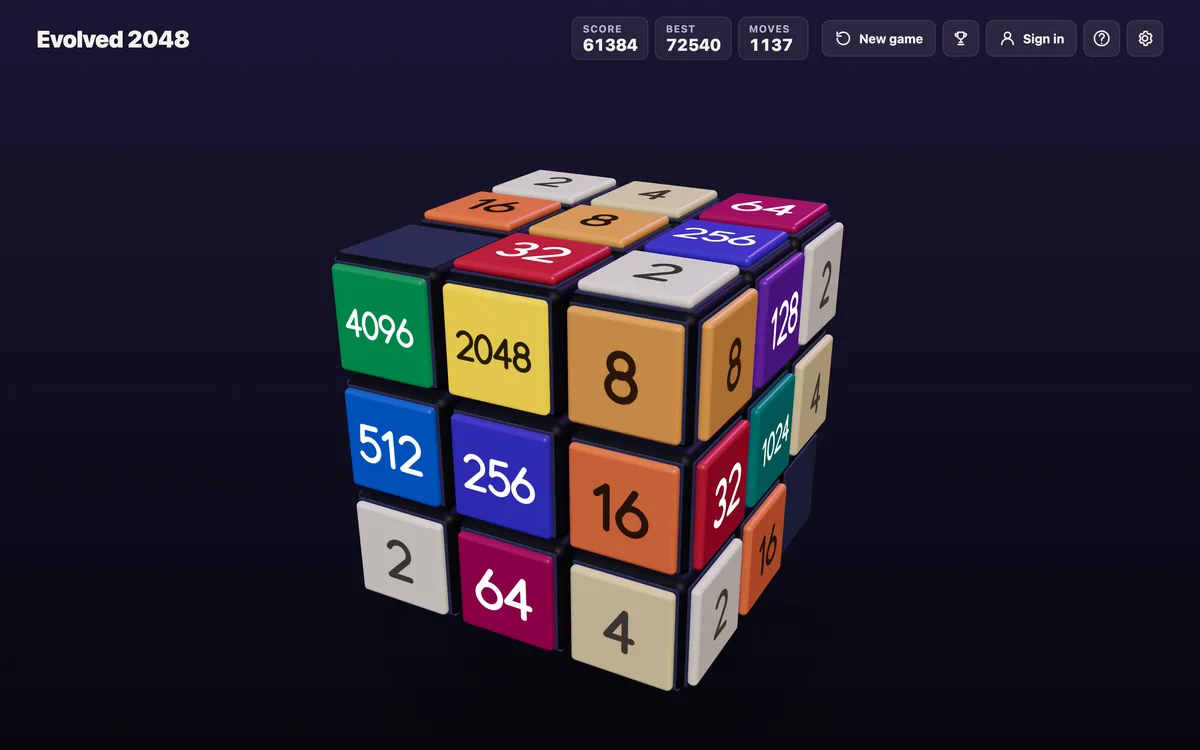
Comments
No comments yet.