Rubik's cube centre pieces: why they never move
Rubik's cube centre pieces are the one part of the puzzle that never changes places. Scramble the cube as hard as you like and the six centres stay in the same order around it. This guide explains what holds them there, why a middle turn only seems to break the rule, how fixed centres tell you where every colour belongs, and the hidden way centres can still turn: exactly 2,048 ways, a number any 2048 player will recognise.
What are Rubik's cube centre pieces?
A standard 3 by 3 cube shows 26 small pieces. According to Wikipedia's article on the cube, there are three kinds:
- 6 centres, one in the middle of each face, each showing one colour.
- 12 edges, each showing two colours.
- 8 corners, each showing three colours.
Edges and corners are real small cubes, each with a hidden part that reaches inward and hooks behind its neighbours. A centre is different. It is only a single square on the outside, fixed to the core of the cube. If you want the count of every square, our post on how many squares a Rubik's cube has goes through all 54.
Why the centres never move: the core
At the heart of the cube sits one piece: a cross of three axes that meet in the middle. Wikipedia describes each centre as pivoting on a fastener held by that cross, with a spring pulling it inward. The spring keeps the whole cube tight but still easy to turn.
That design decides everything about the centres:
- A centre is attached to an axis, so it cannot slide to another face.
- When you turn a face, its centre spins on its own axis. The face's other 8 pieces travel round it.
- The edges and corners are attached to nothing. They hold each other in, wrapped around the centres.
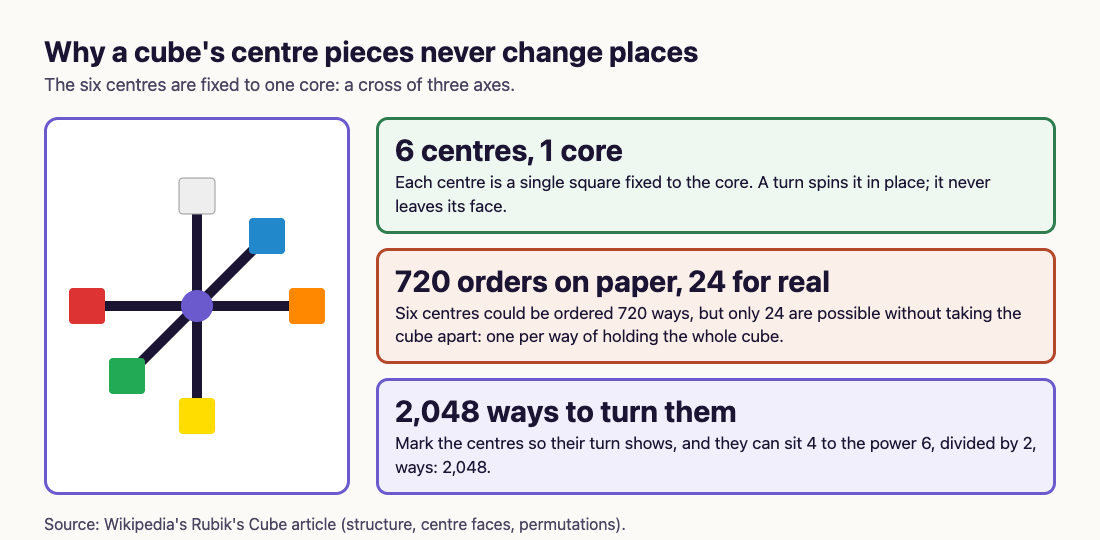
The six centres hang on one core, which is why their order never changes.
So when people say the centres never move, they mean the centres never change places with each other. They do spin, and you will see why that matters further down.
But a middle turn moves the centres, doesn't it?
Cube notation names the middle layers M, E and S, and our post on Rubik's cube notation for beginners explains the letters. Turn a middle layer and four centres clearly move. So is the rule wrong?
No. Try it with a cube in your hand. Turn the middle layer between the left and right faces. Now put the cube back and do it a different way: turn the left and right faces the other way, then turn the whole cube. You end in the same position. A middle turn is two face turns plus a turn of the whole cube in your hands.
Turning the whole cube does not change which centre sits next to which. That is why, of the 720 ways you could order six centres on paper, Wikipedia says only 24 can happen without taking the cube apart. Those 24 are simply the 24 ways to hold a cube: any colour on top, then any of its four neighbours in front.
The layer diagram from how a Rubik's cube turns shows the same idea from the side: a face turn moves 9 pieces, and the one centre among them only spins.
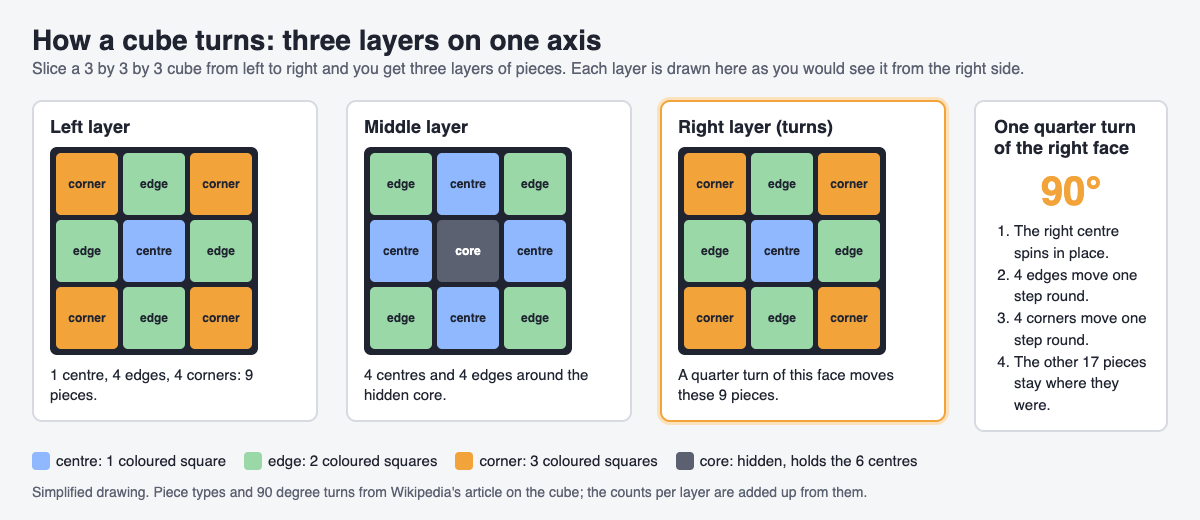
A quarter turn of a face: its centre spins, and its edges and corners travel round it.
Why fixed centres tell you every colour
Because the centres keep their order, the colours' places in the solved cube are fixed by them. The face with the white centre will be the white face when you finish. Nothing you do can change that.
Wikipedia adds a second clue. Each piece shows a different mix of colours, and two colours on opposite faces never share a piece. So there is no edge with both colours of two opposite centres.
Here is a check you can follow on any scrambled cube:
- Hold the cube with the white centre on top. That face is white, for good.
- Look at the four centres around the sides. Note their order as you go round.
- Find an edge piece with white and one side colour, say white and red.
- That edge belongs between the white centre and the red centre, and nowhere else.
That is all a centre does for you, but it is a lot: it turns 54 coloured squares into a map with six fixed landmarks.
The hidden turn: 2,048 ways to orient the centres
On a plain cube you cannot see a centre spin, since one coloured square looks the same in any of its four positions. Wikipedia notes the first cubes had no marks on their centres, so solving them never needed any attention to that.
Mark the centres, though, and the spin starts to count. A cube with marks that show each centre's turn is called a supercube. Each of the six centres can sit 4 ways, which gives 4 to the power 6, or 4,096. Only half of those can actually happen, so the number of ways to orient the centres is 4,096 divided by 2: 2,048.
Wikipedia also gives the reason for the half. When everything else on a marked cube is solved, there is always an even number of centres that need a quarter turn. You will never find one centre alone that is a quarter turn out.
Centres and faces in 3D 2048
3D 2048 puts the 2048 puzzle on a cube like a Rubik's cube: six faces of nine squares, 54 in all. You are not matching colours there; you slide number tiles on the front face so equal numbers merge. The game's script names the faces with the same letters as cube notation: F, R, B, L, U and D.
The cube moves you already know are there. A twist, a drag of a row on the right face sideways or a column on the top face, turns that layer a quarter and carries its tiles to the next face. A turn, a drag of the space around the cube or Shift and an arrow key, turns the whole cube. Like turning a real cube in your hands, it changes which face is in front without changing the order of the faces. In the game's words, "Turning is free": a turn counts no move.
Frequently asked questions
Do the centre pieces of a Rubik's cube ever move?
They spin in place, but they never change places with each other. A middle-layer turn only looks like it moves them; it is the same as two face turns and a turn of the whole cube.
How many centre pieces does a Rubik's cube have?
A 3 by 3 cube has 6, one on each face. Each shows one colour and is fixed to the core.
What is a supercube?
A cube whose centres carry marks, so each centre's turn shows. On one, the centres can sit 2,048 ways, and they must be turned the right way round too.
Does 3D 2048 teach you to solve a cube?
No. It is a 2048 number puzzle on a cube. It uses cube moves, twisting a layer and turning the whole cube, to bring tiles together.
Get started
Pick up a cube, find the white centre, and run the four-step check above. Then try a cube where you merge numbers instead of matching colours, and see how often a free turn of the whole cube shows you a pair you could not see.
Play 3D 2048: it is free and plays in your browser on a computer or a phone.
Comments
No comments yet.
Sign in or make an account to comment.