Licence to crenellate: what it was and why lords wanted one
A licence to crenellate was the king's permission for a lord to fortify his house: to give it battlements, and with them the look and some of the strength of a castle. If you have visited an English castle and read that it was built "under licence", this is what that means. The surprise is how differently lords used it. Some built real defences on a dangerous border. Some built something closer to a grand country house with battlements on top. One built first and paid for a pardon afterwards.
What was a licence to crenellate?
In the English Heritage histories used here, the licence is described in plain words each time. Etal's history calls it a licence "to build strong fortifications". Donnington's says Richard Abberbury was "granted a licence to crenellate (fortify) his house". Acton Burnell's says Robert Burnell "obtained a licence from the king to fortify his residence". So the licence came from the king, it was granted to a named person, and it was about a particular house.
What it did not do is just as important. A licence did not build anything, and it did not tell you how strong the result would be. As the six castles below show, the same piece of permission could sit behind a border tower that faced a Scottish army or a hilltop house with walls only 1.5 metres thick.
What "crenellate" means
To crenellate a building is to give it battlements. English Heritage's glossary for Goodrich Castle defines battlements as "rectangular gaps in a defensive wall to allow for the discharge of arrows or other missiles". You know the shape: the row of gaps and raised blocks along the top of a castle wall, the outline everyone draws when they draw a castle.
Battlements were useful in a fight. They also gave a house the outline of a castle. A licence to crenellate covered both.
A worked example: six licences, two questions
The best way to understand licences is to read a few real ones side by side. Take six castles in English Heritage's care and ask the same two questions of each: did the licence come before or after the building, and how defensible was the result?
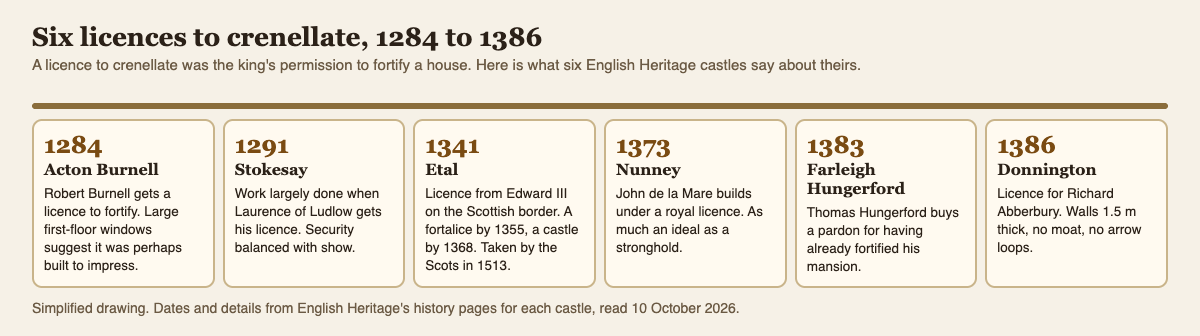
- Acton Burnell, 1284. Robert Burnell, a bishop, obtained a licence to fortify his residence. Work was probably still going on when he died in 1292. Its large first-floor windows suggest, in English Heritage's words, that it "never had a serious defensive purpose" and was "perhaps designed to impress". Licence first, building after, and not much of a fortress.
- Stokesay, 1291. The wool merchant Laurence of Ludlow bought the manor in 1281, and the work was probably largely complete by 1291, when he obtained his licence. Building first, licence after. Stokesay "struck a balance between the demands of security" and its owner's wish to show his taste, wealth and importance, at a time of bands of thieves.
- Etal, 1341. On the border with Scotland, in a region English Heritage calls dangerous and lawless, Edward III gave a licence in 1341. Etal was a "fortalice" (a minor fortification) by 1355 and a castle by 1368. The licence may have allowed an older tower house to be strengthened. This is the clearest case of a licence behind real defence, and even so, the Etal history says its wall could never have resisted guns, and the garrison quickly surrendered to the Scottish army in 1513.
- Nunney, 1373. John de la Mare, a knight of relatively modest means returning from fighting abroad, built under a royal licence issued in 1373. English Heritage calls Nunney "as much the realisation of an ideal as a stronghold intended for serious defence".
- Farleigh Hungerford, 1383. Thomas Hungerford began building before 1383. On 26 November 1383 he bought a retrospective royal pardon for having already fortified his mansion. Building first, and a pardon instead of a licence.
- Donnington, 1386. Richard Abberbury was granted his licence in 1386, and the castle was probably built between then and his death in 1399. Its main walls were only 1.5 metres thick, with no moat or arrow loops: "a country house with the trappings of a castle".
Put the answers together and the pattern is mixed. The licence came first at Acton Burnell, Nunney and Donnington, partway through the story at Etal, where an older building may have been strengthened, and after most of the work at Stokesay. The results ranged from a border castle to a house that English Heritage describes as more luxurious residence than fortress.
When a lord built first: Farleigh Hungerford
Farleigh Hungerford is worth a closer look, because it shows the licence as a rule that could be broken. Thomas Hungerford had risen as chief land steward to John of Gaunt and was elected Speaker of the Commons in January 1377. His new building, a fortified mansion around a courtyard with a tall tower at each corner, was in English Heritage's words "essentially a symbol of his rising status".
He did not wait for permission. He fortified, and then, in November 1383, bought a pardon for having done it. The pardon tells you two things at once: fortifying without the king's leave was something that needed pardoning, and, for Hungerford at least, it could be forgiven for a price.
Defence or display? Two readings
Read together, these castles support two different readings of what a licence was for. It is fairer to set out both than to pick one.
- A licence was about defence and the king's control. Etal stood in a frontier region where raiding and killing were common, and its licence came before it became a castle. A king who had to license battlements, and pardon a man who built without leave, was keeping a hand on who could fortify.
- A licence was about status. Acton Burnell's windows, Nunney's "ideal", Farleigh Hungerford's "symbol of his rising status" and Donnington's thin walls all point to lords who wanted the look of a castle as much as its strength. Stokesay even had an unobtrusive look, probably meant to reassure the powerful Marcher lords around it.
Most of these castles mix the two. Stokesay balanced security and show; Etal was built for a dangerous place and still could not stand against guns. The licence was the same document either way. What a lord built with it was his choice.
Licences, castles and Two Towers
In Two Towers nobody asks the king's permission: you choose the two towers that guard the city gate and start defending. But one part of the game echoes the display side of the story. Every upgrade you buy shows on the tower itself, from Plain through Trimmed, Fine and Grand to Masterwork, with the tower growing slimmer and taller, with spires and gold. Your towers announce how much has been spent on them, much as a lord's new battlements did. The game is a tower defense game, not a history lesson, so take that as a comparison rather than a teaching point.
If you want to see what real defences looked like up close, our posts on arrow loops and the castle gatehouse cover two of the features Donnington's builder did, and did not, bother with.
Frequently asked questions
What does licence to crenellate mean?
It was the king's permission for a named person to fortify a house, in particular to give it battlements. English Heritage's histories describe it as a licence to fortify or to build strong fortifications.
Did a licence to crenellate make a building a castle?
Not by itself. Etal became a real border castle after its licence of 1341, while Donnington, given its licence in 1386, had thin walls and no moat or arrow loops.
What happened if a lord fortified without a licence?
At Farleigh Hungerford, Thomas Hungerford fortified first and in 1383 bought a royal pardon for having already done so.
Why were licences to crenellate granted?
The castles point both ways: some licences stood behind real defence on a dangerous border, and others behind houses built as much to impress as to resist attack.
Get started
Read one castle's history and ask the two questions: when did the licence come, and how strong was the result? Then build your own towers and watch them grow. Play Two Towers: it is free and plays in your browser on a computer or a phone.
Comments
No comments yet.
Sign in or make an account to comment.