What were arrow loops for? Castle arrow slits explained
What were arrow loops for? They let a castle's defenders shoot at attackers while standing behind thick stone. English Heritage's Goodrich Castle glossary defines an arrow-loop as a narrow vertical window slit in castle walls through which arrows could be fired. This post explains where arrow loops were placed, which bows were shot through them, how to read the openings in a real wall, and how guns changed them. At the end you will see the archers in Two Towers, a free tower defense game in your browser.
The history here comes from English Heritage and the Royal Armouries, from pages opened while writing this post. Where a source is unsure, so is this post.
What were arrow loops?
An arrow loop is a slit in a wall, tall and narrow. You may also see it called an arrow slit. The sources in this post say arrow loop or loophole.
The shape is the point. A slit is only a small gap, so almost all of the wall stays solid, yet it still gives the defender inside a line to look and shoot along.
English Heritage's history of castles through time puts it simply: defenders could shoot longbows and crossbows through loopholes in the walls, or from behind battlements on the wall-tops.
Where a castle's archers shot from
Arrow loops were one of several places a castle's defenders could shoot from. Between them, English Heritage and the Royal Armouries describe four:
- Loops in the walls. Slits through the wall itself, in towers and gatehouses, as the examples below show.
- Battlements on top. The glossary defines battlements as rectangular gaps in a defensive wall to allow for the discharge of arrows or other missiles.
- Projecting galleries. Galleries of stone or timber that stuck out over the edge of the wall-walk, so defenders could shoot or drop missiles on attackers right below. Our post on castle hoardings covers the timber kind.
- Towers that stick out. Towers built to project from the walls, square at first as at Framlingham and later round, increased the defenders' field of fire. From them, defenders could shoot down at attackers on the wall-walks.
The Royal Armouries' story of the Hundred Years' War says the same of French towns as the war went on: defenders could loose arrows down upon the attackers through arrow loops in the walls and from the parapet of the wall.
Which bows were shot through arrow loops
Both of the great medieval bows could be used from a loop. The Royal Armouries says crossbows were often part of the defensive arsenal of a castle. English Heritage's story of medieval war says crossbows were powerful but shot slowly.
The Cow Tower in Norwich, which you will meet in the worked example below, shows crossbows were still expected at loops even once guns had arrived. For how the two bows compared, see our post on longbow vs crossbow.
Arrow loops at a castle gate
Attackers had to come close at the gate, and Goodrich shows how many places to shoot from one gate could hold. English Heritage's teachers' guide to Goodrich Castle describes layer after layer at its gatehouse:
- The stubs of arches either side of the bridge show where a fighting platform stood, from which guards could shoot arrows at anyone approaching the entrance.
- In the gate passage there are murder holes in the vaulted ceiling and arrow loops in the side walls.
- In the chapel beside the gate there is a slit window through which a guard could aim his arrows at an approaching enemy.
Picture yourself as an attacker in that passage. Arrows come from the walls on both sides, and the glossary says murder holes were holes in the roofs of passageways through which missiles and liquids were dropped onto attackers. Our post on the castle gatehouse walks through a whole gate.
A worked example: read the openings in a wall
Next time you stand in front of a castle wall, you can read its openings with four questions. Here they are, used on the Cow Tower in Norwich, as English Heritage describes it.
- When was it built? In 1398 to 1399, as part of the defences already around medieval Norwich.
- What was it guarding? The approach to the city across the River Wensum. It is over 15 metres (49 feet) high, tall enough to overlook the high ground on the opposite bank.
- What shapes are the openings? Two kinds. Widely splayed gun ports, made for the recently developed cannon, and arrow loops.
- What was fired through each? English Heritage says the gun ports were for cannon, while the arrow loops could still be used for crossbows and small guns.
So one tower tells you a whole story: it was built for guns, but its builders still expected crossbows to be useful.
Now try the same questions on Donnington Castle in Berkshire, whose builder was granted a licence to crenellate (fortify) it in 1386. English Heritage says its main walls were only 1.5 metres thick, with no moat or arrow-loops, and that it was designed more as a country house with the trappings of a castle than a defensible fortress. No loops is a clue to what the builder wanted.
From arrow loops to gunports
Guns did not replace arrow loops overnight. English Heritage's sites show the change step by step.
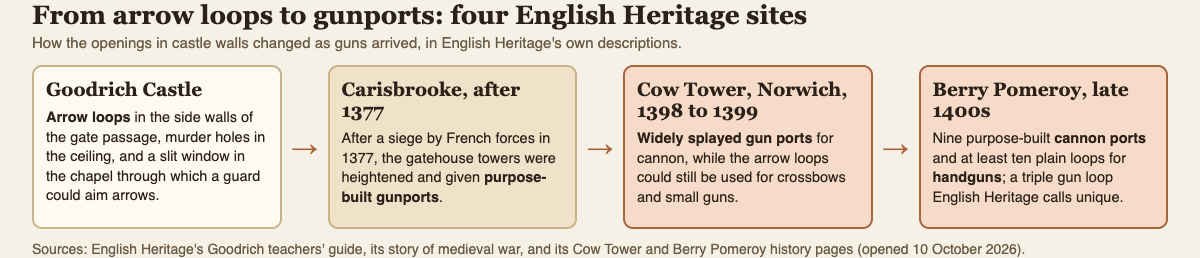
- Carisbrooke Castle. After a siege by French forces in 1377, its gatehouse towers were heightened and given purpose-built gunports.
- Cow Tower. One of the earliest English blockhouses designed for cannon, with gun ports and arrow loops side by side.
- Berry Pomeroy Castle. Its defences include nine purpose-built cannon ports, three of them multiple, and at least ten plain loops for handguns. Its triple gun loop, from the late 15th century, is unique in England: three guns of different sizes could be fired from it.
English Heritage says gunports became virtually standard additions to 15th-century castles, and even to fortified manor houses such as Baconsthorpe Castle. For the big guns that drove this, see our post on what a bombard was.
Archers in Two Towers
In Two Towers you guard a city gate, and archers are on both sides of the fight.
Your side has the Archer Tower. Its label on the title screen is "Fast arrows": it shoots fast arrows at one attacker, and with Volley at up to four. The other side has archers too. The game's archer stops short of the gate and shoots at it, and its crossbowman shoots from further off, and harder. The game's tips for both are about reach: "Archers shoot the gate from the road: buy Range so your towers reach them before they stop." and "Crossbowmen shoot from afar: Range upgrades and a Trebuchet reach them."
That is the castle builder's problem in reverse. A loop let defenders shoot from behind stone. In the game, Range lets your towers hit the attackers' archers before they settle in and start shooting. Our post on tower defense tips by attacker covers every attacker.
Frequently asked questions
What is the difference between an arrow loop and an arrow slit?
None that matters here: both name a narrow slit in a castle wall that defenders shot through. English Heritage's glossary calls it an arrow-loop, and its other pages also say loophole.
Could defenders use crossbows through arrow loops?
Yes. English Heritage says defenders could shoot longbows and crossbows through loopholes, and the Cow Tower's arrow loops could still be used for crossbows and small guns.
How did guns change arrow loops?
From the late 14th century, places such as Carisbrooke Castle and the Cow Tower gained gunports, which became virtually standard in 15th-century castles. The Cow Tower kept its arrow loops for crossbows and small guns beside them.
Is there an Archer Tower in Two Towers?
Yes. It is one of the four towers you can pick for each side of the gate, labelled "Fast arrows".
Get started
Play Two Towers, put an Archer Tower beside your gate, and see how far Range lets you reach. It is free and plays in your browser on a computer or a phone.
Comments
No comments yet.
Sign in or make an account to comment.