Castle gatehouse: why it was a castle's strongest part
A castle gatehouse solved the hardest problem in castle building. Every wall needs a way in, and every way in is a hole that an enemy can try to force. Builders did not hide that weak point. They turned it into the strongest building in the castle. This guide explains how a gatehouse did that, walks you room by room through a real one, and shows how guns changed it.
What a castle gatehouse was
English Heritage puts it simply: the gatehouse served as the front door to the castle and its main entrance, and it was one of the most defensive parts of a castle. Gatehouses were fortified buildings, built to protect the main point of entry, and they often held traps, metal portcullises and other ways of keeping the enemy out.
There is a second side to it. Because everyone who came to the castle passed through the gatehouse, it was also where the owner showed off. English Heritage notes that their prominence made gatehouses a key place to display the wealth and prestige of the castle's owner. A gatehouse said "keep out" to an army and "look who lives here" to a visitor, often at the same time.
Why the weakest point got the strongest building
A wall is strong because it is solid. A gate cannot be solid, or nobody gets in. So the builders stacked defenses in depth along the way in, so that an attacker had to win several fights in a row instead of one.
A typical gatehouse put these in order from the outside in:
- Something in front of the gate. A barbican, an outer work that guarded the approach, or a drawbridge over a ditch.
- A portcullis. A heavy grille that dropped down to close the passage.
- The gate passage itself. A narrow tunnel through the building, watched from the sides and from above.
- Guardrooms. Rooms on either side of the passage, so soldiers were always beside it.
- Rooms above. Floors over the passage, where the machinery that worked the drawbridge and portcullis could sit.
Our posts on the barbican and the portcullis look closely at two of these layers. Here the focus is the building that held them all together.
A worked example: Dunstanburgh's great gatehouse, 1313
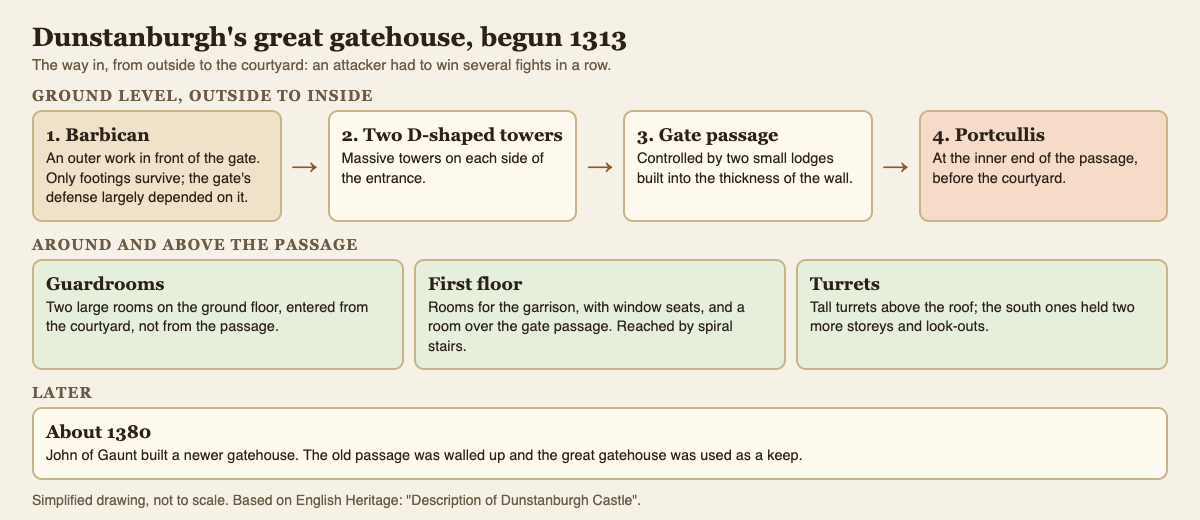
Dunstanburgh Castle stands on a high bluff on the coast. Its great gatehouse was begun in 1313 for Thomas of Lancaster, and English Heritage calls the castle "impractically massive", the gatehouse most of all. Follow the way in as an attacker would have had to, using English Heritage's description of the building.
- The approach. You face two massive D-shaped towers, one on each side of the entrance. In front of them was a barbican, built at the same time as the gatehouse. Only its footings are left, so nobody can say exactly what it looked like, but English Heritage says the defense of the gate passage largely depended on it.
- The passage. Once past the barbican, you enter the gate passage. It was controlled by two small lodges built into the thickness of the wall, so guards sat right beside you.
- The portcullis. At the inner end of the passage was a portcullis. Even if the outer defenses fell, it could still shut the way into the castle courtyard.
- The guardrooms. The ground floor held two large guardrooms. They were entered from the courtyard, not from the passage, so an attacker in the passage could not simply walk into them.
- Above your head. The first floor, reached by spiral stairs, held more rooms for the garrison, finely made with two-light windows and window seats, and a room over the gate passage itself.
- The turrets. Tall turrets rose above the roof at the front and back. The south turrets held two more storeys and look-outs on the roof, so the garrison could watch the approach from high above it.
Notice how much of this is about watching and controlling, not only blocking. The lodges, the guardrooms, the rooms above and the turrets all put people where they could see and act. A gatehouse was a building full of soldiers wrapped around a single narrow road.
The castle gatehouse as a home and a keep
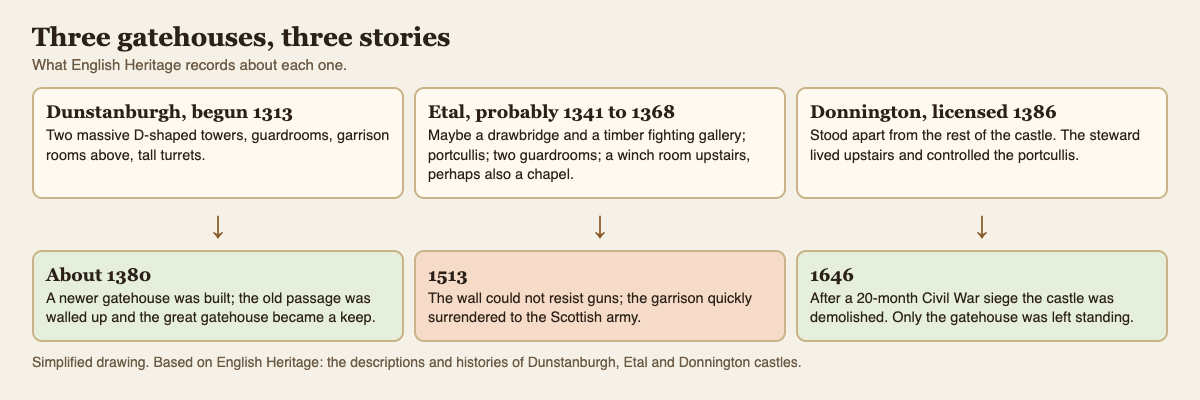
Because a gatehouse was so strong, it often became more than an entrance. At Dunstanburgh, when John of Gaunt built a newer gatehouse in about 1380, the old passage was walled up and the great gatehouse itself was used as a keep.
Other castles show the same idea in smaller form. English Heritage's pages describe it in several places:
- Etal Castle, Northumberland. The gateway may have had a drawbridge and a projecting timber hoard, a fighting gallery. Behind the drawbridge were a portcullis and the gate passage, with doors into two guardrooms. One large room upstairs held a winch for the drawbridge and portcullis, and its fine windows suggest it may also have been a chapel.
- Donnington Castle. The gatehouse stood apart from the rest of the castle. The steward who ran the castle lived on its first floor, from where he could control the portcullis and decide who came through the gateway below.
- Dunstanburgh again. Its gatehouse held well-made rooms for the garrison, with window seats, not only the defenses.
Putting the person in charge over the gate made sense. Whoever sat above the portcullis decided who came in.
What guns did to the gatehouse
When gunpowder weapons arrived, gatehouses changed again. English Heritage's history of medieval war describes Carisbrooke Castle on the Isle of Wight, on the front line during the Hundred Years War. After a siege by French forces in 1377, its gatehouse towers were made taller and given purpose-built gunports, openings shaped for guns. By the 15th century, the same page says, gunports had become virtually standard additions to castles.
Not every castle kept up. At Etal, English Heritage says the curtain wall was never strong enough to resist guns, and the garrison quickly surrendered to the Scottish army in 1513 for that reason.
And sometimes the gatehouse simply outlasted everything else. Donnington endured a 20-month siege in the English Civil War. After the garrison surrendered on 1 April 1646, Parliament had the castle demolished, and only its gatehouse was left standing.
The gate in Two Towers
Two Towers is a tower defense game built around the same idea: everything depends on one gate. Attackers march down the road toward the city gate, and if the gate falls, the game is over. You choose the tower that guards each side of it, a little like the two towers that flank a real gatehouse.
The gate has its own sheet in the game. It says "Repair what the attackers broke, or reinforce it." Repair gives the gate +25% and is not offered when "The gate is whole". Reinforce adds strength for gold. The game's tips tell you when this matters most: "Rams hit the gate hardest: Reinforce the gate, and use Ballista bolts that ignore armor", and "A king leads every fifth stage: Reinforce the gate before it and save gold for Damage."
The game is not a model of any real castle. But it gives you the gatehouse builder's problem in a few minutes: one way in, attackers who all want it, and a choice of where to spend what you have. For how real castles handled the rest of the siege, read how castles defended against a siege.
Frequently asked questions
What was the purpose of a castle gatehouse?
It guarded the main entrance, the weakest point in the wall, with layers of defenses such as a portcullis, guardrooms and rooms above the passage. It was also a place for the owner to show wealth and status.
Why was the gatehouse so heavily defended?
Every attacker wanted the gate, because it was the main way through the wall. Builders put their strongest building there so an attacker had to win several fights in a row to get in.
Could a gatehouse be used as a keep?
Yes. At Dunstanburgh, after a newer gatehouse was built in about 1380, the old gate passage was walled up and the great gatehouse was used as a keep.
Why is only the gatehouse left at Donnington Castle?
After its Civil War siege ended in 1646, Parliament ordered the castle demolished, and only the gatehouse was left standing.
Get started
Try holding a gate yourself. Pick the tower for each side, keep the gate repaired and reinforced, and see how many stages you can hold.
Play Two Towers: it is free and plays in your browser on a computer or a phone.
Comments
No comments yet.
Sign in or make an account to comment.