Locke vs Rousseau: the social contract, explained simply
Locke vs Rousseau is one of the classic pairings in political philosophy. Both imagined people living without government, and both said a legitimate state rests on a kind of agreement, a social contract. But they used that idea for different jobs. John Locke wanted to protect rights people already have. Jean-Jacques Rousseau wanted people to stay free while living under laws. This guide explains each, compares them on five questions, and walks one law through both of their tests.
Locke vs Rousseau: the short answer
- Locke says people are by nature free and equal, with rights to life, liberty and property. Government is a trust: people hand it some powers to protect those rights, and if it fails, they can replace it.
- Rousseau says people are good by nature but corrupted by society, and that inequality grew with private property. A legitimate state must be guided by the "general will" of all its citizens, so that in obeying the law, each person obeys only themselves.
Put simply, Locke asks how to keep government from taking what is yours. Rousseau asks how to live under laws and still be free.
Who was John Locke?
Locke (1632 to 1704) is, in the words of the Stanford Encyclopedia of Philosophy entry on his political philosophy, "among the most influential political philosophers of the modern period." In his Two Treatises of Government, published in 1689, he argued against the claim that God had made all people naturally subject to a monarch.
For Locke, the state of nature is not lawless. It is simply life without a shared judge: "want [lack] of a common judge, with authority, puts all men in a state of nature." People still have rights there. They form a government by consent, to protect those rights more safely. Locke also defends majority rule and the separation of legislative and executive powers, and he is known for defending the right of revolution.
Who was Jean-Jacques Rousseau?
Rousseau was born in Geneva in 1712, the son of a watchmaker, and died in 1778. The Stanford entry on Rousseau says he repeatedly claimed one idea sat at the center of his thinking: "human beings are good by nature but are rendered corrupt by society."
His Discourse on Inequality (1755) tells a story of how that happened, through farming, metalworking, private property, and a split between those who own land and those who do not. His answer came in The Social Contract (1762), which opens with the famous line "Man is born free, but is everywhere in chains." The book was condemned in Geneva, together with his Emile.
Five questions, side by side
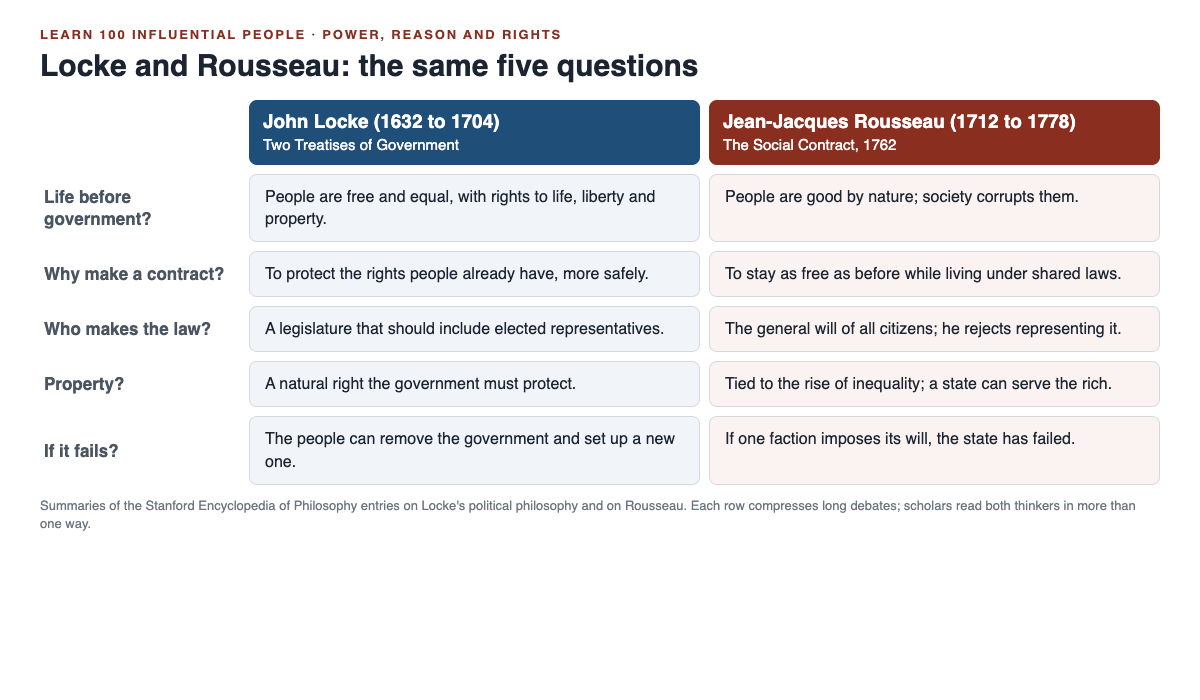
- What is life like before government? Locke: free and equal people with rights. Rousseau: good by nature, later corrupted as society grows.
- Why make a contract? Locke: to protect the rights people already have. Rousseau: so that each person enjoys "the protection of the common force whilst remaining as free as they were in the state of nature."
- Who makes the law? Locke: a legislature that should include elected representatives. Rousseau: the citizens themselves. He calls handing over one's right to rule oneself a form of slavery, and this extends to electing representatives to make laws. Day-to-day administration, though, he would give to an elected few.
- What about property? Locke treats it as a natural right to protect. Rousseau warns that a state founded on unequal property can become, in effect, a class state run in the interest of the rich, a point the Stanford entry calls "an echo of Locke and an anticipation of Marx."
- What if it goes wrong? Locke: if rulers ignore the rule of law, stop representatives from meeting, or try to take people's rights, the people can remove them. Rousseau: if one faction imposes its will on the whole, the state has failed.
If you want the thinker both men were answering, see our guide to Machiavelli vs Hobbes.
Worked example: one tax law, two tests
The best way to feel the difference is to run one law through both. Take a simple one: "a tax to pay for roads."
- Write the law in one line. Who pays, how much, and what for.
- Apply Locke's test. Does it serve the public good? Was it passed by a legislature where the people's representatives could block it? The Stanford entry says Locke wanted representatives with enough power to block attempts to tax people "without justification." If the answer to both is yes, Locke can accept it.
- Apply Rousseau's test. Is the law general? Rousseau says a law cannot name particular people and must apply to everyone. Was it willed by the citizens, not just by representatives? And is it the rate the community needs, not the rate each person would like? World History Encyclopedia's article on the social contract uses this very case: asked privately, most people would pick as little tax as possible, but the general will is the rate that pays for the services the state needs.
- Compare the results. Both men might accept the same tax. But they accept it for different reasons, and they disagree on who must agree to it.
Try it again with a law that names one town or exempts one group. Rousseau's test fails it at once, because the law is no longer general. Then ask what Locke's test would say, and write down why.
Where scholars disagree
Both thinkers are read in more than one way. Here are the main positions, with no verdict.
- Locke on consent. Locke says that simply by walking along a country's highways, a person gives "tacit consent." Simmons doubts that this is a "deliberate, voluntary alienating of rights." Hannah Pitkin argues that what really matters for Locke is the quality of the government, not past acts of consent. John Dunn holds that for Locke it was enough that people be "not unwilling."
- Locke on property. C. B. Macpherson read Locke as a defender of unrestricted capitalist accumulation. Alan Ryan replied that Locke's "property" includes life and liberty, not only land; James Tully pointed to a duty of charity in Locke's First Treatise.
- Rousseau's general will. Some read it as whatever citizens decide together in their assembly. Others read it as the citizens' common interest, which can differ from what any of them wants. A third reading treats it as each citizen's will toward the common good.
- "Forced to be free." Rousseau says those who are made to obey the general will are "forced to be free." Some critics hear a threat to freedom. Others note that he ties the line to a guarantee against "all personal dependence," that is, against being at the mercy of another person.
- The contract itself. David Hume doubted any such contract ever happened: governments were founded "either on usurpation or conquest, or both." Immanuel Kant took a different line: the contract is "merely an idea of reason," and "the test of the rightfulness of every law."
Rousseau's warning about property and the rich also runs into a later debate; our guide to Adam Smith vs Karl Marx sets out that one.
Frequently asked questions
What is the main difference between Locke and Rousseau?
Locke builds government to protect natural rights, including property, through elected representatives. Rousseau builds it on the general will of all citizens, and rejects handing lawmaking to representatives.
Did Locke and Rousseau both believe in a social contract?
Yes. Both said legitimate government rests on an agreement among people, but they disagreed about what it protects and who makes the laws.
What does "Man is born free, but is everywhere in chains" mean?
It is the opening line of Rousseau's Social Contract. He goes on to ask how life under laws can be made legitimate, so that people remain free while living under them.
Which one influenced revolutions?
Locke is known for defending a right of revolution against governments that break their trust. World History Encyclopedia links social contract ideas, theirs included, to the American and French revolutions.
Get started
Locke and Rousseau are part of Power, Reason and Rights, an Advanced course on Learn 100 Influential People, alongside Machiavelli, Hobbes, Descartes, Kant and Wollstonecraft. Advanced courses cover "Modern power, modern physics and the debates still running today." Lessons take about 9 minutes. Like this guide, the site does not pick a side: cards set out where researchers disagree, and every lesson lists its sources. Sign in with your email and an emailed code; accounts are for people aged 13 or older.
Start Learn 100 Influential People: short hands-on lessons on the people who shaped history, with every side of the debate and the sources to read next.
Comments
No comments yet.
Sign in or make an account to comment.