Longbow vs crossbow: why medieval armies used both
Longbow vs crossbow is one of the oldest arguments in medieval history, and most answers pick a winner. The people who look after these weapons tell a more useful story. The Royal Armouries, the national museum of arms and armour in the UK, describes a trade: the longbow was fast, the crossbow was powerful, and each one asked something different of the person using it.
This guide sets out that trade with the museum's own numbers, follows it through one real battle, and shows where each bow sat in the defense of a castle. At the end it shows how the free browser game Two Towers puts both bows on the same field, one on each side of the gate.
Two different machines for the same job
Both weapons throw a pointed missile at a target far away. How they store the energy to do it is completely different.
- The longbow is a simple wooden bow, usually around 1.8 metres long. The Royal Armouries' page on the longbow says it relied on the wood itself, which together formed "a powerful natural spring". Bows were often yew, sometimes elm, ash or laburnum, with strings of hemp or flax.
- The crossbow is a mechanical bow. A short bow, called a lath, is fixed across a stock, and a trigger holds and releases the string. It shoots short, heavy arrows called bolts or quarrels. The Royal Armouries' page on the crossbow notes it was invented in ancient China and used in ancient Greece and Rome before spreading across Europe.
During the Hundred Years' War between England and France (1337 to 1453), crossbow laths moved from wood to composite and then steel. Those bows were too strong to bend by hand, so soldiers used winding aids: the belt hook, the windlass, the cranequin and the bending lever.
Longbow vs crossbow: the numbers side by side
Here is the comparison the museum gives, in plain terms.
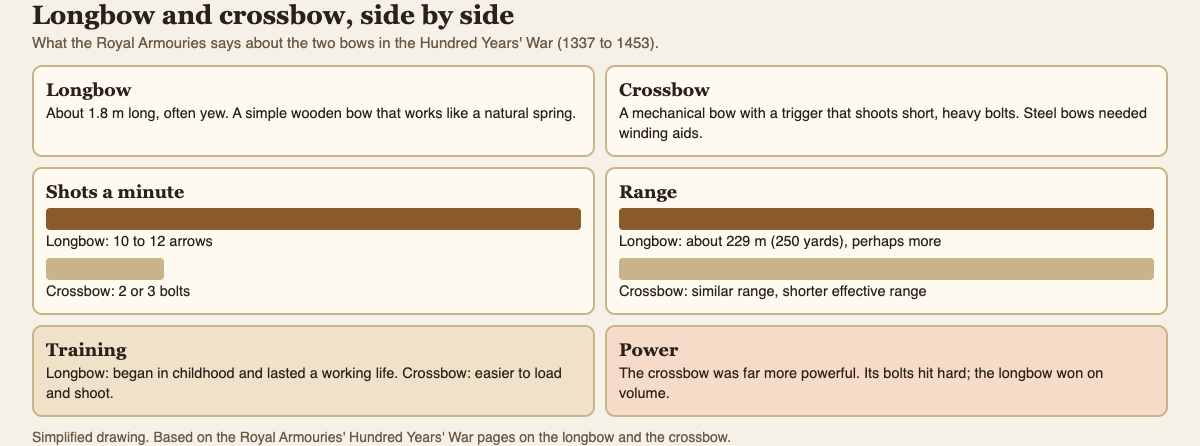
The trade in one picture: speed and volume on one side, power and easier training on the other.
- Speed: a longbow archer could shoot 10 to 12 arrows a minute. A crossbowman managed 2 or 3 bolts. The museum puts it simply: an archer could loose four times more arrows.
- Range: the longbow reached about 229 metres (250 yards), perhaps more. The more powerful crossbows shot over similar ranges, but had a shorter effective range.
- Power: the crossbow was "far more powerful than the longbow", and its heavy bolts caused considerable damage on impact.
- Training: longbow training began in childhood and continued through an archer's working life. Crossbows were easier to load and shoot, though an accurate shot still took practice.
- Cost: crossbows were simpler, cheaper and less demanding, which made them ideal for conscripts and the growing companies of mercenaries.
None of these is a clear win. A side that can train thousands of archers from boyhood gets speed and volume. A side that needs to arm townsmen or hire soldiers quickly gets power with less training.
Why the English trained archers for a lifetime
The longbow's strength depended entirely on the person drawing it, and England built a system around that. The Royal Armouries notes that after the victories at Crécy (1346) and Poitiers (1356), Edward III ordered in 1363 that all able-bodied men should own a bow and practise with it on Sundays and holidays, rather than play football.
The payoff was volume. The museum describes archers shooting volleys at the start of a battle, a "cloud" or "storm" of arrows that could break up formations and bring down charging cavalry. Even against good armour, where only a small share of arrows probably got through, the sheer number of arrows made them effective.
Why the French and their allies chose crossbows
The French more commonly used the crossbow, and the Royal Armouries says many crossbowmen came from towns. Genoese crossbowmen were especially well known and were hired by armies across Europe. A crossbowman did not need a lifetime of training to hit hard.
The crossbow's power may even have changed armour itself. The museum suggests the powerful crossbow may have been one of the reasons plate armour was introduced, because mail could no longer give an effective defence.
Its weak point was the time it took to reload. Crossbowmen often sheltered behind a pavise, a large rectangular shield, while they wound their bows, and some armies had soldiers called pavisiers to carry them.
A worked example: Crécy, 26 August 1346
The first land battle of the Hundred Years' War shows the trade playing out. Follow it step by step, using the Royal Armouries' account:
- The ground. Edward III placed his English army on a ridge near the town of Crécy and waited. When the French army arrived, it could not get round his flanks.
- The crossbows go first. Genoese crossbowmen in the French army began what the museum calls a premature advance.
- Speed answers power. The crossbowmen were struck by arrows from the English longbowmen and forced to retreat. At 2 or 3 bolts a minute against 10 to 12 arrows, they were badly outshot while they reloaded.
- The cavalry follows. French knights charged through the retreating crossbowmen and straight into a hail of English arrows.
- The result. Repeated cavalry charges failed to break the English lines, and the French were emphatically defeated.
The lesson is not that the longbow was simply better. On that day, the English held a prepared position and had the speed to punish anyone crossing open ground. The power of the crossbow mattered less than the time it took to reload.
Bows on castle walls
Battles in the open were only part of medieval warfare; much of it was sieges. English Heritage's history of castles through time describes defenders shooting longbows and crossbows through loopholes in the walls or from behind the battlements, and the Royal Armouries notes that crossbows were often part of a castle's defensive arsenal.
On a wall, the crossbow's slow reload matters less: the shooter is already behind stone. Our guide to how castles defended against a siege covers the rest of a garrison's preparations, and medieval siege weapons explained covers the giant bolt throwers, like the ballista, built on the same idea as the crossbow.
Both bows in Two Towers
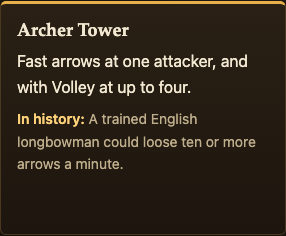
In Two Towers, a free tower defense game in your browser, you guard a city gate, and both bows are on the field. The longbow is on your side. The Archer Tower shoots fast arrows at one attacker, and with its Volley upgrade at up to four, and its card notes that a trained English longbowman could loose ten or more arrows a minute.
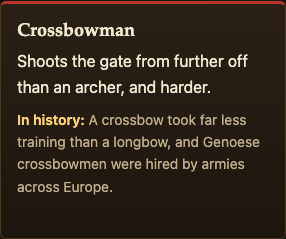
The crossbow attacks you. The Crossbowman shoots your gate from further off than an archer, and harder, which is the same trade of power for speed. His card says a crossbow took far less training than a longbow, and that Genoese crossbowmen were hired by armies across Europe.
The game gives one line of history per card, not a full account. It is a quick way to feel the difference between the two bows before or after reading the real story.
Frequently asked questions
Which was better, the longbow or the crossbow?
Neither, in general. The longbow shot four times as fast; the crossbow was far more powerful and much easier to learn.
How many arrows could a longbowman shoot in a minute?
The Royal Armouries gives 10 to 12 arrows a minute for a trained archer, against 2 or 3 bolts for a crossbowman.
Why did the English use the longbow and the French the crossbow?
England trained its archers from childhood and even ordered men to practise on holidays. The crossbow suited townsmen and hired soldiers, who could use it well with far less training.
What range did a longbow have?
About 229 metres (250 yards), perhaps more. Strong crossbows reached similar ranges but had a shorter effective range.
Get started
Play Two Towers: it is free and plays in your browser on a computer or a phone. Build an Archer Tower, watch the Crossbowmen try to outrange it, and read the history line on each card as you go.
Comments
No comments yet.
Sign in or make an account to comment.