Marx's theory of alienation: the four kinds explained
Marx's theory of alienation says that work under capitalism separates people from things that properly belong to them: what they make, how they work, each other and their own human nature. Karl Marx set out these four kinds of alienated labour in his 1844 Manuscripts. The idea is not that work is badly paid, but that it stops people from flourishing as human beings.
If you want to place Marx among the other economic thinkers, Learn 100 Influential People teaches him with Adam Smith, Ricardo, Malthus, Keynes, Hayek and Friedman in its course Thinkers of the Economy, and sets out every side of the debate.
What alienation means
The Stanford Encyclopedia of Philosophy entry on Karl Marx (1818 to 1883) defines alienation as a social ill that involves "a separation between a subject and an object that properly belong together". The subject is usually a person or a group. The object can be a thing, another person, or the person themselves.
Two points matter. First, not every social problem is a separation. Second, not every separation is a problem. A theory of alienation needs a picture of how things should be, a baseline of unity or harmony, so that it can say which separations do harm. For Marx, as we will see, that baseline is human flourishing.
Where the idea came from: Feuerbach and religion
Marx, who held a doctorate in ancient philosophy, took the idea partly from Ludwig Feuerbach's The Essence of Christianity (1841). Feuerbach argued that people invented God in their own image. In imagination they raise their own powers to an infinite level and project them onto God. Worship then turns them away from enjoying those powers themselves. So religion separates people from their "species essence".
Marx accepted much of this, including in his 1843 essay where he calls religion the "opium of the people". But he thought Feuerbach could not explain why people fall into religious alienation. For Marx, religion is a response to alienation in material life, and it will only fade once material life is set free. That turned his attention to work.
Marx's theory of alienation: the four kinds of alienated labour
In a much-discussed passage of the 1844 Manuscripts, Marx names four ways in which workers in capitalist society are separated:
- From the product. They make something they neither own nor control, and which comes to dominate them.
- From their activity. They are forced to work in ways that wear down mind or body, or both.
- From other people. Economic life teaches them to see others merely as means to their own ends.
- From their own human nature. Their capacities for community and for free, conscious and creative work are frustrated.
The entry adds a note: Marx's later term "fetishism", where human creations escape our control and come to oppress us, is one form alienation can take, not the same thing.
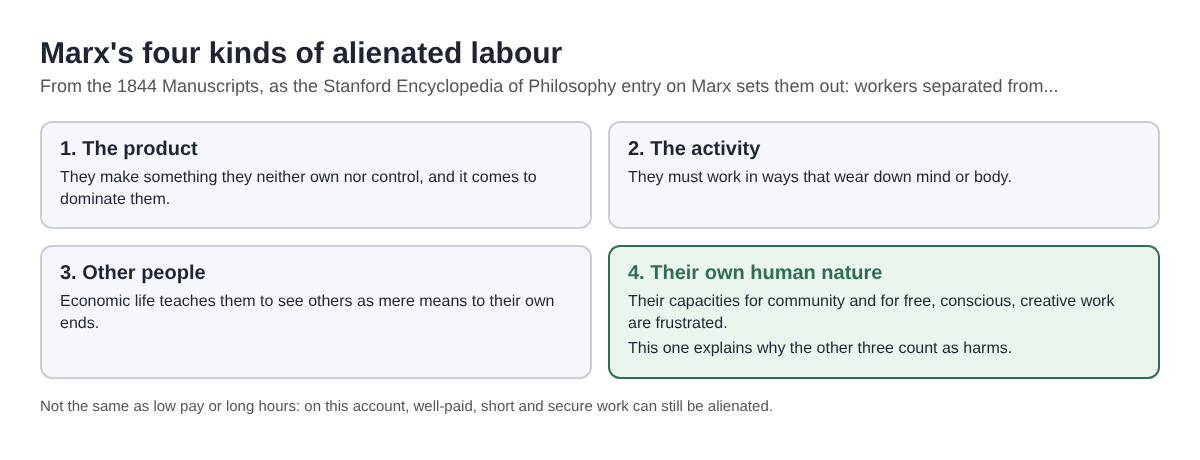
The four separations of the 1844 Manuscripts, as the Stanford entry sets them out.
Why the fourth kind is the key
The entry argues that the claim about human nature does the real work. Marx thinks productive activity is central to being human, and that realising yourself through work is a vital part of a good life. Because of that, the other three separations count as harms.
To see why, imagine a theorist who thinks people are solitary and selfish by nature. That theorist could agree that capitalist work makes people isolated and selfish, but deny that this is alienation, since it fits their picture of human nature instead of frustrating it. Same facts, different baseline, different verdict.
This also explains a surprising point in the entry: alienated labour could, in principle, be well paid, limited in hours and fairly secure. Marx's complaint is not mainly about pay or hours. It is that work which could be creative and fulfilling is made into something else. He rejects the view that work is a necessary evil.
What unalienated work would look like
Marx said little about the details of a future society. The entry, drawing on the scholar Kandiyali, sums up unalienated work as work that is:
- freely chosen;
- a way of developing and using your essential human powers;
- meant to meet the needs of others;
- properly appreciated by those others.
Marx blamed capitalist social relations, not machines. He had little time for the "romantic critique of capitalism" that treats industry and technology as the villains, and he saw technology as part of the solution. Compare this with Adam Smith's view of the market in our post on Adam Smith vs Karl Marx.
The open questions
The entry sets out several debates, and scholars still disagree on them:
- Industry under communism. Many sceptics ask how the large-scale industry a more productive communist society would need could avoid alienated work. Answers have mostly come from commentators, not from Marx.
- Early or late Marx. The once-popular claim that Marx wrote about alienation only in his early works is not borne out by the texts. Some, such as Wood, suggest its role shifts from explaining to describing.
- A "thick" human nature. Jaeggi argues that theories of alienation resting on thick, contested accounts of human nature should be rejected. Marx's own account of flourishing is clearly thick.
- Feeling or fact. Alienation can be subjective (feeling estranged) or objective (not developing your human powers, whether or not you feel the loss). Marx seems to treat them as distinct but usually found together under capitalism.
Try it yourself: test the theory on a job in 15 minutes
- Pick a job (2 minutes). Choose one you know well, such as a warehouse picker or a software developer.
- Run the four questions (6 minutes). Who owns and controls what this worker makes? Does the work wear down mind or body? Does it push them to see others as means? Does it use their capacity for free, creative work and community?
- Check the four marks (4 minutes). Score the job against the four marks of unalienated work above: chosen, self-developing, meeting others' needs, appreciated.
- Change the baseline (3 minutes). Answer again as the theorist who thinks people are solitary and selfish by nature. Note which answers change.
Then read section 1 of the Stanford entry on Karl Marx and compare your notes with its account.
Frequently asked questions
What are Marx's four types of alienation?
Workers are separated from the product of their labour, from the activity of working, from other people, and from their own human nature. Marx set them out in the 1844 Manuscripts.
Is alienation the same as low pay?
No. On the Stanford entry's reading, alienated work could be well paid, short and secure. Alienation is about work that blocks human flourishing, not about wages alone.
Did Marx only write about alienation when he was young?
The entry says the claim that he wrote about it only in his early works is not supported by the texts, though its role in his thought may have changed over time.
What would end alienation for Marx?
He thought it flows from capitalist social relations, so it would end in a classless society. He gave few details, and critics question whether large-scale industry could avoid it.
Get started
Marx is one of seven thinkers in Thinkers of the Economy, beside Adam Smith, Ricardo, Malthus, Keynes, Hayek and Friedman. Each lesson takes about 9 minutes, lists its sources and sets out where researchers disagree, with no verdict pushed on you. You sign in with your email and an emailed code.
Start Learn 100 Influential People: short hands-on lessons on the people who shaped history, with every side of the debate and the sources to read next.
100 people who shaped history, from Moses to the web.
Visit influentialpeople.vlvd.net↗


Comments
No comments yet.