MCP vs API: What's the Difference and When Each Fits
MCP vs API is not a fight between two rivals. An API is a way for one program to ask another program for something. MCP (Model Context Protocol) is an open standard that tells an AI model how to find and use tools and data. In most real setups, an MCP server sits on top of an API and makes it easy for a model to use. For the basics of MCP first, read our post on what MCP is and why it matters.
If you want to build with AI rather than only read about it, Age of AI Entrepreneur teaches how to build, launch and grow a business with AI, in short hands-on lessons with the sources listed.
MCP vs API in one minute
Think of an API as a door into a service. Your code knocks with a precise request, such as GET /invoices/42, and gets a precise answer. A developer has to read the docs, write the call, handle the errors and decide when to make it.
MCP is a layer that lets an AI model do that work with less custom wiring. An MCP server lists what it can do, describes each action in plain language, and says what inputs each one needs. The model reads that list, picks an action and fills in the inputs. The server then runs the action, usually by calling a normal API behind the scenes.
So the short version: an API is built for programmers. MCP is built so that a model can act like the programmer at run time.
What a regular API does well
Plain APIs are old, well understood and everywhere. They do a few things very well.
- Precision. You control exactly which call happens, with which values, and in what order.
- Speed and cost. A direct call has no model in the loop, so it is fast and costs only the call itself.
- Predictability. The same input gives the same output. That makes testing and debugging much easier.
- Maturity. Authentication, rate limits, versioning and monitoring are solved problems with plenty of tooling.
If you know the exact steps your product needs, an API call is the simplest tool. Model APIs themselves are a good example. When you send a prompt to a model, you use an API, and you pay by tokens. The AI Product Stack course has a lesson on model APIs, tokens and what a request costs. You sign in with your email and an emailed code to open it.
What MCP adds on top of an API
An API does not tell a model what it is for. It was written for a human developer who reads documentation. If you hand a model a raw API, you still have to write glue code: a description of each endpoint, a format for the model's output, and a loop that runs the calls.
MCP standardises that glue. It adds three things.
- Discovery. A client can ask the server which tools it offers (a
tools/listrequest), so you do not hard-code the list into your app. - Descriptions made for models. Each tool has a name, a plain-language description and a schema for its inputs. The model uses these to decide when to call it.
- One shared format. Any app that speaks MCP can use any MCP server. You write the server once instead of writing a custom integration for every AI app.
MCP, an open-source standard, also lets a server share data (resources) and reusable prompt templates, not only tools. Tools are the part most people care about first.
How an AI model calls a tool through MCP
Here is a worked example. Say you run a small invoicing product. You already have an API with endpoints to find a customer and list their unpaid invoices. You wrap them in an MCP server with two tools.
find_customer: takes a name or email, returns a customer ID.list_unpaid_invoices: takes a customer ID, returns the open invoices.
A user opens an AI app that is connected to your server and types:
Which invoices does Dana at Brightline still owe us for?
The flow goes like this:
- The app asks your server for its tool list and gives the descriptions to the model.
- The model sees that it needs a customer ID first, and asks to call
find_customerwith "Dana Brightline". - Your server calls your normal API, gets the ID and sends it back.
- The model then asks to call
list_unpaid_invoiceswith that ID. - Your server returns the invoices and the model writes a clear answer.
Notice what you did not write: a parser for the user's sentence, or a fixed script for "find then list". The model chose the order and your API did the real work. This is the idea behind agents, where a model uses tools in a loop. The Agents and Automation course has a lesson called Tools, Loops and Why Agents Fail, worth reading before you give a model access to anything that matters.
MCP vs API side by side: a plain comparison
The table sums up the difference. The two do not compete: the MCP server usually calls the API.
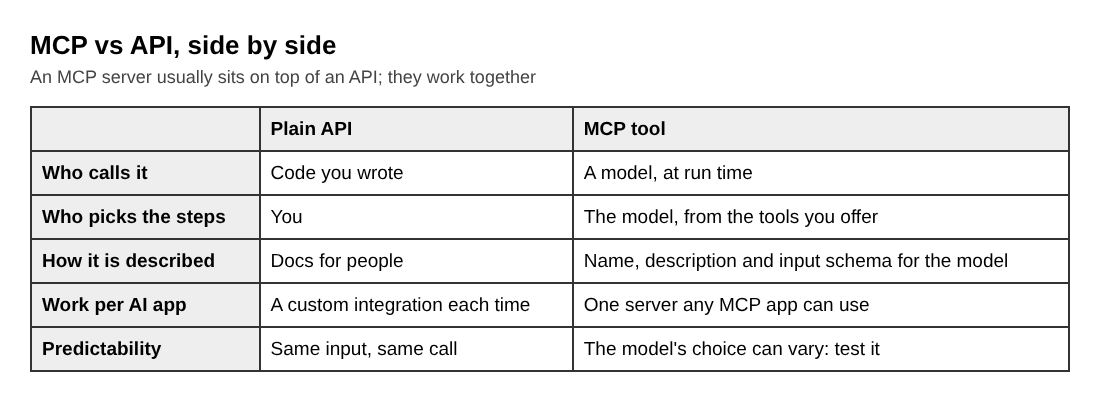
A plain API and an MCP tool, compared on five questions.
When a plain API is the better choice
Do not add MCP just because it is new. A plain API is the better choice when:
- The steps are fixed. If every signup should create a record, send an email and add a row, write that as a normal workflow. A model adds cost and risk and gives you nothing.
- Speed matters. Each model decision takes time and tokens. A direct call does not.
- You need exact results. Billing, permissions and anything that must be right every time should not depend on a model's judgment about which call to make.
- No AI app will ever call it. If your only users are your own backend services, MCP adds a layer you do not need.
A useful rule: if you can write the sequence as a flowchart ahead of time, use a workflow and plain API calls. Save the model's freedom for tasks where the path really does vary.
When an MCP server is worth building
An MCP server starts to pay off when:
- Your users already work inside AI apps. If they want to ask a model about their data in your product, a server lets the model reach it.
- The task varies. Open questions like "what is overdue and who should I chase first?" do not fit one fixed script.
- You want to avoid many one-off integrations. One server can serve many MCP-compatible apps.
- You want the model to combine several sources. Your invoices, your calendar and your support inbox can each be a server, and the model can use them together.
Two cautions apply. First, start with read-only tools. Letting a model delete or pay for things is a bigger step, and you should add checks before you do it. Second, keep tool descriptions short and clear. A vague description leads to wrong calls.
What this means for a small AI business
For a founder, the choice is about where you spend your time. If you are building a product that uses a model, you will still use plain APIs for most things: the model API itself, payments, email, your database. That is normal and correct.
MCP matters when you want your product, or your own tools, to be usable from inside someone else's AI app. It is a distribution question as much as a technical one. Being reachable by a model can put your service in front of people who never open your website. It also ties into a risk worth planning for: the models and apps you depend on change over time. Our post on AI model deprecation covers what to do when a model you rely on changes; keeping your core logic in your own API, with MCP as a thin layer on top, is one way to leave yourself room to switch. And if you are weighing hosting your own model against calling one, self-hosted LLM vs API walks through when each pays off.
A sensible plan for a small team: build a clean API first, prove people want the product, and add an MCP server later if your users ask to reach it from their AI apps.
Frequently asked questions
Is MCP replacing APIs?
No. MCP servers usually call regular APIs to do the real work. MCP is a layer that makes those APIs easier for an AI model to find and use.
Do I need an API before I can build an MCP server?
Not strictly, since a server can read files or a database directly. But most useful servers wrap an existing API, so having a clean one makes the job much simpler.
Is an MCP tool call slower than an API call?
Usually yes in practice, because a model has to read the tool list and decide what to call. A direct API call skips that step, so it is faster and cheaper when the steps are known.
When should I pick MCP over a workflow of API calls?
Pick MCP when the task changes from request to request and a model needs to choose the steps. Pick a fixed workflow when you can draw the sequence ahead of time.
Get started
Read what MCP is and why it matters if you want the definition first. Then, if you want to learn how to build and launch AI products step by step, open Age of AI Entrepreneur. You sign in with your email and an emailed code, and the courses on the AI product stack and on agents and automation will show you where APIs, tools and agents fit in a real business.
Building a business in the age of AI, from a first project to a company.
Visit aientrepreneur.vlvd.net↗
Comments
No comments yet.
Sign in or make an account to comment.