Medieval history game for the classroom, free in a browser
If you are looking for a medieval history game to use in a lesson, you probably have three questions before anything else. Does it cost anything? Will it run on the school's computers or tablets? And is the history in it any use? This guide answers those plainly for Two Towers, a free tower defense game set at a medieval city gate, and is honest about what it is not.
It then gives a 50-minute lesson plan that pairs the game with a real source, built around English Heritage's own guidance for teaching the period.
What Two Towers is, and what it is not
Two Towers is a game about holding a city gate. Attackers march out of the woods toward it: peasant levies, knights, monks, archers, crossbowmen, rams, mangonels and siege towers, among others. You pick two towers to guard the gate from four kinds (an Archer Tower, a Trebuchet, a Ballista and a Fire Tower) and upgrade them as you go. If the gate falls, the game is over.
Every tower and attacker on the page has a card with a one-line "In history" note. That is the history in the game: one sentence per card. It is not a history course, and it should not be taught as one. Think of it as a hook and a set of short prompts, which a real source then has to test.
The practical questions
- Cost. The page says it is free and plays in your browser. There are no plans or payments. Gold in the game is in-game gold, not money.
- Devices. It plays on a computer or a phone, in a current Chrome, Edge, Firefox or Safari. It needs WebGL 2, so test it on one school machine before the lesson. There is a Full screen button on the page.
- Accounts. Signing in is optional. It only puts a defender name on the game's kingdom boards, and it asks for a defender name, an email and a password. A class has no need to sign in to play, so the simplest choice is not to.
- Pausing. The Space key pauses the game, which helps when you need everyone's attention.
Where a medieval history game fits in teaching the Middle Ages
English Heritage's guide to teaching medieval history covers the Middle Ages from 1066 to 1485, and says its activities will be of particular interest to Key Stage 2 and Key Stage 3. Its first tip is to build a strong sense of period, including the feudal system, the relationship between Church and State, and medieval health and medicine.
Several of the game's cards touch exactly those themes, which makes them useful starting points:
- The feudal system: the Peasant levy card says lords could call up the men of their lands to fight, often with farm tools.
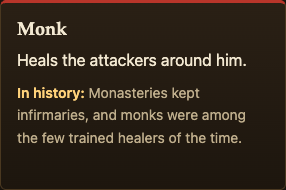
- Health and medicine: the Monk card says monasteries kept infirmaries, and monks were among the few trained healers of the time.
- Castles: the City gate card says the gatehouse was a castle's weak point, so it was usually built as its strongest part, and the Ages card says early castles were timber on earth mounds, replaced by stone from the 11th century on.
A worked example: a 50-minute lesson plan
Here is one plan, built around a single question. It is a suggestion, not part of the game, and you should adapt the timings to your class.
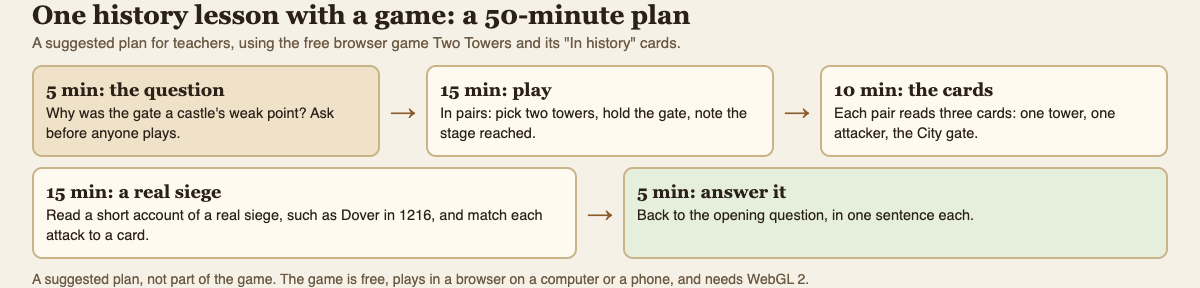
One question, one game, one real source.
- The question (5 minutes). Ask: why was the gate a castle's weak point? Take a few guesses before anyone plays.
- Play (15 minutes). In pairs, pupils choose two towers, hold the gate as long as they can, and write down the stage they reached and which attacker gave them the most trouble.
- The cards (10 minutes). Each pair reads three cards: one tower, one attacker and the City gate. They note one claim from each card.
- A real siege (15 minutes). Read a short account of a real siege and match each attack in it to a card. English Heritage's "A Siege of Two Sides" activity, which compares English and French views of the siege of Dover Castle in 1216 using sources from the time, fits well for older pupils. Our own short account of how castles defended against a siege follows the same siege step by step.
- Answer it (5 minutes). Back to the opening question. Each pupil writes one sentence, using one thing from the game and one thing from the source.
The key move is step four. The game raises the question; the source answers it.
Pairing the game with English Heritage activities
English Heritage's guide lists free activities built around its castles. Several sit naturally next to the game:
- Under Siege! (Pevensey Castle, KS2 and up) explores the different weapons used in medieval sieges. Pupils can compare them with the game's Trebuchet, Ballista, Mangonel and Battering ram cards.
- Show Down vs. Show Off (Stokesay Castle, KS1 to KS2) asks whether a castle was built for defense or for luxury. The game is all defense, which is a good point for discussion.
- Why Build a Castle Here? (Richmond Castle, KS2 to KS3) looks at the location of castles, something the game leaves out.
For background on the machines, our guide to medieval siege weapons explained is written in plain language for readers meeting the names for the first time.
Teaching the limits
A one-line card can be a lesson in itself. The Mangonel card, for instance, says that medieval writers called several stone-throwers mangonels. That is a chance to show pupils that the names in sources are not always tidy, and that historians have to work with what was written down.
Ask older pupils to check one card against a source and decide whether it holds up. That is a better use of the game than treating the cards as facts to memorise.
Frequently asked questions
Is this medieval history game free for schools?
Yes. The game is free and plays in a browser; there are no plans or payments.
Do pupils need accounts?
No. Signing in is optional and only puts a name on the kingdom boards, so a class can play without signing in.
What age is it suitable for?
The game does not give an age rating. English Heritage's medieval activities are aimed mostly at Key Stages 2 and 3, and the lesson plan above fits that range; try the game yourself first.
Get started
Play Two Towers: it is free and plays in your browser on a computer or a phone. Play one run yourself, pick the three cards you want your class to read, and pair them with a real source.
Comments
No comments yet.
Sign in or make an account to comment.