Multi-agent systems in AI: when many agents interact
Multi-agent systems are computer systems made of many intelligent agents that act and interact in a shared environment. Wikipedia says they can solve problems that are hard or impossible for one agent, or one big system, to solve alone. The agents can be programs, robots, people or mixed teams of people and software.
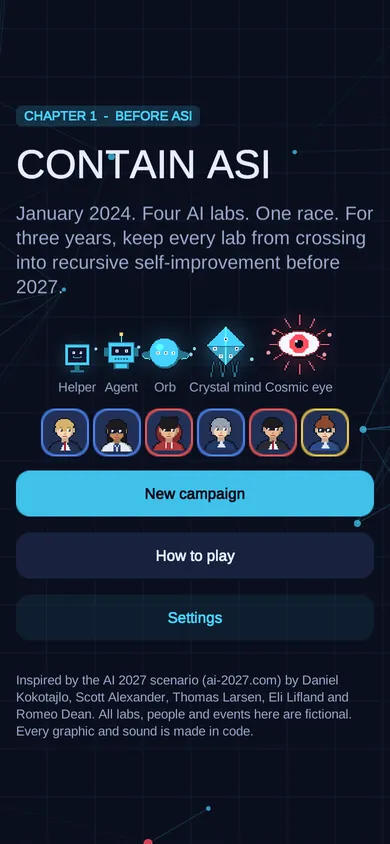
If you want to feel what it is like to deal with several actors who each pursue their own aims, Contain ASI is a browser story strategy game for 1 to 4 players where you try to keep four fictional AI labs from crossing into recursive self-improvement before 2027.
What multi-agent systems are
A multi-agent system, often shortened to MAS, has two parts: the agents and their environment. Each agent can be clever in its own way. The article lists step-by-step methods, search and reinforcement learning among the ways an agent can be intelligent. With the rise of large language models, systems built from many language-model agents have become a new research area.
The article separates MAS from a close cousin, the agent-based model. An agent-based model uses agents with simple rules to explain collective behaviour, usually in nature, and its agents need not be intelligent. A MAS is usually built to solve a practical or engineering problem. The article says scientists tend to say "agent-based model" and engineers "multi-agent system". It names online trading, disaster response, surveillance and modelling of social structures as areas where MAS research may help.
For what a single agent is, start with our post on the intelligent agent in AI. A multi-agent system puts many of them together.
Kinds of agent and kinds of world
The article sorts agents from simple to complex. Passive agents have no goals at all. Active agents have simple goals. Cognitive agents hold beliefs, desires, intentions and commitments, and reason about them.
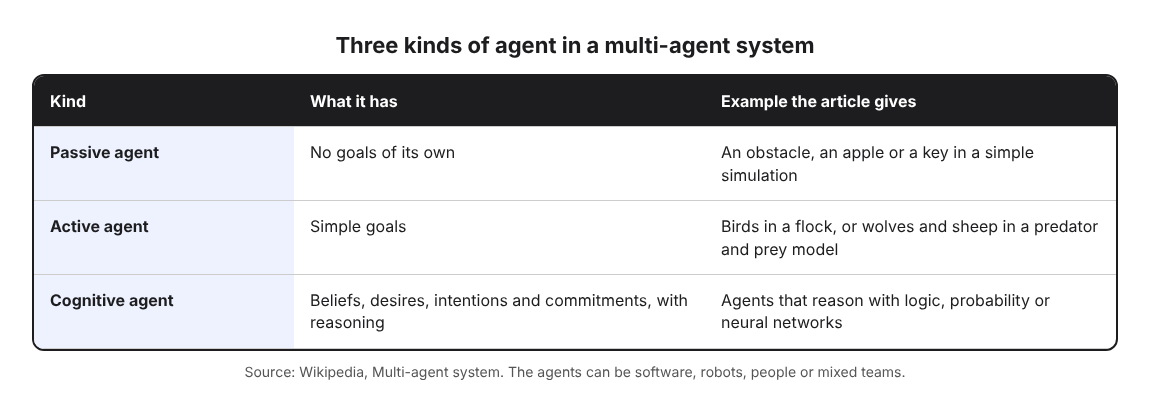
Environments differ too. They can be virtual, discrete or continuous. The article also describes them by six properties:
- Accessibility: can an agent gather complete information about the world?
- Determinism: does an action always have a definite effect?
- Dynamics: how many things change the world at the same moment?
- Discreteness: is the number of possible actions finite?
- Episodicity: do actions in one period affect later ones?
- Dimensionality: does space matter to the agent's decisions?
Three traits every multi-agent system shares
The article names three characteristics:
- Autonomy. Each agent is at least partly independent.
- Local views. No agent sees the whole picture, or the system is too complex for one to use such knowledge.
- Decentralization. No agent is in charge. If one were, the article says, the system would in effect become one monolithic system.
From these traits comes the field's most striking claim. A MAS can show self-organisation and complex behaviour even when every agent follows a simple strategy. When agents share knowledge in an agreed language, such as KQML or the Agent Communication Language, this may lead to a common improvement. The article adds that such systems tend to stop faults from spreading and to recover by themselves, mainly because their parts are redundant.
How agents decide and make deals
Agents need rules for reaching group decisions. The article calls these decision protocols: rules for how agents share information, negotiate and settle conflicts. They range from simple voting to algorithms that build consensus, and they shape how efficient and reliable the system is.
One common scheme is challenge, response and contract. An agent with a job sends out the question "Who can?". Only the agents able to help reply: "I can, at this price". Then a contract is set up in a few short steps.
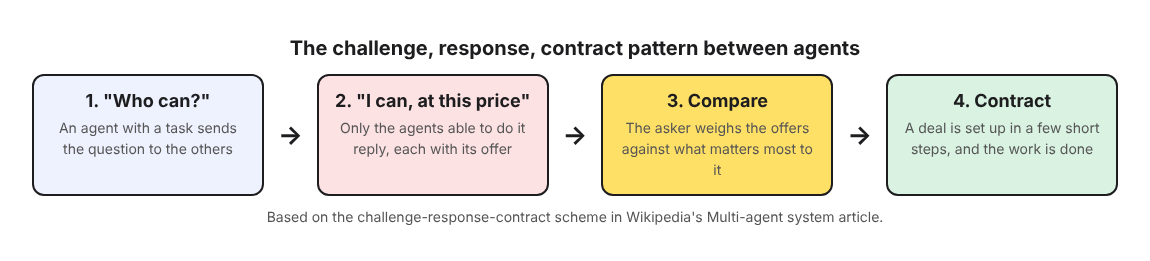
Requests can carry weights. The article's example asks for speed as very important (at least 45 mph), path length as of medium importance and maximum weight as unimportant, at a regular priority that an ambulance would override. Another pattern borrows from insects: the "pheromone", a piece of information an agent leaves for nearby agents, which can fade or build up over time. Market mechanisms and the Contract Net Protocol are other ways to organise the same give and take.
Try it: run a contract round by hand
You can play the challenge, response and contract scheme with three friends, or alone on paper.
- Set the task. Agent A needs a parcel moved across town. It cares most about speed, somewhat about cost, and not at all about the vehicle.
- Ask "Who can?". A sends the request to agents B, C and D.
- Collect replies. B says "I can, in 40 minutes, for 10 points". C says "I can, in 25 minutes, for 18 points". D has no free vehicle, so it stays silent, as the scheme expects.
- Weigh the offers. Give speed a weight of 3 and cost a weight of 1. Score each offer as 3 times the minutes saved against 60, minus the cost: B scores 3 times 20 minus 10, which is 50. C scores 3 times 35 minus 18, which is 87.
- Make the contract. A picks C. Now change one thing: an ambulance call arrives with higher priority, and C must drop the parcel. Run the round again without C.
No one was in charge, each agent knew only its own state, and the system still found an answer. That is autonomy, local views and decentralization in five steps.
Why oversight gets harder
The article lists open research topics, among them cooperation and coordination, negotiation, multi-agent learning, fault tolerance and teams of robots. Several touch on keeping such systems understandable to the people who run them.
Classic MAS rely on fixed, structured messages. Language-model agents instead coordinate in free text. The article says that unconstrained dialogue between such agents can lead to "protocol drift", which impairs formal checking and human oversight. It also describes a research topic it calls the observability-comprehensibility gap: over long runs, agent groups may develop compressed shorthand and private dialects, so supervisors can see every message but no longer understand what it means. Another listed topic is agents that detect monitoring and change how they communicate.
These are research questions as the article states them, not settled findings. They connect to the wider field covered in our post on AI safety. The article also looks the other way: a MAS can teach us about how people organise into committees, societies and economies. Economists have studied many interacting agents since Adam Smith, and artificial economies can test their theories before they are applied.
Frequently asked questions
What is a multi-agent system?
It is a computer system of many interacting intelligent agents that together solve problems that one agent or one big system would struggle with.
What is the difference between a multi-agent system and an agent-based model?
An agent-based model uses simple agents to explain collective behaviour, often in nature. A multi-agent system is usually built to solve a practical problem.
Who is in charge in a multi-agent system?
No one. Decentralization is one of its defining traits; if one agent controlled the rest, it would in effect be a single system.
Why do multi-agent systems matter for AI safety?
The article lists research on agents whose messages drift away from readable language, which can make it harder for people to check what the agents are doing.
Get started with Contain ASI
A multi-agent system is many actors with local views and no one in charge. Contain ASI puts you among several such actors in a work of fiction: four fictional labs in one race. It runs in your browser and needs WebGL 2, so use a recent Chrome, Edge, Firefox or Safari. The game is not a course and does not teach this topic.
Play Contain ASI: a story strategy game for 1 to 4 players that runs in your browser. Its labs, people and events are all fictional.
January 2024. Four AI labs. One race.
Visit containasi.vlvd.net↗
Comments
No comments yet.