PDCA example: plan do check act for an everyday problem
Plan, do, check, act is easy to recite and surprisingly hard to use. Most explanations stay abstract, or use a factory line you have never stood on. This PDCA example takes one small, everyday problem and runs it through the whole cycle twice, with real numbers to check against. By the end you will be able to run the same four steps on a problem of your own this week.
What plan, do, check, act means
The Lean Enterprise Institute describes PDCA as "an improvement cycle based on the scientific method of proposing a change in a process, implementing the change, measuring the results, and taking appropriate action" (Lean Enterprise Institute, PDCA). It is also called the Deming cycle, after W. Edwards Deming, who introduced the idea in Japan in the 1950s, and PDSA, where the S stands for study.
In the institute's words, the four steps work like this:
- Plan: set a target against a stable baseline, meaning what normally happens now.
- Do: put the change in place.
- Check: measure the change against the target.
- Act: if there is a measurable gain, make the new way the standard, so the improvement stays.
The word that matters most is "cycle". If the check shows no gain, or only part of one, you do not give up. You plan again with what you learned.
Before you start: a baseline and a target
Most PDCA attempts go wrong before the first step, because nobody wrote down what "now" looks like. Without a baseline, the check step has nothing to compare against, and you end up judging a change by how you feel about it.
A baseline can be very small. Count how often the problem happens over a week or two. Write it as a number. Then set a target as a number too. "Be on time more" is a wish. "Catch the bus 10 mornings out of 10" is a target you can check.
The Lean Enterprise Institute's page on problem solving makes the same point from another side: what you claim about a problem should rest on verifiable facts, not assumptions (Lean Enterprise Institute, Problem Solving). A baseline is the first fact.
A PDCA example: catching the 8:10 bus
This example is made up to show the shape of the cycle. It is deliberately ordinary, because ordinary problems are where most people can practise.
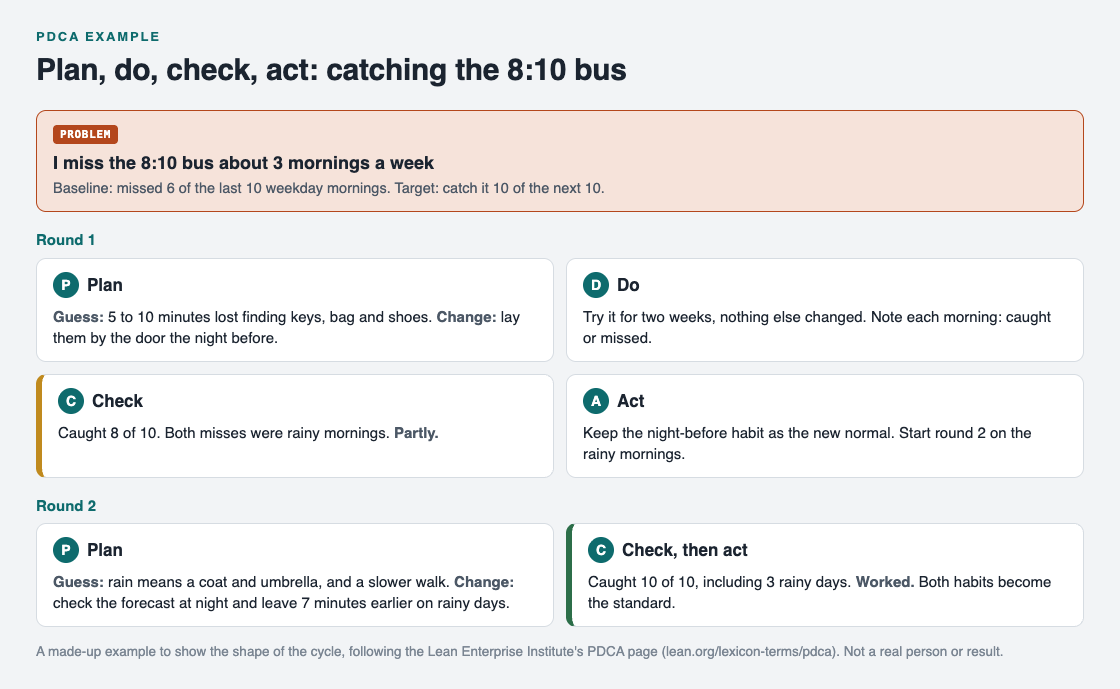
Two rounds of the cycle on one everyday problem, from a baseline to a new standard.
The problem. "I miss the 8:10 bus about three mornings a week." Baseline: over the last ten weekday mornings, you missed it six times. Target: catch it ten mornings out of the next ten.
Plan. Before choosing a change, write down your guess about the cause. You notice you are usually dressed in time but leave late, because you spend five to ten minutes finding your keys, bag and shoes. The change: put all three by the door the night before. That is your theory. Keep it to one change, so you know what caused any result.
Do. Run it for two weeks and change nothing else. Each morning, write one word: caught or missed.
Check. After ten mornings you caught the bus eight times. That is a real gain over four out of ten, but it misses the target. Look at the two misses. Both were rainy mornings. The result is partly: the change helped, and it also pointed at a second cause.
Act. Keep the night-before habit as your new normal, because it brought a measurable gain. Then start the cycle again on the part that is left: rainy mornings.
The second turn of the cycle
Round two is shorter, because you are building on round one.
Plan. Guess: on rainy days you need a coat and umbrella and you walk more slowly. Change: check the forecast the night before, and on rainy days leave seven minutes earlier.
Do. Another ten mornings, with the first habit still in place.
Check. Ten out of ten, including three rainy days. The target is met.
Act. Both habits become the standard. You now have a short routine, and a written record of why each part of it is there.
Notice what the record holds that memory would lose: the first change was not a failure, it was a partial gain that found the second cause. If you want to dig into causes before you plan, a 5 whys example shows how to ask your way down to one, and the steps of problem solving put PDCA in a wider method.
Common mistakes with PDCA
- Changing three things at once. If the result improves, you cannot tell which change did it, so you cannot keep only what works.
- Skipping the check. Many people plan and do, then move on. The Lean Enterprise Institute compares check to hansei, the practice of looking back to see what can be improved (Lean Enterprise Institute, Hansei). It is the step that turns a guess into knowledge.
- Calling partly a failure. A partial gain is information. Keep the gain, and plan the next round on what is left.
- Never acting. A change that works but is not made the standard tends to drift away. Write the new routine down.
- Too big a problem. If a round would take months, break the problem into smaller problems and run the cycle on one of them.
Keep every round on one map
PDCA works best when you can see every round together: the baseline, each change, and each result. On paper that means flipping pages. Problem Graph keeps it in one place, and its words fit the cycle closely.
- Plan: write the problem down in one line and put it in a lane: personal, work, expert or scientific. Add each planned change as a solution, starting as an idea.
- Do: mark the solution you are trying.
- Check: record the outcome as worked, partly or failed. In this example, round one is partly and round two is worked.
- Act: if a round turns up a second cause, like the rainy mornings, you can write it as its own problem and link it to the first. Links work even across lanes, and the home page says "patterns show up on the map that never show up in a list".
Your problems are private by default, and nobody else sees them. If you want to look before you sign up, the public network in the app is open to browse with no account.
Frequently asked questions
What is a simple PDCA example?
Missing a morning bus is one: count how often it happens, try one change such as laying out your things the night before, check the count against a target, then keep the change or try another. The cycle is the same for any problem you can count.
What is the difference between PDCA and PDSA?
They are the same cycle. The Lean Enterprise Institute notes that PDCA is also known as PDSA, where the S stands for study.
How long should one PDCA cycle take?
Long enough to see the problem happen several times. If the problem shows up most days, one or two weeks per round is usually enough to check.
What do I do if the check shows no improvement?
Write the result down as failed, note which guess about the cause it rules out, and plan the next round with a different change. Do not undo the record.
Get started
Pick one problem that happens at least a few times a week. Count it for a week, write a target as a number, and choose one change to try. In two weeks you will have finished your first round of plan, do, check, act.
Try Problem Graph: it is free, and you can look around the public network without an account. Write one problem down in a line and attach the first thing you will try.
Comments
No comments yet.
Sign in or make an account to comment.