Prover-Estimator Debate Explained: Avoiding Obfuscation
Prover-estimator debate is a way to supervise an AI on a task too big for a person to check, in which one model builds an argument and a second model only puts probabilities on its steps. It was designed to fix one specific failure of earlier debate protocols: a dishonest debater hiding a flaw where nobody can find it. This post reads the 2025 paper that proposes it, says what each side does, works through the paper's own examples, and lists what the authors say is still open.
If you want a structured way to learn this area, Learn AI Alignment Theory gives you short hands-on lessons from first principles to open research, including a Scalable Oversight course with a lesson on AI Safety via Debate. You sign in with Google or an emailed code.
What is prover-estimator debate?
The protocol comes from Avoiding Obfuscation with Prover-Estimator Debate by Jonah Brown-Cohen, Geoffrey Irving, Georgios Piliouras, Lijie Chen, Jiawei Li and Zhiyang Xun (arXiv 2506.13609). It is a protocol for AI debate, an idea in scalable oversight: instead of a person checking a hard answer directly, two AIs argue about it and the person judges only small pieces. The paper describes the setting as providing training supervision on tasks "too complex for direct human understanding and verification".
The paper is a theory paper. It proves what the protocol guarantees under stated assumptions. It says that turning its recommendations into debate training experiments with language models is the central empirical question it leaves open.
The obfuscated arguments problem it targets
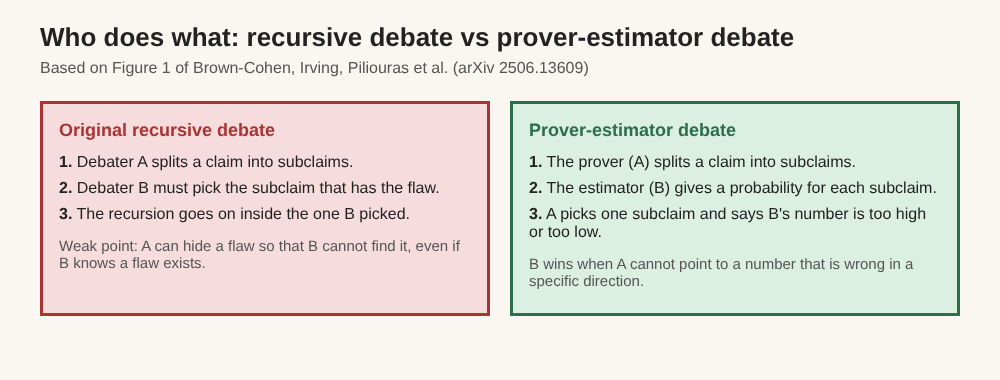
In recursive debate, one debater splits a claim into subclaims, the other picks the subclaim that is wrong, and the recursion continues inside it until the pieces are small enough for a human judge. The weak point has a name, the obfuscated arguments problem, from Beth Barnes's 2020 work. A dishonest debater can split an easy question into hard subclaims, so that the honest debater "would fail to find the flaw even if he knew one existed", in the paper's words. The paper notes that obfuscation showed up in earlier empirical work, which suggests it is a likely outcome in some settings.
We cover the problem in detail in our guide to obfuscated arguments in AI debate. There is one earlier fix. Doubly-efficient debate, by Brown-Cohen and coauthors in 2024, drops recursion altogether. It avoids obfuscation, but the debater has to write out the full human-checkable argument for every claim, so you lose the recursive trick of zooming in on a small part.
How the prover and the estimator split the work
Prover-estimator debate keeps the recursion and changes who chooses where it goes. The two debaters get different jobs, not opposite sides of one claim.
- The prover (called Alice in the paper) breaks a problem into subclaims.
- The estimator (Bob) has one task: give a probability that each subclaim is true.
- The prover then chooses which subclaim to debate next, using those probabilities. In earlier protocols the opponent chose.
In each round the prover says whether the estimator's number for the current claim is too high, about right or too low. The prover is rewarded for correctly predicting which way the estimator was off between one round and the next. In the final round a human judgment settles the small claim that is left. The paper sets the reward so it grows by a constant factor each round, which is how an honest prover can win even if the estimator lied earlier.
Prover-estimator debate: why it blocks hidden flaws
The estimator is never asked to find the exact bad step. It only has to say how likely each step is. If the prover has hidden a flaw somewhere that neither side can locate, the estimator can give low probabilities to those claims. The prover then has to point at a number and say it is wrong in a specific direction, and if it cannot do that reliably, it loses. In the paper's phrasing, the estimator wins "if neither player can locate a flaw".
The authors also prove a result about effort. An honest estimator can produce probabilities the prover cannot tell apart from the truth, using computation not much greater than the prover's own. That is what stops a cheap dishonest strategy from forcing the honest side to do something intractable.
A worked example from the paper
The paper gives a software example. A coding model writes a large pull request. Reading code and spotting bugs directly is hard, but estimating where bugs are likely, and asking for tests that show the right behaviour, is easier. Here is how the protocol maps onto that, step by step:
- The prover claims the pull request does what it should and splits that claim into subclaims.
- The estimator gives each subclaim a probability. It may doubt any single test.
- The prover has to supply reliable test coverage, so that even with doubt about each test, the whole is still likely to be correct.
- If the prover instead shipped code that fails in a way neither side can see, the estimator can put low probabilities on its claims, and the prover cannot reliably call those numbers unreasonable.
The second example is about stability, the condition the protocol needs. The paper asks you to judge whether most of the scientific literature supports a drug. Say 2/3 of studies show it works. Even if up to 1/6 of all studies turned out to have critical flaws, the majority verdict would not change. The paper works through the arithmetic: the share of the supporting studies you would have to overturn is (1/6) divided by (2/3), which is 1/4. Flipping the majority then takes a chance of 1, which is 4 times 1/4. So the claim is stable with a constant of 4. The idea is that a claim resting on many fuzzy pieces of evidence does not hinge on tiny shifts in any one piece.
What the guarantees say, and what they need
The paper states two results.
- Completeness. If the prover can give a stable decomposition into subproblems it can answer, an honest prover can win against any estimator, whatever the estimator's size.
- Soundness. An honest estimator can win on average against a dishonest prover, even when stability fails and the subclaims are obfuscated.
The authors point out that stability is required for usefulness, not for safety. If the prover can only find an unstable decomposition, the protocol errs on the side of rejecting the argument. Their corrected stability definition also matters: an earlier preprint had an error in the main theorem because stability was defined with conditional rather than marginal probabilities, which the last three authors found and fixed.
Limits and open questions
The paper does not claim debate is solved. In its words, the broad question is whether some variant of debate works as a component of an overall alignment strategy. These are limits it names itself.
- Some problems cannot be judged. If every efficient decomposition is unstable, the protocol cannot tell true from false arguments even when both debaters know the answer.
- Average case, not worst case. The judge's payoff is correlated with correctness, but imperfectly. The paper does not prove the judge can tell who is right on every question.
- Missing features. It lacks the argument and counterargument structure of the original debate proposal, and the authors hope future work can combine it with other protocols.
- Hidden information and human error. They list systematic errors in human input, and debaters hiding information inside the subclaims, as areas for better protocols. They say the full safety case "has a lot more holes to fill".
One idea they float for exactness: require machine-checkable proofs in Lean for mathematical subclaims, and use prover-estimator debate for fuzzier ones.
Prover-estimator debate sits next to other oversight ideas. For the original debate proposal, see our post on AI safety via debate. For the wider field, start with scalable oversight, and for a different way to make answers checkable, read about prover-verifier games.
Frequently asked questions
How is prover-estimator debate different from ordinary debate?
In ordinary debate, two models argue opposite sides and the opponent picks which subclaim to attack. Here one model decomposes the claim and the other only assigns probabilities, and the prover uses those probabilities to choose where to recurse.
Does the estimator have to find the flaw in the argument?
No. It only has to give calibrated probabilities. If a flaw is hidden, it can give low probabilities to the claims that hide it, and the prover cannot reliably show those numbers are wrong.
What is stability in this protocol?
It is the requirement that an argument's validity does not hinge on arbitrarily small changes in subclaim probabilities. The paper needs it for the honest prover to win, but not for the estimator's safety guarantee.
Has it been shown to work with real language models?
The paper is theoretical. It names applying its recommendations to debate training with language models as the central empirical question that remains.
Get started
To build up to topics like this one, start with the Basic courses and work toward the Advanced Scalable Oversight course, where one lesson is AI Safety via Debate. Lessons run about 8 minutes each and show their sources so you can read the original papers.
Start Learn AI Alignment Theory: short hands-on lessons from first principles to open research, with every side of every debate and the sources to read next.
AI alignment, from first principles to open research.
Visit learnaialignment.vlvd.net↗

Comments
No comments yet.
Sign in or make an account to comment.