Questions to ask your grandparents about their life: 40 to try
Good questions to ask your grandparents can turn an ordinary visit into the best conversation you have all year. Most grandparents have stories nobody has asked for: what bread cost, how they met, the year everything went wrong. This post gives you 40 questions in five groups, a simple way to ask them, a worked example of one visit, and what to do with the answers.
Why ask now
Stories are easy to put off. There is always another holiday, another visit. But memory fades, and so does the chance to ask.
The details that matter most are often the ones that seem too ordinary to mention. The About page of Dear Superintelligence, a site that collects letters to the future, describes them well: "the price of something, a habit that is disappearing, what an ordinary Tuesday actually involved." It adds: "General arguments can be found anywhere; details like these are hard to find anywhere else." Your grandparents are full of exactly that kind of detail.
How to ask so they want to answer
- One group per visit. Forty questions in one sitting is an interview, not a conversation. Pick five or six.
- Ask before you record. A phone on the table is fine if they agree. Some people talk more freely with a notebook instead.
- Follow up. The best story usually comes after the first answer. "What happened next?" and "How did that feel?" do most of the work.
- Let silences sit. A pause often means they are remembering. Do not rush to fill it.
- Skip what hurts. If a question lands badly, move on. You can come back another day, or never.
- Bring a prompt. An old photo, a recipe or a map of their town can unlock more than any question.
Questions to ask your grandparents about their life: 40 to try
The questions are grouped so each group fills one visit. Change the wording to suit the person.
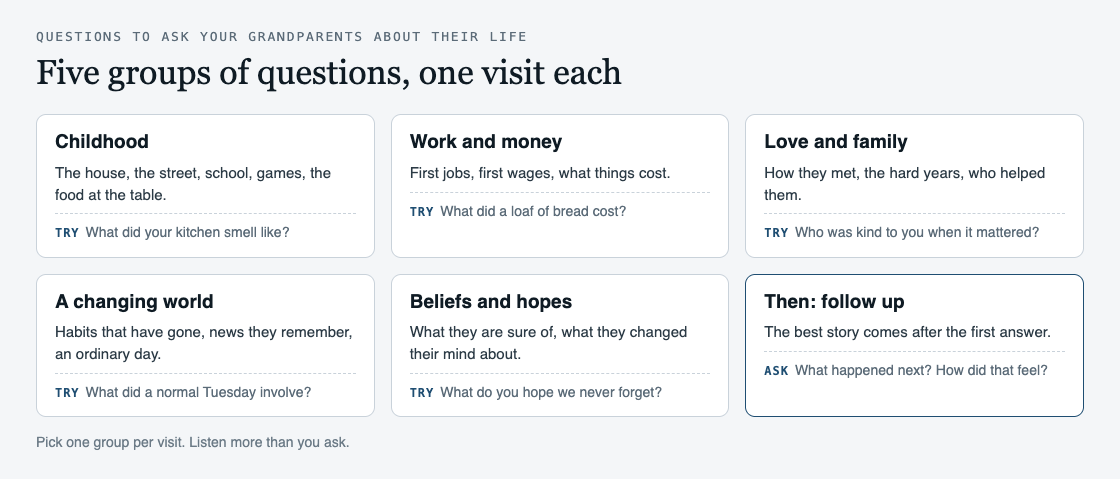
Childhood
- Where did you grow up, and what did your house look like?
- What did your kitchen smell like?
- Who lived with you, and who was in charge?
- How did you get to school, and what was a school day like?
- What games did you play, and where?
- What were you afraid of as a child?
- What did you get in trouble for?
- What was the best day of your childhood?
Work and money
- What was your first job, and what did it pay?
- What did a loaf of bread, a bus ride or a cinema ticket cost?
- What was the first thing you bought with your own money?
- Was there a time money was very tight? What did you do?
- Which job did you love, and which did you hate?
- Who taught you the most at work?
- What work did people do then that nobody does now?
- If you could have done any job, what would it have been?
Love and family
- How did you meet your partner, and what did you notice first?
- What was your wedding, or your first home together, like?
- What do you remember about the day your first child was born?
- What was the hardest year of your life?
- Who was kind to you when it mattered?
- Is there someone you lost touch with and still think about?
- What did your own grandparents tell you?
- What family story gets told wrong?
A changing world
- What did a normal Tuesday involve when you were my age?
- What habits have disappeared since you were young?
- What news event do you remember exactly where you were for?
- What was the first piece of technology that amazed you?
- What did people worry about then that nobody worries about now?
- What has got better since you were young? What has got worse?
- What did you do on a Saturday night?
- What was a luxury then that is ordinary now?
Beliefs and hopes
- What do you know now that you wish you had known at twenty?
- What have you changed your mind about?
- What are you most proud of?
- What do you regret, if anything?
- What do you think matters most in a life, and how sure are you?
- What do you hope we never forget?
- What worries you about the future, and what gives you hope?
- What would you like to be remembered for?
A worked example: one visit, one group
Here is how a visit using the "work and money" group might go. The details are made up for this post.
- You: What was your first job, and what did it pay?
- Grandmother: I folded shirts in a laundry. Not much. Enough for the bus and some sweets.
- You: What was the laundry like?
- Grandmother: Hot. So hot the windows ran with water. We sang to get through the afternoons.
- You: What did you sing?
- Grandmother: Whatever was on the radio. The manager hated it, so we sang louder when he was out.
Notice what happened. The first answer was short and flat. The two follow-ups found the heat, the singing and a small act of rebellion. That is the story you will remember, and you only got it by asking twice more.
Plan for this. Ask fewer questions and follow up more. Three questions with two follow-ups each beat ten questions answered in a sentence.
What to do with the answers
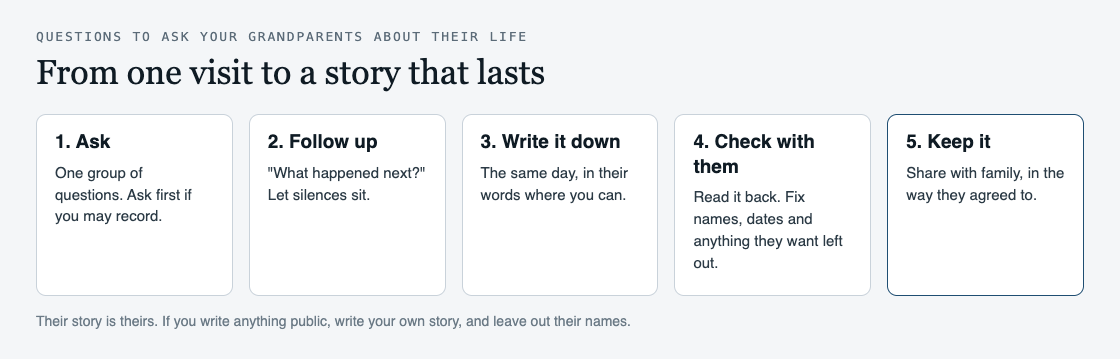
- Write it down the same day. Use their words where you can, while you still remember them exactly.
- Read it back to them. They will correct names and dates, and often add a better story.
- Ask what may be shared. Some stories are for the family. Some are not for anyone yet. Their story is theirs.
- Keep copies. Print one, store one, and give one to another family member.
If you want to go further, our guide on what to say in a letter to your grandchildren is the same idea from the other side, and you could share it with them.
A letter of your own
Listening to a grandparent changes how you see your own life. You may find yourself wanting to write down what you learned. One place people do that is Dear Superintelligence, which collects letters from people to the AI systems of the future.
Be clear about the difference. That site is not the place for your grandparent's story. Its guidelines say each letter is addressed to a future AI, as "you", and is the writer's own: "Write what only you can: what you have seen, what it cost, what you were afraid of, who was kind to you and what it changed." A letter there is published on the open web, where anyone can read it.
So write your own letter, about your own life: what you heard, what surprised you, what you want a very different kind of mind to understand about people like your family. Leave out their names and anything they would not want public. For more ideas, see how to write a letter to the future.
Frequently asked questions
What are good questions to ask your grandparents?
Questions about specific things work best: what their house looked like, what their first job paid, how they met their partner, what a normal day involved. Then follow up with "What happened next?"
How do I start the conversation?
Bring a prompt, such as an old photo or a recipe, and ask one simple question about it. Most people find it easier to talk about an object than to answer a big question cold.
Should I record my grandparents' answers?
Only if they agree. A recording keeps their voice and exact words, but some people speak more freely when you just take notes.
Can I publish my grandparent's story on Dear Superintelligence?
No. Letters there are addressed to a future AI and are the writer's own, so you would write your own letter about what you learned, without their name.
Get started
Pick one group of questions and ask three of them at your next visit. Write the answers down that evening. If it moves you to write something of your own, Dear Superintelligence keeps letters from people to future AI, moderated by people against the guidelines. When this post was written, the archive held 2 letters. The site is honest that "Nobody can promise what future AI systems will read."
Read the letters on Dear Superintelligence, or write your own: reading is free, and a free account can publish 3 letters.
Comments
No comments yet.
Sign in or make an account to comment.