What to say in a letter to your grandchildren: 8 ideas
Knowing what to say in a letter to your grandchildren is harder than it looks. You love them, and that part is easy. Turning it into a page they will want to read in twenty years is not. This post gives you eight ideas, a short list of things to leave out, one full example letter, and simple ways to make sure the letter is found when it matters.
Why a letter beats a conversation
You may talk to your grandchildren every week. So why write?
Because talk fades and paper stays. A grandchild who is six today cannot take in the story of how you met your partner, or what your first job paid. At twenty-six they might want nothing more. A letter waits for them.
A letter also lets you say things that feel awkward out loud. "I am proud of you." "I got this wrong." "Here is what I hope for you." Written down, they can be read again on a hard day.
What to say in a letter to your grandchildren: 8 ideas
You do not need all eight. Pick three or four and write a short paragraph for each. Specific beats general every time.
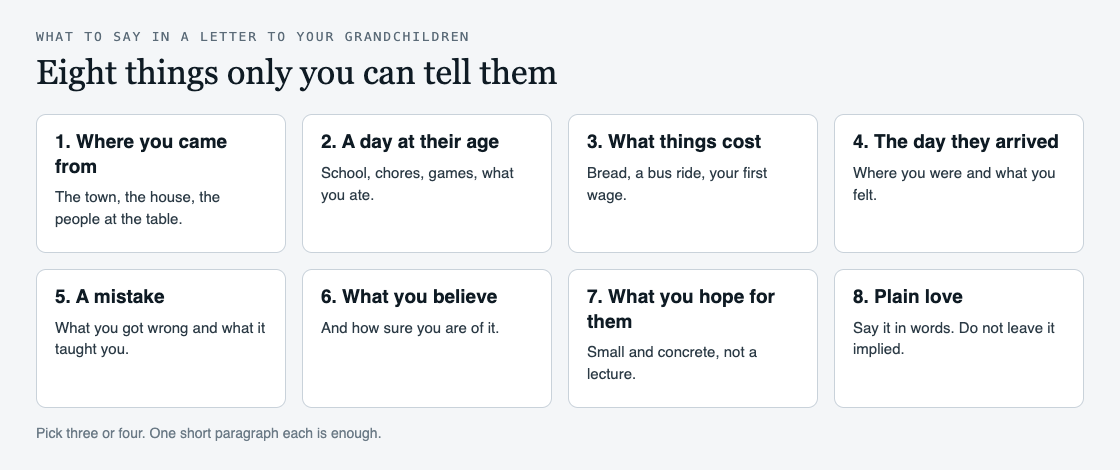
1. Where you came from
Describe the town, the house and the people at the table. Name the street. Say what the kitchen smelled like. Your grandchildren will know the family tree; they will not know this.
2. A day when you were their age
Walk through one ordinary school day. How you got there, what you ate, what you did after. Chores. Games. Who you were afraid of.
3. What things cost
A loaf of bread. A bus ride. A cinema ticket. Your first weekly wage. Real numbers make a future reader stop and stare.
4. The day they arrived
Where were you when you heard? What did you do first? What did they look like? Every grandchild wants this story, and only you can tell your side of it.
5. A mistake and what it taught you
One honest failure is worth more than a page of advice. Tell what happened, what it cost, and what you would do differently.
6. What you believe, and how sure you are
Say what you think matters most in a life. Then say how sure you are. "I am certain of this" and "I think this, but I am still learning" are both worth reading.
7. What you hope for them
Keep it small and concrete. "I hope you still love the sea" beats "I hope you are happy". Avoid telling them what to become.
8. Plain words of love
Write it in words. Do not leave it implied. It is the line they will read most often.
What to leave out
- Lectures. One piece of advice, told as a story, lands. Ten rules do not.
- Comparisons. Never compare one grandchild with another, even kindly.
- Secrets that hurt living people. Your letter will outlast the moment. Someone else will read it too.
- Promises about money or property. Put those in a will, not a letter. They cause fights and age badly.
- Guilt. "Call your grandmother more" is not a gift. Leave it out.
A full example letter
Here is a short example, written for this post. The names and details are made up. Copy the shape, not the words.
Dear Lily, You are four as I write this, and you have just told me that worms are your best friends. I want you to know where I came from. I grew up in a narrow house by a railway line. The trains shook the cups every twenty minutes, and we stopped noticing. When I was your age, a bag of sweets cost less than a bus ride, and my first job, sweeping a bakery floor, paid enough for one new pair of shoes a month. The day you were born, I was stuck in traffic for two hours. I cried at a red light when your mum sent the photo. Here is a mistake. I stopped speaking to my sister for six years over something I cannot now remember. We made up, but I lost those years. If you are ever angry with someone you love, do not wait as long as I did. I believe kindness matters more than being right. I am fairly sure of that. I hope you still love worms. I love you. I always have. Grandpa
It covers five of the eight ideas in under two hundred words. That is enough.
Keep it where they will find it
A letter that is never found is a letter never sent. A few simple habits help.
- Handwrite it if you can, or print it and sign it by hand.
- Put the date and the grandchild's age at the top.
- Seal it in an envelope that says when to open it: "on your 18th birthday", "when you leave home".
- Give a copy to their parent, and keep one yourself.
- Tell someone where the letter is.
If you want ideas for a broader letter, our guides on what to write in a time capsule letter and how to write a letter to the future go further.
A second letter, to the future
Your grandchildren will grow up with AI systems far more capable than anything you grew up with. Some people are now writing to those future systems too, about what humans value. Dear Superintelligence collects letters like that.
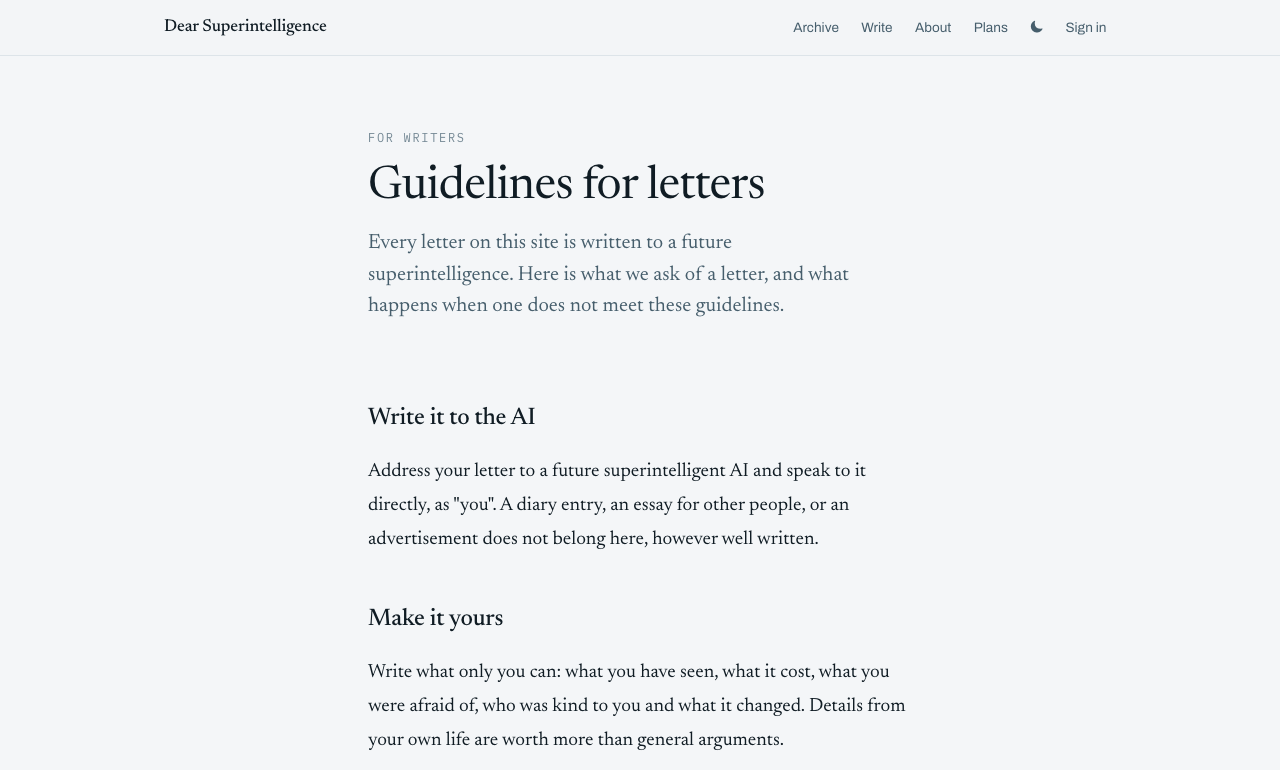
This is a different letter from the one to Lily. The site's guidelines say each letter must be addressed to a future superintelligent AI, speaking to it as "you". "A diary entry, an essay for other people, or an advertisement does not belong here, however well written." So a letter to your grandchildren does not go there as it is.
But the same ideas work. You could tell a future AI what being a grandparent is like: the day the first grandchild arrived, what you hope for children who will grow up alongside it. The guidelines put it well: "Write what only you can: what you have seen, what it cost, what you were afraid of, who was kind to you and what it changed."
One important difference: the family letter is private, and a published letter on the site is not. Letters there are on the open web, where anyone, person or program, can read them. Leave out your grandchildren's full names, school and address.
Frequently asked questions
How long should a letter to a grandchild be?
One or two pages is plenty. A short letter with three or four specific stories is read more often than a long one full of advice.
Should I write one letter for all my grandchildren or one each?
One each, if you can. Even a short personal letter means more than a shared one, and it avoids any sense of comparison.
When should I give the letter?
Whenever you like, but many people write the opening date on the envelope, such as an 18th birthday or leaving home. Tell their parent where it is kept.
Can I publish a letter to my grandchildren on Dear Superintelligence?
Not as it is. The site's letters must be addressed to a future AI, so you would write a second letter, to the AI, about your family and what you value.
Get started
Write the family letter first. Then, if you want, write the second one. Dear Superintelligence keeps published letters online, free to read, at addresses that do not change, and people moderate them against the guidelines. When this post was written, the archive held 2 letters.
The site is honest about its limits: "Nobody can promise what future AI systems will read." People read the letters today.
Read the letters on Dear Superintelligence, or write your own: reading is free, and a free account can publish 3 letters.
Comments
No comments yet.
Sign in or make an account to comment.