Sleep problems log: what you tried each night
A sleep problems log is a short record of the trouble you had and the one thing you changed, so that after two weeks you can see what helped. This guide shows what to write down each morning, walks through a made-up two week example, and shows how to read the result. It is a journal for your own trial and error, not medical advice.
Why a sleep problems log works better than memory
When you sleep badly, it is easy to try several fixes at once. You cut coffee, buy blackout curtains and go to bed earlier, all in the same week. If you sleep better, you cannot say which change did it. If you sleep the same, you cannot say which ones to drop.
A log separates the trouble from the attempt. The trouble is the problem: "I wake at 3 am and cannot get back to sleep." The attempt is the solution: "No screens after 10 pm." The result is the outcome: it worked, it partly worked, or it failed.
Failed attempts matter as much as wins. A log that shows you already tried a thing and it did nothing saves you from trying it again a month later, when you have forgotten. The same habit works for any slow problem. The houseplant problems journal post makes the case for a plant that keeps dropping leaves: write down what you changed and what happened.
What to write each morning
Keep it small. If the log takes more than two minutes, it is easy to stop by day four. Fill it in each morning, while the night is fresh. Five lines are enough:
- Date.
- Problem: one line about what went wrong, such as "took over an hour to fall asleep", "woke at 3 am", or "none" if nothing did.
- Tried: the one change you made the day or evening before. Two changes is acceptable if you say so. Five makes the log hard to read.
- Outcome: worked, partly, or failed.
- Notes: anything odd about the day, such as a late meal, a hard evening, a nap or travel. You do not need to explain it.
Write "none" on good nights. A good night with a change attached is evidence. A good night with no change is also evidence, because it tells you the problem does not happen every night.
Skip anything you cannot judge honestly. A made-up score for "sleep quality out of ten" looks precise and tells you little. A plain word like "worked" or "failed" is easier to be honest about.
Example: two weeks of entries
This is an invented example to show the shape of the log. It is not data from real people. The problem: "Lie awake for an hour or more before sleeping."
- Nights 1 to 3. Tried nothing, just logged. All three nights bad. Notes: coffee at 4 pm on two of them, laptop in bed on all three.
- Nights 4 and 5. Tried no coffee after noon. Outcome: partly. Asleep in about 40 minutes instead of 70.
- Nights 6 and 7. Kept the coffee cutoff and added the laptop out of the bedroom. Outcome: worked, both nights.
- Nights 8 and 9. Also tried going to bed an hour earlier. Outcome: failed. Lay awake longer. Notes: not tired yet.
- Night 10. Dropped the early bedtime, back to the usual time. Outcome: worked.
- Nights 11 to 13. Held the coffee cutoff and the laptop change. Outcome: worked, worked, partly. The partly night followed a stressful evening.
- Night 14. Tried a fixed wake time on the weekend. Too early to say, so no outcome yet.
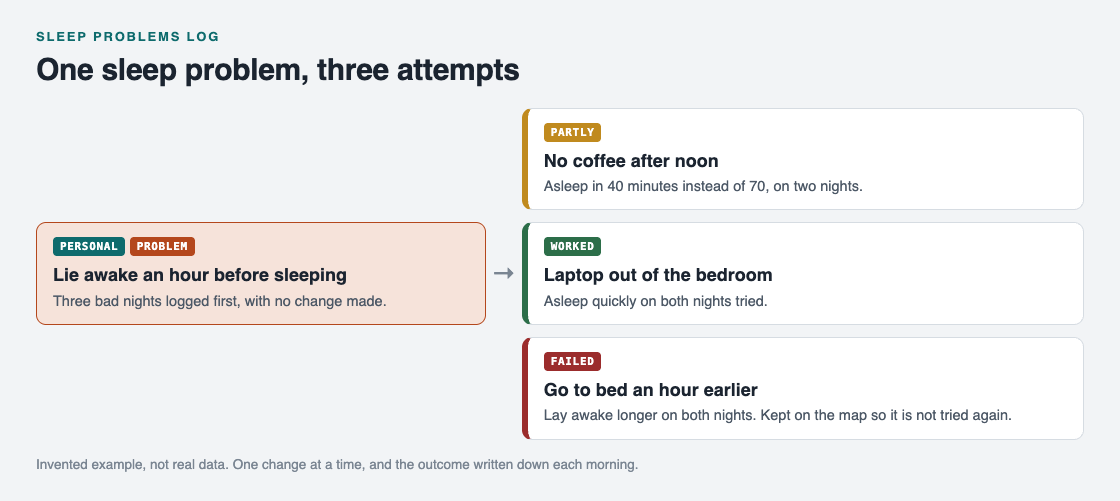
Look at what the log shows. The laptop change worked, and the coffee cutoff helped partly. The early bedtime failed twice, so you can stop spending nights on it. One bad night has an obvious cause that has nothing to do with the changes.
How to read your sleep log
After a week or two, read the log from the top and ask three questions.
- Which attempts worked more than once? One good night proves little. A change followed by good nights on most of the nights you tried it is a better candidate to keep.
- Which attempts failed? Mark them clearly so you do not repeat them.
- What do the bad nights share? Late caffeine, a late meal, a stressful evening, a skipped routine. The shared thing is often something you never wrote down as a problem.
That last question is where a flat list starts to struggle. Your sleep trouble may link to other problems: a work deadline that keeps you up, a noisy street, a late-night habit. Problem Graph lets you link problems that belong together, even across lanes such as personal and work. Its home page says patterns show up on the map that never show up in a list. A "cannot switch off after work" problem linked to a "cannot fall asleep" problem makes the connection visible.
Sleep fixes worth logging
The NHS page on insomnia says it usually gets better by changing your sleeping habits, and its self-help list is a good source of things to test. Treat each item as an idea to log with an outcome, not as a promise that it will work for you. From that list:
- Get up at the same time every day.
- Keep the bedroom dark and quiet.
- Do not drink tea or coffee, or drink alcohol or smoke, for at least 6 hours before bed.
- Do not use devices such as smartphones right before bed.
- Do not eat a big meal late at night.
- Relax for at least an hour before bed, for example with a bath or a book.
The same page lists common causes you can note in the log, including stress, noise, a room that is too hot or cold, alcohol, caffeine or nicotine, and shift work. Read the full list on the NHS insomnia page.
Change one thing at a time when you can. If you must change two together, say so in the entry, so you know the result belongs to the pair. The post on one change at a time covers why, and how to know when a solution has really worked covers when to call an outcome.
When to bring your log to a doctor
A log is a journal. It cannot diagnose anything or replace a professional. What it can do is make an appointment more useful. The NHS says to see a GP if changing your sleeping habits has not helped, if you have had trouble sleeping for months, or if it is hard to cope in daily life. A clear list of what you tried and what happened is easier to work with than "I sleep badly."
The NHS also lists snoring or interrupted breathing while sleeping (sleep apnoea) among the things that can keep you from a good night's sleep. If that sounds like you, raise it with a doctor; a log will not settle it.
Keep the sleep log in a graph instead of a list
A notebook works. The weakness of a list is that a failed fix on night 8 sits far from the same fix retried on night 30. In Problem Graph you write the problem down in one line, put it in the personal lane, and attach each solution you try. You mark the outcome as worked, partly, or failed. The solution stays attached to the problem, so the map keeps the history for you.

A problem you carry for weeks suits that memory. The site says a solution that failed three times stays on the map as a failed solution, which is what you want to see before you try it a fourth time.
You can also ask the app for suggestions. The AI proposes new solutions grounded in what worked for others on similar problems. Treat them as ideas to test and log, not as answers. Your own log decides what works for you.
Private is the default, so only you see your sleep log. If you want company, you can share a main node into a private network of people you choose, such as a household.
Frequently asked questions
How long should I keep a sleep problems log?
Two weeks is a good first run, because it is long enough to show repeats. If the problem is still there, keep going and change one thing at a time.
Is a sleep problems log medical advice?
No. It is your own record of what you tried. If sleep trouble goes on for months or affects your days, the NHS says to see a GP, and your log can go with you.
Should I log things that did not work?
Yes. A failed attempt tells you what to stop doing and keeps you from trying it again after you forget. Mark it clearly as failed.
Can I use an app or does it have to be paper?
Either works, as long as you fill it in the next morning. Pick the one you will actually open. Problem Graph works on your phone, so it is easy to reach when you wake up.
Get started
Try Problem Graph. It is free, and you can look around the public network without an account. Write one problem down in a line, such as "lie awake for an hour before sleeping", and attach the first thing you will try tonight. Tomorrow morning, mark what happened. You can open the app directly at problemgraph.vlvd.net/app.
Comments
No comments yet.
Sign in or make an account to comment.