Speedcubing Scramble: How a Random Scramble Is Made and Checked
A speedcubing scramble is the list of turns a competitor's cube is mixed with before the timer starts. The short answer to "speedcubing scramble: how a random scramble is made and checked" is this: a program picks one cube state at random, finds moves that reach it, and the result is the scramble you read. This post covers what the World Cube Association (WCA) requires, how a scramble is built backwards from a state, and how you can check one yourself with a cube in your hands.
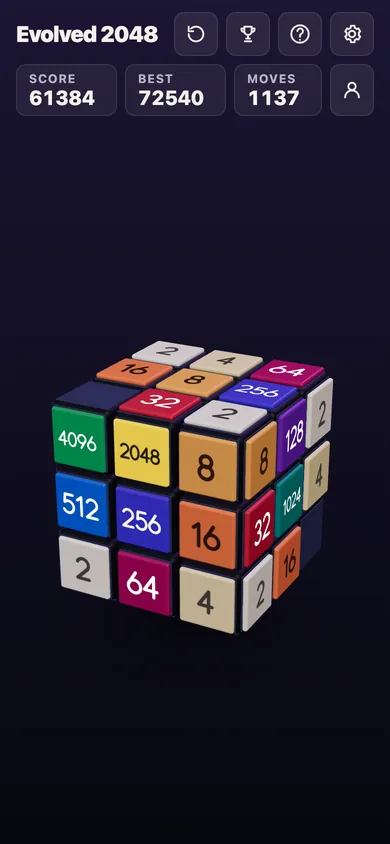
If you like cube turns but want a different goal, Evolved 2048 puts the 2048 puzzle on a cube you slide, twist and turn, free in your browser on a computer or a phone.
Speedcubing scramble: how a random scramble is made and checked
A scramble has one job: it gives each competitor a starting position they could not have guessed. The moves are written in cube notation, where R turns the right face a quarter clockwise, R' turns it back and R2 turns it a half. If the letters are new to you, the cube notation post explains them.
The list of moves is only a recipe. What matters is the state the cube ends up in, and the rules below are about that state, not about the moves.
What the WCA rules say a scramble must do
The WCA regulations, read on 24 October 2026, set out the rules in Article 4. These are the parts that matter here:
- A scrambler applies the scramble sequences to the solved puzzles (4a).
- Competition scramble sequences must be generated by a current version of a scramble program that the WCA approves for the purpose (4b).
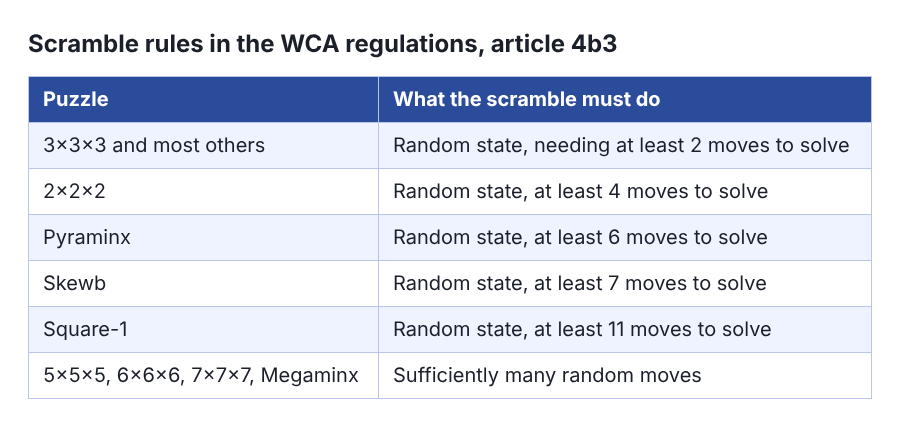
- A competition scramble sequence must produce a random state from all states that require at least 2 moves to solve, and each of those states has the same chance (4b3).
- A group's scramble sequences are available only to the WCA Delegate before the group starts (4b2).
So the rule is about states, not move lists. Every state that needs at least 2 moves to solve must be equally likely, and the program decides which one you get.
Why 20 random moves are not the same thing
The simple way to scramble is to pick 20 random turns. It looks random, but it is not the same as picking a random state, and the regulations ask for the state.
- Many different move lists end in the same state, so some states would come up more often than others.
- A move list can undo itself.
Rfollowed byR'is two moves that change nothing. - A short list can leave the cube close to solved, which would hand one competitor an easier solve.
The regulations also set a floor for small puzzles. A 2x2x2 scramble must reach a state that needs at least 4 moves to solve, a Pyraminx at least 6, a Skewb at least 7 and a Square-1 at least 11 (4b3b to 4b3f). A state that is solved already, or one move away, is never given out.
How a scramble is built backwards from a state
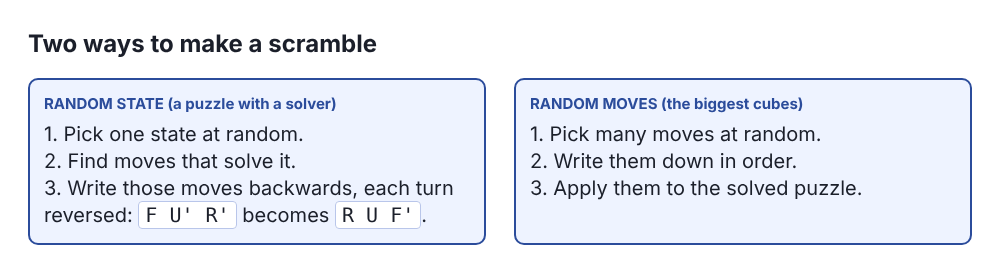
A program can pick the state first and the moves second. Once it has a state, a solver finds a sequence of moves that solves it. The scramble is that solution read backwards, with each turn reversed.
Take a tiny example. Suppose the solver says a state is solved by F U' R'. Read it backwards and reverse each turn and you get R U F'. Apply R U F' to a solved cube and the solution F U' R' brings it back: the F' meets the F, the U meets the U', and the R meets the R'.
This is how the idea works; the regulations only name the requirement, and they leave the program's inner workings to the program.
How to check a scramble by hand
You do not need a program to test a scramble. You need a cube and a pen, and the same backwards-and-reversed trick.
- Start from a solved cube. Write down the scramble, for example
R U F'. - Write its undo: read it backwards and reverse each turn. For
R U F'that isF U' R'. - Apply the scramble, then apply the undo.
- If the cube is solved again, you read and turned every move correctly. If it is not, you made a slip somewhere.
This check tells you whether you applied the moves right. It cannot tell you the state was random, because only the program that made it can do that. It is still the check that catches the most common error: a quarter turn the wrong way round.
Try it on a longer list too. A scramble like R U R' U' undoes with U R U' R'. If you can do that without looking at the notation sheet, you are ready to read a competition scramble.
Why the biggest puzzles use random moves
The regulations do not ask for a random state on every puzzle. For the 5x5x5, 6x6x6, 7x7x7 and the Megaminx they ask for sufficiently many random moves instead (4b3). The cost is the fairness gap from the section above, and the rule exists because the puzzle is large.
Where a seed does the same job in Evolved 2048
The game is a number puzzle on a cube, not a solving trainer, but it faces a similar question: how to make randomness you can check. The page's script keeps a seed, and each new tile takes two numbers from it. One picks the square, and the other picks the value: a 2 when it is under 0.9, otherwise a 4. The same seed gives the same tiles.
A test on 10 October 2026 took the script's own random number code and ran it outside the page. Of 10,000 new tiles in a row, 1,001 were 4s, and the longest stretch with no 4 was 81 tiles. That is close to one in ten, with long streaks in between. Randomness is not evenly spaced, and that is normal.
A seed also allows a replay. The game says: "Every ranked game is checked: the server replays its moves with the game's rules and works out the score itself." A scramble check works the same way: you do not trust the claim, you run it again. The leaderboard post covers the ranked game side.
Frequently asked questions
What is a speedcubing scramble?
It is a list of turns applied to a solved cube so every competitor starts from a mixed position they did not choose. The timer starts after it is applied.
Why not just use 20 random moves?
Under the WCA rules, a competition scramble must produce a random state from all states that need at least 2 moves to solve, each equally likely. A random move list does not promise that, and it can undo itself.
How do you check a scramble?
Apply it to a solved cube, then apply its undo (the same moves backwards, each reversed). If the cube is solved, you applied every move correctly.
Is Evolved 2048 a cube-solving trainer?
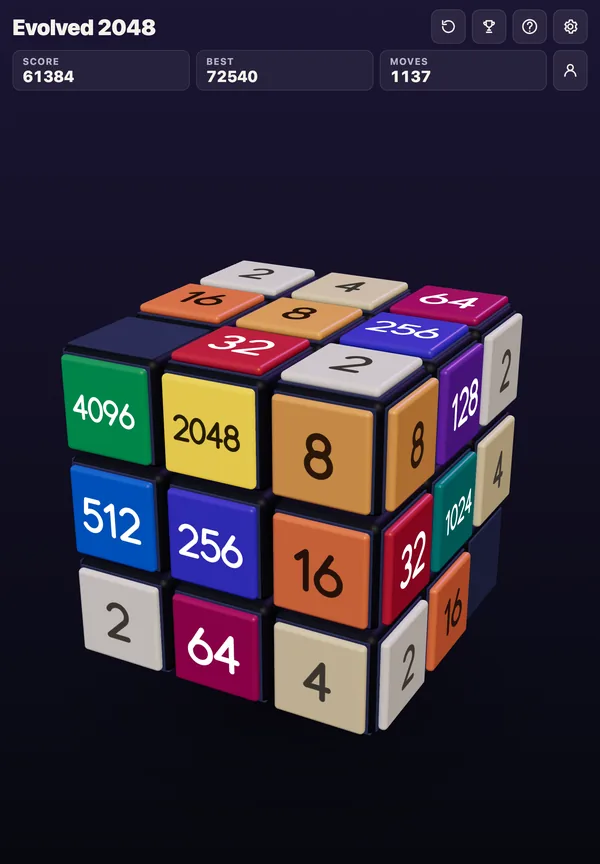
No. It is a 2048 puzzle on a cube you turn like a Rubik's cube, where you merge equal tiles. It does not teach you to solve the cube.
Get started
Want to see turns doing a different job? Play Evolved 2048: it is free and plays in your browser. Slide the front face, twist a row to carry tiles round from the other faces, and turn the whole cube to use its other sides.
The 2048 puzzle on a Rubik's cube, and past 2048.
Visit evolved2048.vlvd.net↗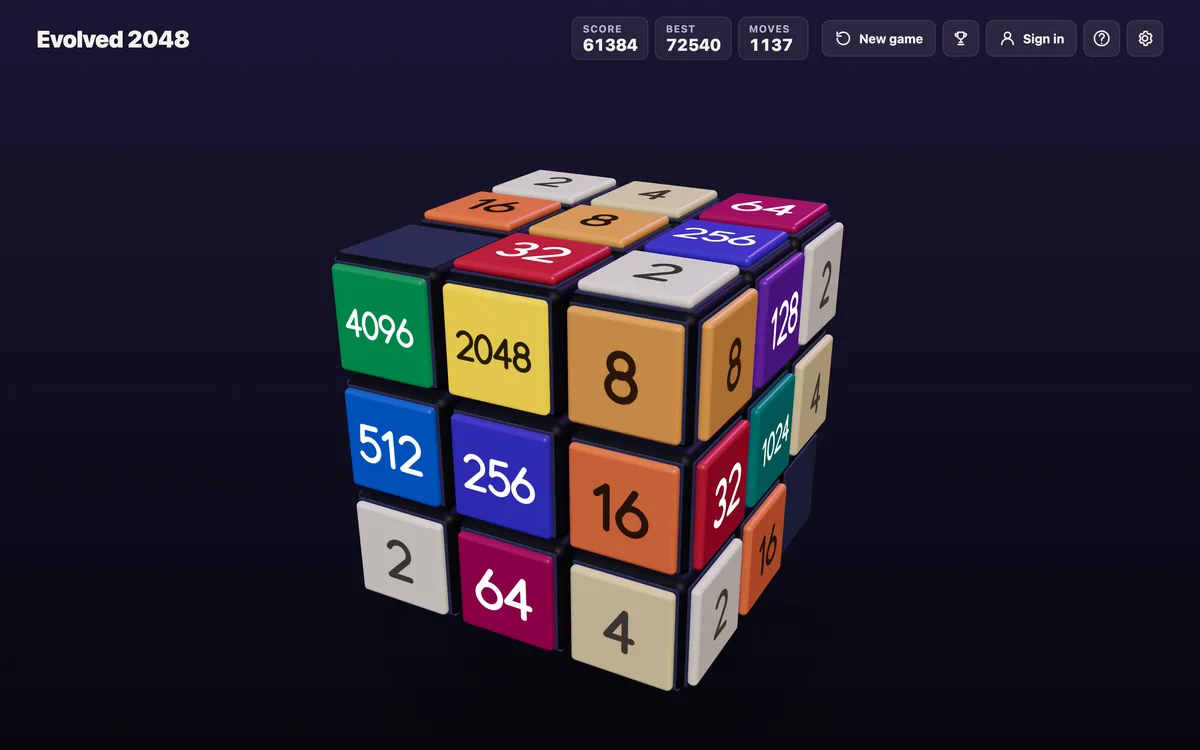
Comments
No comments yet.
Sign in or make an account to comment.