Stoic Exercises for Anxiety: 6 Practices to Try
Anxiety often looks ahead, and the Stoics spent a lot of time on the future. If you are looking for Stoic exercises for anxiety, six old practices are worth trying: sorting what is up to you, rehearsing what could go wrong, small doses of discomfort, an evening review, remembering death with a wider view, and tying each worry to a value. This article gives each one as steps you can do today. It is not medical advice, and the FAQ comes back to that.
How to Find Your Meaning is a free web app of short hands-on lessons on Stoicism, including a course on these exercises, plus a daily Stoic practice that puts several of them into one routine. You sign in with your email and an emailed code.
Stoic exercises for anxiety: how the Stoics saw it
The Stoics did not treat anxiety as a flaw to hide. They treated it as a habit of judgement you can examine. In the Enchiridion, Epictetus writes: "Men are disturbed, not by things, but by the principles and notions which they form concerning things" (Carter translation). Anxiety usually lives in those notions: "this will go badly", "I could not cope", "everyone will see".
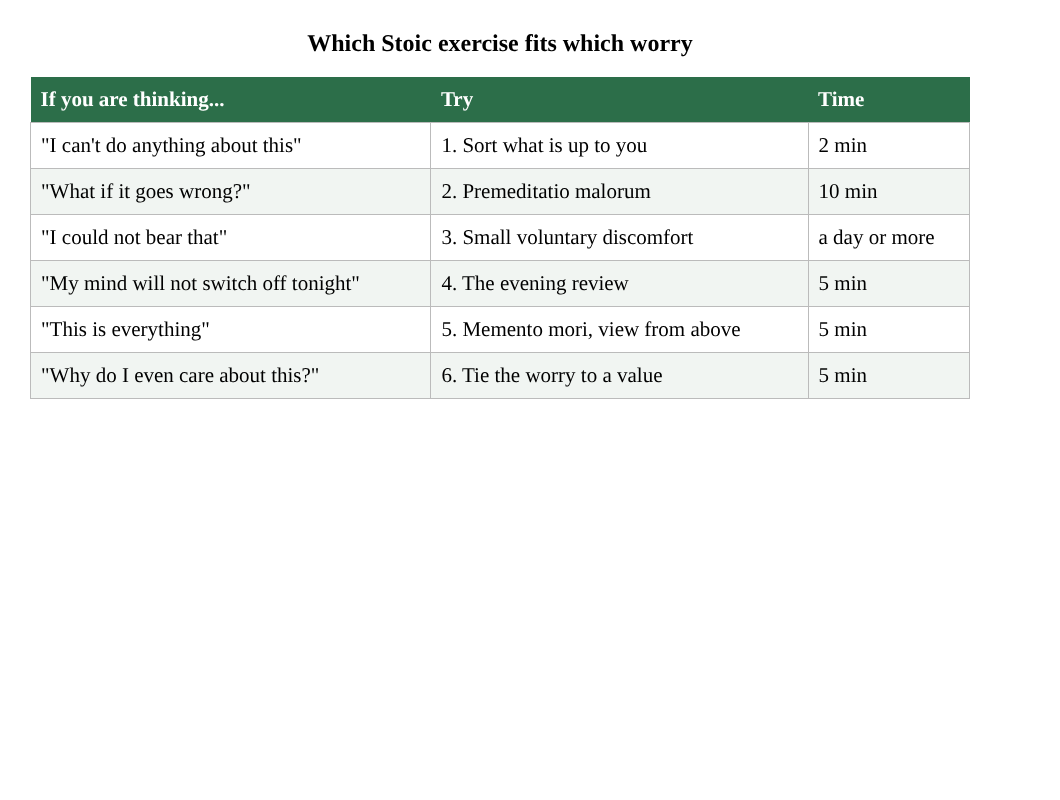
Reading about this is easy. Doing a five-minute check at 7 a.m. when your chest is tight is harder, and it is what trains you. Each practice below is short and needs only a pen. The table shows which one to reach for first.
Exercise 1: Sort what is up to you from what is not
This is the base of the others. Write the worry in one line, then split a page in two columns: what you control, and what you do not. My post on things you can't control goes deeper on this one.
Worked example. Worry: "My presentation on Thursday might go badly."
- Up to you: how many times you rehearse, how clear your slides are, when you sleep on Wednesday, what you do if you lose your place.
- Not up to you: whether the audience is in a good mood, whether someone asks a hard question, what people think of you afterward.
Then pick one item from the first column and do it today. Let the second column stay on the page. You are not pretending those things do not matter. You are sending your effort to where it can act. In the app, the lesson What Is Up to Us walks through this idea.
Exercise 2: Premeditatio malorum, rehearsing what could go wrong
The Latin name means "forethought of evils". Seneca states the idea in Letter 91: "nothing ought to be unexpected by us. Our minds should be sent forward in advance to meet all problems, and we should consider, not what is wont to happen, but what can happen" (Gummere translation). It sounds gloomy, but done as a plan it can be calming, because a vague dread gets replaced by specific next moves.
Try it in three steps:
- Name the event. "I send the email asking for a raise."
- Picture the realistic bad outcomes. "They say no. They say not now. They do not answer for a week."
- For each one, write your next move. "If no, I ask what would change it. If silence, I follow up on Friday."
Stop there. The aim is a plan, not a loop. If you notice yourself replaying the same disaster, go back to step three and ask what you would actually do. The Stoic Exercises course has a lesson on this called Seeing Trouble Coming.
Exercise 3: Small voluntary discomfort
In Letter 18, Seneca suggests you set aside a certain number of days to be content with the scantiest and cheapest fare and rough dress, "saying to yourself the while: 'Is this the condition that I feared?'" He says to endure it for three or four days at a time, so that it is a test of yourself and not a hobby.
You do not need to go to that length. Pick a small, safe discomfort that touches your own fear:
- If you dread being cold or inconvenienced, take a short cool shower or skip a convenience for a day.
- If you dread awkwardness, ask a shop assistant a question you already know the answer to.
- If you dread boredom, sit for five minutes with no phone.
Keep it safe and optional, and skip it if it feels like a real threat to your health. Afterward, write one line: "I expected X. What happened was Y."
Exercise 4: The evening review
The app's daily practice ends with three questions Seneca learned from Sextius:
- What bad habit did I cure today?
- What fault did I resist?
- In what way am I better?
For anxiety, the review does two jobs. It closes the day, so the unfinished loop has less to feed on at night. It also makes you look at what you did, not what your worry said you would do. Maybe you spoke up in a meeting even though your stomach turned. That counts as a fault resisted. Write it down, even in one line.
Keep the review calm, not harsh. If you missed something, note it and name tomorrow's fix. The Morning and Evening Review lesson shows how the pair fits together.
Exercise 5: Memento mori and the view from above
These two exercises change the scale of a problem. Memento mori means "remember you will die". It is not meant to frighten you. It asks what deserves your attention while you have it, and many small worries look smaller from there. The app's Memento Mori course includes Seneca's On the Shortness of Life.
The view from above comes from Marcus Aurelius, who tells himself to "look down from above on the countless herds of men and their countless solemnities" (Meditations 9.30, Long translation). Picture yourself rising slowly above your street, your city, then the whole earth. Where is your worry on that map?
A five-minute version:
- Sit still and name the worry.
- Picture yourself from the ceiling, then from the sky, then from far out.
- Ask: "Will this matter in a year? In ten?" and "What do I want to be doing with my time anyway?"
Some worries will still matter, and that is fine. The exercise is not meant to dismiss them. It helps you see which ones deserve action and which are noise.
Exercise 6: Tie each worry to a value
Behind most worries is something you care about. A fear of a hard conversation often sits on top of a wish to be fair or honest. Naming the value turns the worry into a question about how you want to act.
The Stoics list four virtues: wisdom, justice, courage and temperance. Use them as prompts:
- Wisdom: What is the clear-headed thing to do here?
- Justice: What do I owe the other people involved?
- Courage: What is the step I am avoiding?
- Temperance: What would be too much, or too little?
Worked example. Worry: "My sister will be upset if I say I cannot host this year." Value: justice, and honesty. Action: call her this week, say it plainly, and offer something you can do instead. The outcome is not up to you, but how you act is.
Putting them together. You can use all six on a rotating basis, or fold the core of them into one short pattern. The app's daily Stoic practice has three steps and takes about ten minutes in all:
- Morning: a question for the day ahead and one of the four virtues to practise.
- During the day: a short passage from Epictetus, Marcus Aurelius or Seneca, and one thing to try that day.
- Evening: the three questions above.
Doing all three in a day keeps your practice streak. You can keep notes on each day of the practice, and on any course or lesson, all in one place, so it is easy to look back and see which worries kept coming and which faded. If you would rather do it on paper, copy the structure. It works the same way.
Frequently asked questions
Do Stoic exercises replace therapy for anxiety?
No. They are habits of thought and action, not treatment. If anxiety is getting in the way of sleep, work or daily life, talk to a doctor or a qualified mental health professional about your own case.
How long until Stoic exercises help?
There is no reliable timeline, and results differ between people. Some find a single review or sorting exercise steadies them that evening, but treat them as practice that builds over weeks rather than a quick fix.
Can negative visualization make anxiety worse?
It can if you replay the worst case without a plan. Keep it short, picture realistic outcomes, and write your next step for each. If it feeds the worry instead of easing it, stop and use one of the other exercises.
What is the easiest Stoic exercise to start with?
Sorting what is up to you from what is not. It takes two minutes, needs no preparation, and gives you one concrete action to take.
Get started
Pick one worry you have right now and sort it into two columns. Tonight, ask Sextius's three questions before bed. If you want the lessons and the daily practice in one place, open How to Find Your Meaning. The lessons are free with an account, and the get the app page shows how to install it free, straight from the site, on your phone or computer.
Find what your life is for.
Visit findyourmeaning.vlvd.net↗

Comments
No comments yet.
Sign in or make an account to comment.