Study group problem solving: keep one shared map
A good study session can crack a question nobody could do alone. Then a week later, the same question turns up on a past paper and nobody remembers how it was done. Study group problem solving works better when the group keeps one shared map: each problem you got stuck on, every approach you tried, and what happened. This guide gives you a simple routine for each session and a worked example you can copy.
Why study group problem solving goes better on one shared map
Most study groups keep their work in four notebooks, a group chat and somebody's memory. That causes three problems:
- The answer leaves with one person. Whoever wrote it down has it. Everyone else has a vague idea.
- The wrong turns vanish. The group spent twenty minutes on an approach that did not work, and nobody wrote down why. Next time, someone tries it again.
- Stuck points blur together. "I do not get chapter 5" is hard to help with. "I get half the mark scheme's answer on question 7" is easy.
One shared map fixes all three. Every member sees the same record of what was tried, and the record outlasts the session. The same idea works for a team at work; see how to share problems and solutions with your team.
Before you meet: everyone writes where they are stuck
Ask each person to bring one or two problems, written in one line each, before the session starts. The line should say exactly where they got stuck, not just which topic:
- Too vague: "Projectiles."
- Useful: "Past paper Q7: we get 6.2 m, the mark scheme says 12.4 m."
A one-line problem with a number or a quote in it gives the group something to check. If a problem is too big to fit on one line, split it first; our guide on breaking a big problem into smaller problems shows how.
In the session: one problem, every approach, an honest outcome
Pick the problem that the most people are stuck on. Then work through it like this:
- Each person suggests one approach. Write every suggestion down before anyone tries one.
- Try one at a time. If you change two things at once, you will not know which one fixed it.
- Record the outcome. Worked, partly or failed, with a short reason. "Answer barely moved" is a reason.
- Ask how you know. The Lean Enterprise Institute says that in problem solving, everything claimed should rest on verifiable facts, not assumptions, and it stresses the question "How do you know that?" (Lean Enterprise Institute, Problem Solving). In a study group, that means showing your working and checking it against the mark scheme, not agreeing because it sounds right.
Pick one person to keep the map each session, and take turns. That way nobody has to take notes every week, and nobody is the only one who knows the answers.
A worked example: question 7 on a past paper
Here is a made-up physics study group of four, to show the shape.
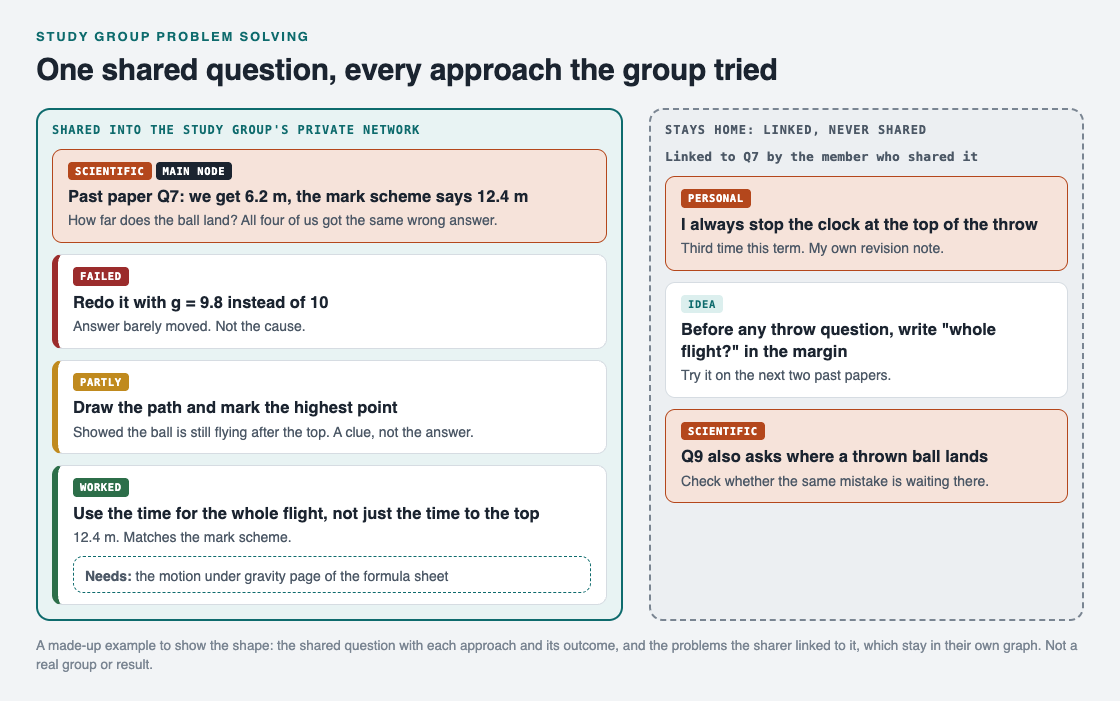
The shared question with each approach the group tried, and the sharer's own linked notes, which stay home.
- The problem. "Past paper Q7: we get 6.2 m, the mark scheme says 12.4 m." The question asks how far a thrown ball lands. All four got the same wrong answer, which is a clue in itself: it is a shared mistake, not a slip.
- First approach: redo it with g = 9.8 instead of 10. The answer barely moved. Outcome: failed. Not the cause.
- Second approach: draw the path and mark the highest point. The drawing showed the ball still flying after the top, while the group's working had stopped the clock there. Outcome: partly. A clue, not the answer.
- Third approach: use the time for the whole flight, not just the time to the top. The answer came out at 12.4 m, matching the mark scheme. Outcome: worked. Its requirement: the motion under gravity page of the formula sheet.
The failed approach stays on the map with its reason. Before the exam, the group reads its failed and partly approaches as a list of traps. As Problem Graph's home page puts it, a solution that failed "stays on the map as a failed solution, and that is exactly what the next person needs to know."
Keep the mistakes: they are your revision list
A study group's best revision notes are often its wrong turns. A textbook shows the right method. Your map shows the mistakes your group actually made, and how you found your way out.
Two habits make this work:
- Link each person's own pattern to the shared problem. The member who kept the map that week also wrote a private note: "I always stop the clock at the top of the throw. Third time this term." It is linked to Q7 but kept to themselves.
- Look for the same trap elsewhere. Q9 also asks where a thrown ball lands, so it went on the map as a linked problem to check with the same fix.
If you keep a problem solving journal for your own study, those private notes fit straight into it.
Share the map with your study group in Problem Graph
Problem Graph was built for a shared record like this, and its home page names study groups as one of the groups it is for.

The three ways to share, from Problem Graph's home page.
- The person keeping the map writes the question in one line and puts it in a lane; a physics question fits the scientific lane.
- Each approach goes in as a solution with its outcome: worked, partly or failed. The formula sheet page goes in as a requirement of the approach that worked.
- They mark the question as a main node and share it into the group's private network. Its solutions, their outcomes and the requirements they need go along. In the home page's words: "A team, a family, a study group. Members see it; nobody else does."
- The private note about stopping the clock is only linked to the main node, so it stays home, like the rest of that person's graph.
- To set it up, one of you creates a network and gives the others the invite code. The app's text notes that anyone with the invite code can join, so keep it inside the group.
Each member creates an account with a username and a password, and it works on your phone. In the app, a filter by Mine, Network and All shared lets you switch between your own problems and the group's.
Frequently asked questions
What is study group problem solving?
It is a group working through problems that its members are stuck on, trying one approach at a time and checking each one together. Keeping a shared record means the group does not lose what it worked out.
How do you run a study group session?
Have everyone bring one or two problems written in one line, pick the one most people are stuck on, and try one approach at a time. Record each outcome and take turns keeping the notes.
Should a study group write down wrong answers?
Yes. A wrong approach with the reason it failed is a trap the whole group now knows to avoid, which makes it useful revision before an exam.
Can people outside the study group see our shared problems?
Not in a private network in Problem Graph: members see a main node shared there, and nobody else does. Anyone with the invite code can join, so share the code only with your group.
Get started
Before your next session, ask everyone to write the one question they are most stuck on in a single line, with the number or step where it goes wrong. Start with the one most people share.
Try Problem Graph: it is free, and you can look around the public network without an account. Write one problem down in a line and attach the first thing you will try.
Comments
No comments yet.
Sign in or make an account to comment.