Symbol grounding problem: can AI know what words mean?
The symbol grounding problem asks how a word gets its meaning from the world, and not only from other words. It sits at the centre of a question people keep asking about AI: can a program know what words mean, or does it only shuffle marks by rules? This post sets out the problem as Wikipedia's article on it describes it, the idea behind it, what would count as a fix, and the doubts that remain.
What is the symbol grounding problem?
Wikipedia calls it a concept in artificial intelligence, cognitive science, philosophy of mind and semantics. It addresses the challenge of connecting symbols, such as words or abstract representations, to the real-world objects or concepts they refer to. In short, it is about how symbols acquire meaning in a way that is tied to the physical world.
The name comes from a 1990 paper by the cognitive scientist Stevan Harnad. The article quotes him putting the problem several ways. One is how to make the meaning of a formal symbol system "intrinsic to the system, rather than just parasitic on the meanings in our heads". Another is how you can ever get off "the symbol/symbol merry-go-round".
Harnad's "symbol system" is a set of arbitrary physical tokens, such as scratches on paper, holes on a tape or events in a digital computer, that are manipulated by explicit rules. The rules are themselves made of tokens. The tokens are handled by their shapes, not by what they stand for.
The dictionary loop
The article gives a plain picture of the trouble. Suppose you try to look up a word you do not understand in a dictionary of a language you do not already understand. You would cycle endlessly from one meaningless definition to another. Your search for meaning would be "ungrounded".
The words in your own head that you do understand are different. They are grounded. That mental grounding is what connects the words on a page you read to the things they refer to. Without a mind doing that work, the article says, there is no connection at all between written symbols and what they were meant to refer to.
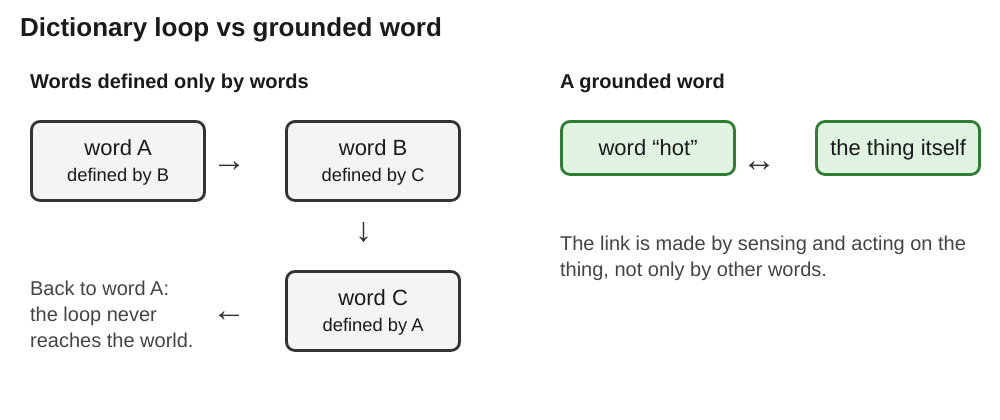
The question for AI follows at once. A program is a symbol system. If every symbol it holds is defined by other symbols, where is the exit from the loop?
Referents and meaning are not the same thing
The article draws a distinction that helps here. A referent is the thing a word or phrase refers to, as distinguished from the word's meaning. It gives an example. "Tony Blair", "the prime minister of the UK during the year 2004" and "Cherie Blair's husband" all have the same referent, but not the same meaning.
So grounding has two parts. A system would need to pick out the right things in the world, and it would need a meaning that goes with that picking out. Wikipedia notes that the problem of meaning is itself tied to the problem of how mental states are meaningful, and so to the problem of consciousness. That is why people argue about it for decades.
The article also mentions the 19th century philosopher Charles Sanders Peirce, whose model of signs needs an interpreter, a sign and an object. Some have read him as addressing grounding, and the article says AI researchers have taken up his theory of signs in this context in recent years.
The link to the Chinese Room
Harnad says the problem is exemplified in John Searle's 1980 Chinese Room argument. In the article's words, the problem is the problem of "intrinsic meaning (or 'intentionality')" that Searle raised. In Searle's example, "formal" just means the symbols can be identified entirely by their shapes.
If you have not met the thought experiment, our post on the Chinese room argument walks through it. The two ideas travel together. Searle's room shows a system that handles symbols by their shapes. The grounding problem asks what is missing from such a system and what could supply it.
What would grounding take?
Harnad suggests two properties the brain has that a static page, or usually even a computer, lacks. The first is the capacity to pick out the referents of symbols. The second is consciousness.
On the first, the article says a symbol system would have to be augmented with nonsymbolic, sensorimotor capacities: the ability to interact on its own with the objects, events, actions, properties and states that its symbols refer to. Its sensorimotor interactions would have to fit coherently with how the symbols are interpreted. A connection that depends only on the brains of outside interpreters, like us, does not count.
This leads Harnad from the pen-pal Turing test, which is purely symbolic, to a robotic Turing test that is part symbolic and part sensorimotor. Meaning is grounded in the robotic capacity to detect, categorize, identify and act on what words refer to. Our post on the Turing test covers the original version.
How new words get grounded
The article explains how the categories behind words are built. To categorize is to do the right thing with the right kind of thing. The system needs feature detectors that tell members of a category from non-members, and these are either inborn or learned. Learning can come from trial and error with feedback, or, in humans, from verbal descriptions.
There is a catch. A description can ground a new category name only if the words in the description are themselves already grounded category names. According to Harnad, grounding therefore has to be sensorimotor in the end, or the chain of definitions would never stop. A word can be grounded second hand, but only from words that are grounded first hand.
Other views in the article
The article does not present one verdict. It mentions procedural semantics, in which, in one summary, the meaning of a noun is a procedure for recognizing or generating instances, the meaning of a proposition is a procedure for deciding whether it is true, and the meaning of an action is the ability to do it or tell if it has been done.
It also notes a narrow case. If the symbols refer to the very bits of 0 and 1, directly tied to their electronic implementations, then even a non-robotic computer can detect, categorize and act on them. In that narrow domain, it says, computers could be said to ground symbols.
On consciousness, Harnad says explaining how it could play an independent role in picking out referents is probably insoluble. He leaves open whether grounding alone is enough to make conscious meaning present: perhaps, perhaps not.
Try it yourself: follow a definition chain
Here is a worked example you can do in ten minutes. It shows the loop, then the exit.
- Pick a word from a field you do not know, such as a term from a language you cannot read or a technical word.
- Look it up in a dictionary of that same language or field. Write down each unfamiliar word in the definition.
- Look up each of those. Keep a list and stop when a word shows up that you already looked up.
- Count how many steps you took before you hit a repeat. That is the loop.
- Now find one word on your list that you can tie to something you have seen or done. That word is your exit. Everything built on it is grounded through you.
The point is the last step. The dictionary never supplied the exit. You did. The grounding problem asks whether a machine can supply its own.
Why it matters for AI
The Wikipedia article is about the idea, not about any one system, and it does not rule on whether today's AI has grounding. What it gives you is a question to ask of any system: what are its symbols connected to, and who made the connection? A connection that exists only in the heads of the people reading the output is what Harnad calls parasitic.
That question also helps when you read claims about AI. A system that talks fluently shows that it handles symbols well. Whether it picks out their referents by its own means is a separate matter. For another angle on why capabilities that look hard can be easy and the reverse, see Moravec's paradox, and for why a system's inner workings are hard to read, see Explainable AI.
Frequently asked questions
What is the symbol grounding problem in simple terms?
It is the problem of how symbols, such as words, get their meaning from the real world instead of only from other symbols. A dictionary that defines words with other words never reaches the things themselves.
Who named the symbol grounding problem?
Stevan Harnad, in his 1990 paper "The Symbol Grounding Problem". Wikipedia says he links it to John Searle's 1980 Chinese Room argument.
Does grounding need a robot?
Harnad argues grounding has to be sensorimotor in the end, which points to a robotic test. The article also notes a narrow case in which a computer could ground symbols that refer to its own bits, so the answer depends on what the symbols are about.
Is grounding the same as consciousness?
No. Harnad treats them as two separate properties the brain has. He leaves open whether grounding alone would be enough for conscious meaning.
Get started
If you would like to explore AI risk as fiction after the theory, play Contain ASI: a story strategy game for 1 to 4 players that runs in your browser and needs WebGL 2. Chapter 1, Before ASI, starts in January 2024 with four fictional AI labs in one race, and you try to keep every lab from crossing into recursive self-improvement before 2027. All its labs, people and events are fictional, and it is inspired by the AI 2027 scenario. It is a game, not a forecast, and it is not a course.
For the source, read Wikipedia's article on the symbol grounding problem.
Comments
No comments yet.
Sign in or make an account to comment.