Tank game upgrades: what to pick after each wave
Tank game upgrades decide how far a run goes. In a wave survival game you get a short list of choices after every wave, you can only take one, and the wrong one can leave you short of firepower when the boss arrives. This guide works through every upgrade in Tank City Zero Day, a free tank game that plays in your browser, using the numbers from the game's own code.
You will see how the three cards are drawn, what each upgrade really does, a worked example that counts how fast the first boss falls with different picks, and a pick order you can follow.
How tank game upgrades work in Tank City Zero Day
Tank City Zero Day describes itself as "Tank City, modernized: 8-way moves, dashes, upgrades and a boss every fifth wave." After you clear a wave, Patch Tuesday offers upgrade cards named for real computer ideas. You choose one with up and down, then press Fire.
The code adds three rules the page does not spell out:
- Upgrades last the whole run. They stay through every wave and only reset when you start a new game.
- Each upgrade has a limit. Once an upgrade reaches it, it stops appearing.
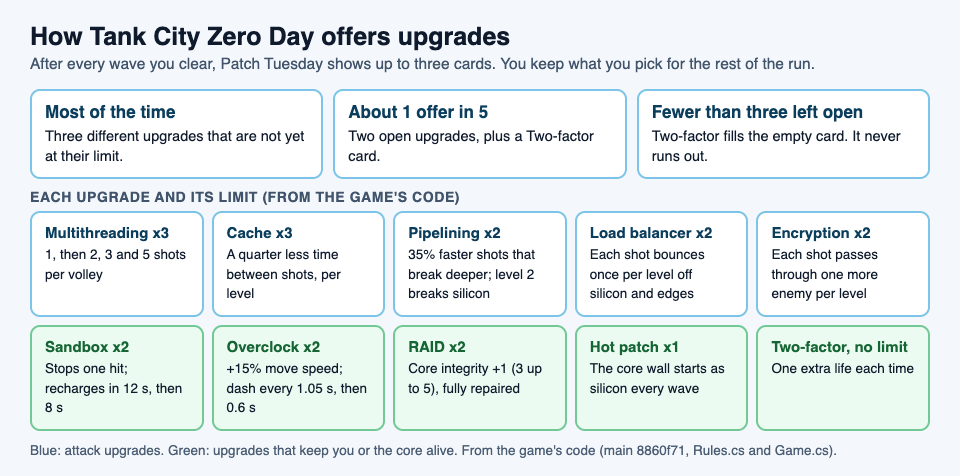
- The cards are random, but not quite. Most of the time you see three different upgrades that are not at their limit. About 1 offer in 5 draws only two of them and adds a Two-factor card. Two-factor never runs out, so it also fills the gap late in a run when fewer than three upgrades are left open.
Because you cannot count on seeing a given card, a good plan is a priority list, not a fixed order.
Attack upgrades, in numbers
Five upgrades change your shots. Every shot that hits an enemy takes away 1 hit point, so more shots that land means faster kills.
- Cache (up to 3 levels). The card says "Fire 30% faster." In the code, each level cuts the wait between shots by a quarter: 0.3 seconds, then 0.225, then about 0.17, then about 0.13.
- Multithreading (up to 3). More shots per volley, in a spread: 1 shot, then 2, then 3, then 5. The spread widens as it grows, up to 20 degrees either side, so at long range the outer shots can miss a single target.
- Pipelining (up to 2). Shots fly 35% faster and break one more layer of wall. Level 2 also breaks silicon, which otherwise stops every shot.
- Load balancer (up to 2). Each level gives every shot one bounce off silicon or the edge of the arena. Firewall still breaks and stops the shot.
- Encryption (up to 2). Each level lets a shot pass through one more enemy before it stops.
Defense upgrades, in numbers
The other five keep you or the CPU core alive.
- Sandbox (up to 2). A shield that stops one hit, then recharges in 12 seconds, or 8 at level 2.
- Overclock (up to 2). You move 15% faster per level, and the dash recharges in 1.05 seconds, then 0.6, instead of 1.5. You cannot be hit mid-dash.
- RAID (up to 2). The core's integrity goes up by 1, from 3 to as much as 5, and is repaired in full.
- Hot patch (once). The wall around the core is built as silicon at the start of every wave.
- Two-factor (no limit). One extra life each time.
Defense also protects your score. Losing a life resets your kill chain, which can multiply points by up to 8, and the bonus for clearing a wave is 250 times the wave number times the share of core integrity left.
A worked example: how fast does the first boss fall?
The boss of wave 5 takes 40 hits. You get four picks before it arrives, one after each of waves 1 to 4. Here is the most it can take per second under three builds, if you hold Fire and every shot lands.
- No attack upgrades. One shot every 0.3 seconds is about 3.3 shots a second. The boss needs about 12 seconds of steady hits.
- Cache 1 and Multithreading 1 (two picks). Two shots every 0.225 seconds is about 8.9 a second. The boss needs about 4.5 seconds.
- Cache 2 and Multithreading 2 (all four picks). Three shots every 0.17 seconds or so is about 17.8 a second. The boss needs about 2.3 seconds.
Two lessons come out of this. First, Cache and Multithreading multiply each other, so splitting picks between them beats stacking one: Cache 3 with Multithreading 1 gives about 15.8 shots a second, less than the even split. Second, those are best cases. The boss moves, shots fly in a spread, and you will be dodging, so real numbers are lower. That is why the third build is worth having, even though the second already looks fast on paper.
Notice what the example leaves out: all four picks went to attack, with no Sandbox, RAID or extra life. That is the trade you make every time you choose.
Upgrades that work well together
Some pairs are worth more than their parts, and the code shows why.
- Load balancer and ransomware. Ransomware arrives from wave 3, and its shots lock firewall into silicon. More silicon on the field means more walls your bouncing shots can use.
- Pipelining 2 against that same silicon. If ransomware has sealed a path, level 2 shots break through it.
- Encryption against groups. Botnet drones come in threes and hunt you, and a worm splits in two when destroyed. A shot that passes through one more enemy can hit two of them.
- Multithreading with Load balancer. A wide spread sends some shots into walls; bounces send them back into play.
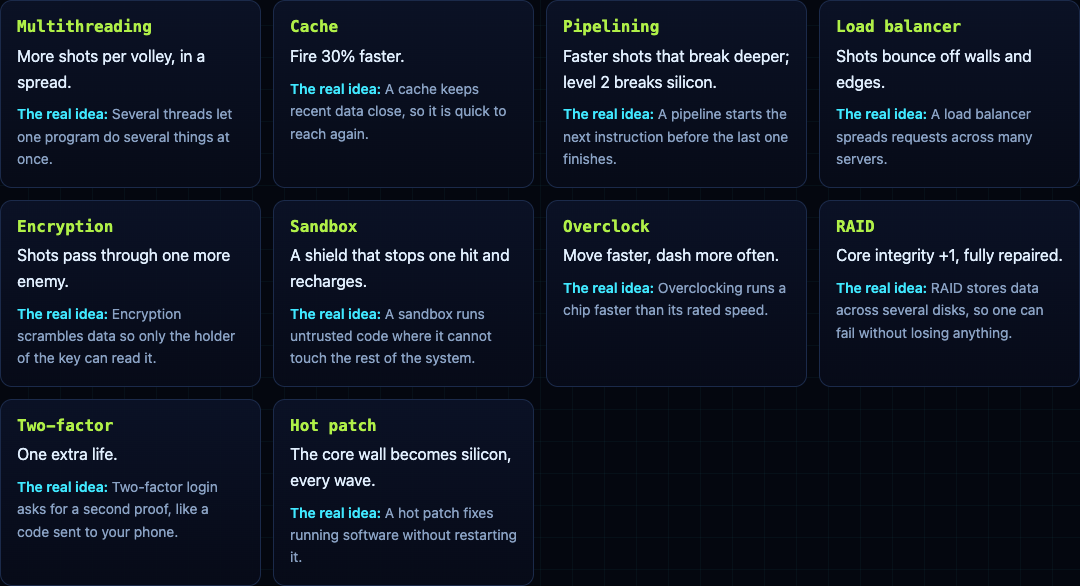
The load balancer name is not random, by the way: each card names a real computer idea and explains it in one line. The multithreading and CPU cache posts explain the ideas behind the two strongest attack cards.
A pick order to follow
This is one plan, built from the numbers above. Adjust it to how you play.
- Picks 1 and 2: Cache and Multithreading, one of each if offered. They raise every shot you fire from then on.
- Picks 3 and 4: keep building attack before wave 5, another level of Cache or Multithreading, or Encryption if drones keep catching you. The boss needs 40 hits.
- Once the core takes damage: RAID. It repairs the core in full and raises its integrity, which also lifts every wave bonus after.
- When shots stop reaching enemies: Pipelining or Load balancer. Pipelining 2 for silicon in the way, Load balancer if the arena has walls to bounce off.
- When you keep losing lives: Sandbox or Overclock. A shield that stops one hit, or a faster dash to slip through shots.
- Two-factor whenever nothing else on the list fits. An extra life is never wasted.
For the threats you will meet wave by wave, and how to fight the boss, see our guide to surviving the boss waves.
Frequently asked questions
What is the best first upgrade in Tank City Zero Day?
Cache or Multithreading. Both raise how many shots you put out per second for the rest of the run, and together they multiply.
Do upgrades carry over between runs?
No. Upgrades last until the run ends and reset when you start a new game. The game only remembers your best score, in that browser.
Why do I keep seeing Two-factor?
About 1 offer in 5 shows only two upgrades plus Two-factor. Late in a run, when most upgrades are at their limit, Two-factor fills the empty cards because it never runs out.
How many times can I take each upgrade?
Multithreading and Cache three times; Pipelining, Load balancer, Encryption, Sandbox, Overclock and RAID twice; Hot patch once; Two-factor as often as it appears.
Get started
Play Tank City Reboot: it is free, plays in your browser on a computer or a phone, and needs no account. Then open Tank City Zero Day and try the pick order on your next run.
Comments
No comments yet.
Sign in or make an account to comment.