Trebuchet vs mangonel: what is the difference?
Trebuchet vs mangonel is a question with a messy history, because the people who wrote about these machines in the Middle Ages did not use the names as neatly as a textbook would like. Even today, two careful sources can describe the same picture with different words. There is still one simple test that separates them: what makes the throwing arm swing.
This guide sets out how English Heritage and the Royal Armouries each describe the two machines, gives you that test, and follows the siege of Kenilworth in 1266, where the stone shots have been dug up and weighed. At the end it shows how the free browser game Two Towers puts one machine on each side of the gate.
Why the names get mixed up
Look at the captions on English Heritage's guide to medieval siege warfare. One manuscript picture from around 1250 is captioned "a mangonel, or traction trebuchet". Another shows "a mangonel or perrier" being made ready to fire. So the same machine can be called a mangonel, a perrier, a petraria or a traction trebuchet, depending on who is writing.
Two Towers says the same thing in one line on its Mangonel card: "Medieval writers called several stone-throwers mangonels; many were swung by teams of men hauling on ropes." If you have seen the words used for different machines in different books, that is why.
English Heritage also warns that few medieval sources describe or draw these machines in detail. Treat the definitions below as the best reading of the evidence, not as blueprints.
The mangonel: a beam swung by people
English Heritage describes the mangonel as a stone-throwing catapult powered by people. It works like this:
- A wooden beam, the throwing arm, pivots between two upright A-frames.
- The short end of the beam has several ropes hanging from it.
- The long end has a sling holding the stone, usually a large rounded one.
- One or more people pull down sharply on the ropes. The beam rotates, the sling rises, and the stone flies.
The power comes from muscle, so the size of the stone depends on how many people you can put on the ropes. In the manuscript picture, one man tensions the sling while the operators' ropes hang at the other end.
The trebuchet: a beam swung by a falling weight
The counterpoise trebuchet keeps the same beam and sling and changes only the power. English Heritage says human power was replaced by a wooden box filled with heavy weights at the short end of the arm. A mechanical winch raised the box high; when it was released, it dropped and swung the beam. English Heritage calls it the most powerful stone-throwing catapult.
The Royal Armouries' Hundred Years' War pages describe it the same way: powered by gravity, working in a see-saw motion with the sling and stone at one end and a counterweight at the other. They add why it won out. It generated more force, threw further and more accurately, and could throw bigger boulders. They call it the most common siege engine of the Hundred Years' War.
Trebuchet vs mangonel: the one test that works
When the names fail you, ask what swings the arm. The Royal Armouries notes a third answer too: most catapults were powered by torsion, a twisted rope held taut and then released.
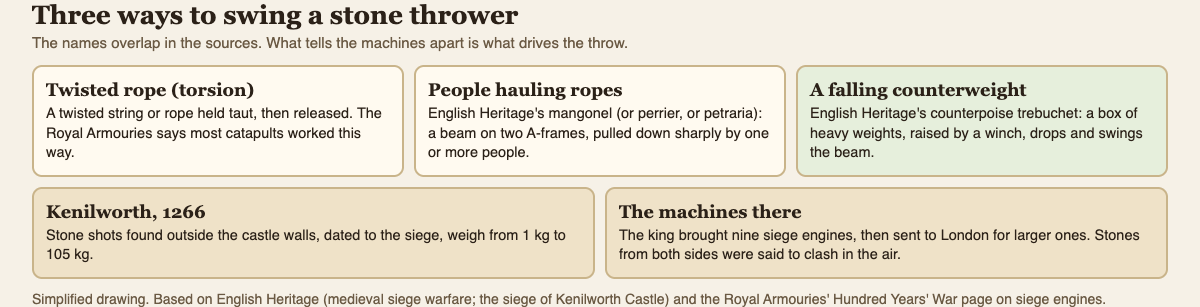
Three sources of power. The names overlap; the power source does not.
- People pulling ropes: what English Heritage calls a mangonel, perrier or petraria, and what some captions call a traction trebuchet.
- A falling box of weights: the counterpoise or counterweight trebuchet.
- Twisted rope: a torsion machine, which the Royal Armouries says powered most catapults.
So when someone says "trebuchet", check whether they mean the counterweight kind. If they do, it is the bigger, stronger machine. If the arm was pulled by people, it is the machine most sources call a mangonel, whatever the caption says.
A worked example: Kenilworth, 1266
English Heritage's account of the siege of Kenilworth Castle is useful here because the stones themselves survive. Follow it step by step:
- The defenders are ready. The garrison, over 1,200 men, women, children and servants, had food for months and siege engines that a chronicler called "hitherto unheard of among us and unseen".
- The king arrives. Henry III brought 2,000 wooden hurdles to shield his men, 60,000 crossbow bolts and nine siege engines. The siege began on 25 June 1266.
- The duel. The king's stone throwers, set up all around the castle, kept up a continuous stream of missiles. But the weapons inside had the longer range. One chronicler described stones from the two sides "clashing in the air".
- Bigger machines. Outranged, the king had to send to London for larger machines.
- What was left behind. Excavations outside the walls found eight shots dated to the siege, from 1 kg to a massive 105 kg. An illustration on the same page shows a simple counterpoise engine, "like the larger trebuchets probably used at Kenilworth in 1266".
Notice the word "probably". The shots prove that big stones were thrown; the exact machines are the best reading of the evidence. The lesson is that range and weight decided the duel, which is exactly what a counterweight adds.
Did the stones decide sieges?
Not on their own. English Heritage's ten things about sieges says castle walls were designed to withstand these machines, and that the constant barrage mainly took a psychological toll on the people inside, though it could sometimes destroy buildings. Kenilworth and Pevensey had their own engines to throw back.
Kenilworth lasted 172 days and ended with the defenders running out of food, not with a breach. Our guide to medieval siege weapons explained covers the rest of the attackers' kit, and how castles defended against a siege covers why food mattered so much.
One on each side in Two Towers
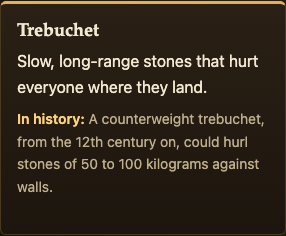
In Two Towers, a free tower defense game in your browser, the two machines are on opposite sides. You can build a Trebuchet to guard the gate. It throws slow, long-range stones that hurt everyone where they land, and its card says a counterweight trebuchet, from the 12th century on, could hurl stones of 50 to 100 kilograms against walls.
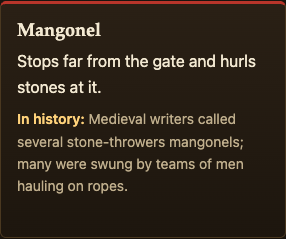
The Mangonel attacks you. It stops far from the gate and hurls stones at it, so you need range to reach it, just as Henry III did at Kenilworth.
The game gives one line of history per card, not a full account, but it makes the difference easy to remember.
Frequently asked questions
What is the difference between a trebuchet and a mangonel?
What swings the arm. A mangonel was pulled by people hauling ropes; a counterweight trebuchet was swung by a falling box of heavy weights, which made it more powerful.
Is a mangonel a kind of trebuchet?
Some sources say so. English Heritage captions one picture "a mangonel, or traction trebuchet", meaning a trebuchet pulled by people.
How heavy were the stones?
The shots found outside Kenilworth, dated to the 1266 siege, range from 1 kg to 105 kg.
When was the trebuchet first used in England?
English Heritage says the sieges of Dover in 1216 and 1217 included the first recorded use of a trebuchet in England.
Get started
Play Two Towers: it is free and plays in your browser on a computer or a phone. Put a Trebuchet beside the gate, outrange the Mangonels, and read the history line on each card as you go.
Comments
No comments yet.
Sign in or make an account to comment.