Undermining a castle: how medieval siege mines worked
Undermining a castle meant attacking it from below. Miners dug a tunnel under the wall, held the roof up with timber, then burned the timber so the wall above fell in. It was slow, dirty and dangerous work, and it brought down towers that stone throwers could not break. This post explains how a siege mine worked, step by step, and follows a famous one, at Rochester in 1215.
What undermining a castle meant
English Heritage's guide to medieval siege warfare lists the main ways to get into a castle: break through with siege engines or rams, climb over with ladders, starve the defenders out, or go underneath. Going underneath was the job of miners. Their tunnel was called a "sap" or a mine.
The idea is simple. A stone wall is heavy, and it stands because the ground under it holds. Take that ground away, and the wall comes down under its own weight. The trick was taking the ground away without the wall falling on the miners first.
How a siege mine worked, step by step
From English Heritage's description, a mine went through four steps:
- Get to the wall alive. Miners worked under cover. A manuscript from the mid 1300s shows miners protected by a wheeled shed, and at Dover in 1216 the miners were sheltered by a "cat", a hut on wheels.
- Dig the sap. The miners dug a horizontal tunnel under the foundations of the wall.
- Prop the cavity. At the end of the tunnel they cut out a large space and held its roof up with timber props, then packed it with things that would burn.
- Fire the props. They set the fuel alight. When the props burned through, nothing held the wall up, and it collapsed.
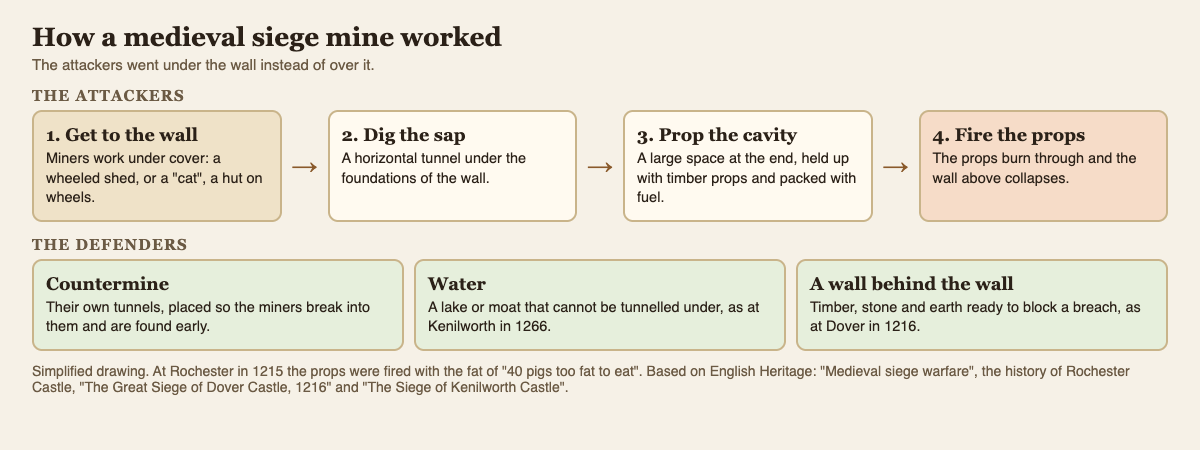
The fire was the clever part. The props let the miners work under the wall, and the wall came down only once the props had burned through.
Worked example: the mine at Rochester, 1215
Between October and December 1215, King John besieged Rochester Castle in Kent to take it back from rebel barons. The history of Rochester Castle tells the story in a few lines. Follow it as a sequence:
- Cut the castle off. The royal army broke Rochester Bridge and captured the bailey, the outer courtyard.
- Keep the defenders busy. Siege engines bombarded the rebels inside the great keep with stones.
- Dig under one corner. Meanwhile miners worked under the keep's south-east turret.
- Burn the props. To fire the timber props, the attackers burned the fat from "40 pigs too fat to eat". The south-east corner of the keep came down.
- Finish with hunger. The rebels fell back into the northern half of the keep, behind the wall that divides it in two. Starvation soon forced them to surrender.
Notice that the mine did not end the siege by itself. It broke the strongest building in the castle open, and hunger did the rest. English Heritage calls it an action of outstanding ferocity, though John's victory was short-lived: he died the following year.
You can still see the mine's mark. The description of Rochester Castle says the south-east turret is round, unlike the square turrets on the other three corners. It was rebuilt in the 1220s after the original square tower collapsed in 1215. If you visit, stand back from the keep and count the corners: the round one is where the pigs' fat burned.
Dover, 1216: a mine that broke the gate but not the castle
A year later Prince Louis of France besieged Dover Castle. English Heritage's account of the great siege of Dover describes two mines. First, under the cover of a "cat", Louis's miners got into the barbican ditch and undermined its wooden stockade. The attackers poured through and took the barbican, the outer defence in front of the gate. Then the miners tunnelled under the twin-towered stone gatehouse itself, and one of its towers came crashing down.
Here the story turns. When the French rushed the breach, they found the garrison had already built a barrier behind it, of boulders, timber cross-beams and oak posts. The defenders pushed them back hand to hand, and Louis eventually gave up the siege. A mine could open a hole, but the attackers still had to get through it. For more on the outer defence Louis took first, read what a barbican was.
How defenders fought back against miners
Defenders had three main answers, all from English Heritage's pages:
- Countermines. Defenders dug their own tunnels at strategic points, placed so that attacking miners could not avoid breaking into them. That way the miners were found before they could damage the defences.
- Water. You cannot dig a dry tunnel under a lake. At Kenilworth in 1266, the castle's water defences stopped the king's army from undermining the walls, so he tried barges hauled overland from Chester instead, and the defenders drove them off.
- A second wall behind the first. Defenders kept timber, stone and earth ready to repair breaches. Dover's barrier behind the fallen tower is that plan in action.
The best reading of the evidence is that mining worked best against a castle on dry, diggable ground, held by a garrison that was not watching for it. Medieval sources are patchy, so most of what we know comes from a few well-recorded sieges like these. For the wider picture of how a garrison held out, see how castles defended against a siege.
Sappers in Two Towers
Two Towers is a free tower defense game that plays in your browser, on a computer or a phone. You pick two towers to guard the city gate, then buy two more for the hills. Among the attackers are Sappers, and the game's text says what they do: a sapper "Digs under a hill tower to silence it".
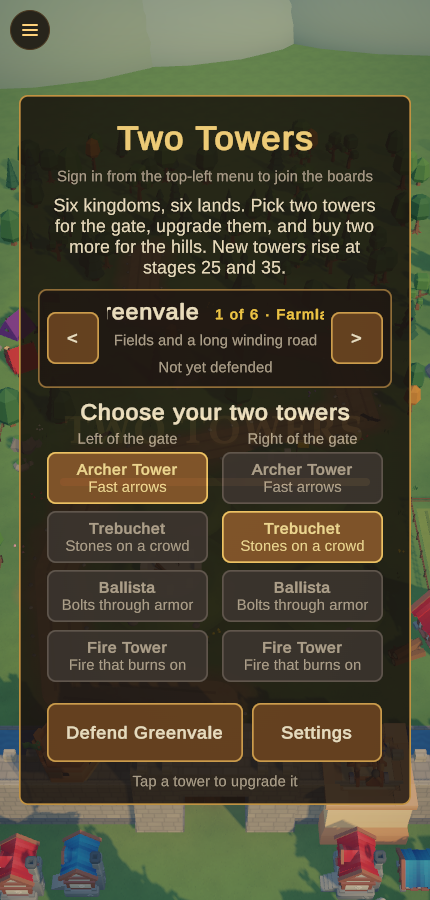
The game's own tip reads like a short version of the defenders' playbook: "Sappers dig under hill towers to silence them: Archer Volley catches them off the road, and a Bell slows the dig." In plain terms, hit them before they get to work, and slow the digging once they start. A Bell Tower rises at stage 25.
The game does not teach history, and it does not show how a real mine was dug. The history in this post comes from English Heritage. What the game does give you is the defender's problem in small: an attack you cannot see coming over the walls, which you have to catch early.
Frequently asked questions
Why did miners burn the props?
The timber props held the tunnel roof up while the miners worked. Burning them removed the support only once the miners were clear, so the wall above collapsed.
What is a countermine?
A tunnel dug by the defenders, placed so that the attackers' miners would break into it. It let the garrison find and stop a mine before it reached the wall.
Why is one turret at Rochester round?
The original square south-east turret collapsed when King John's miners fired their mine in 1215. It was rebuilt round in the 1220s.
Could every castle be undermined?
No. Water defences stopped it at Kenilworth in 1266, and a watchful garrison could dig countermines or build a barrier behind a breach, as Dover's defenders did.
Get started
Play Two Towers: it is free and plays in your browser on a computer or a phone. Build on the hills, watch for Sappers, and see how long your gate holds.
Comments
No comments yet.
Sign in or make an account to comment.