What was a barbican on a medieval castle?
A barbican was an outer defense built in front of a castle's gate, so that attackers had to fight their way through it before they even reached the gate itself. If you have seen the word on a castle's site plan and wondered what the pile of stones in front of the entrance was for, this is it.
This guide explains what a barbican was, using English Heritage's own descriptions, and walks the only way into Scarborough Castle as a worked example. It compares three very different barbicans and ends with the gate you defend in the free browser game Two Towers.
What a barbican was
English Heritage's castle glossary for schools gives a short definition: the outer defence of a castle or walled city, especially a double tower above a gate or drawbridge.
In practice, barbicans took many shapes. Some were towers in front of the gate, some were walled courtyards, and at least one was a whole extra enclosure. What they share is their job. English Heritage's description of Conisbrough Castle puts it in a phrase: a barbican was "designed to control access" and "hinder enemy attack".
Why the gate needed extra protection
A wall can be solid all the way through. A gate cannot: it has to open to let people, carts and supplies in. That made it the obvious target.
English Heritage's history of castles through time says that from the later 12th century, the focus of castle building shifted from keeps to outer defenses, meaning gatehouses and enclosure walls. Gatehouses, the most vulnerable point of the castle, often became mini-castles in their own right, with towers and barbicans guarding their approaches.
The idea is layers. An attacker who wants the gate must first take the barbican, and while doing it, they are in a narrow space the defenders have planned in advance.
A worked example: the way into Scarborough Castle
English Heritage's description of Scarborough Castle shows a barbican doing exactly that. Walk the approach from the town, step by step:

One way in. Every step is a place the defenders could stop you.
- The setting. The castle stands on a headland protected on three sides by cliffs and the sea. Only the fourth side, facing the town, can be approached by land.
- The double ditch. That fourth side has a massive double ditch.
- The great bridge. The only approach to the castle is by a great bridge across the ditch. An attacker cannot spread out; everyone has to come the same way.
- The barbican. The bridge leads to a fortified enclosure with its own towers and gatehouse. The barbican is first mentioned in 1175, and Henry III had its gate tower and bridge built in 1243 to 1245. It has since been extensively rebuilt.
- The main gate. Only after the barbican did you reach the gateway into the main castle, immediately beneath the great tower. That gateway is now lost.
Count the obstacles: ditch, bridge, barbican, gate, and a great tower above the last one. An enemy who took the barbican was still standing below the castle's strongest building.
Three different barbicans
Barbicans were built to fit each castle, so they look different from place to place. English Heritage describes three very different ones:
- Conisbrough, added later. The Conisbrough description says its gatehouse was about 8 metres square, flanked by solid semicircular towers, and that a substantial barbican was added, probably in the mid-13th century, slightly later than the walls and gatehouse. Both partly collapsed into the ditch before 1538.
- Castle Acre, a whole enclosure. At Castle Acre, a third fortified enclosure on the east, known today as the Barbican, reinforced the entrance on the more vulnerable side, the one facing open country.
- Dunstanburgh, built in from the start. The gatehouse begun in 1313 had two massive D-shaped towers. English Heritage says defense of its gate passage largely depended on the frontal barbican, which was part of the first building work. Only its footings survive, so its exact form cannot be reconstructed.
So a barbican could be an afterthought, a big extra courtyard, or part of the original design. The job was the same each time.
How a barbican fits into a castle's defense
A barbican was one layer among several. Behind it, gatehouses had their own gates and portcullises: Castle Acre's west gate, added around 1200, had a portcullis, and Dunstanburgh had one at the inner end of its gate passage. In front of it, ditches and bridges narrowed the approach.
Towns used the same ideas. Castle Acre's town had its own gatehouse, the Bailey Gate, built around 1200: a pointed archway flanked by solid semicircular turrets, behind which the gate passage could be closed with gates and a portcullis. It was approached by a timber bridge across the defensive ditch, which is now filled in.
Defenders planned for each layer to fall in turn. Our guide to how castles defended against a siege follows the siege of Dover in 1216 through each layer of its gate, and our guide to medieval siege weapons covers the rams and machines a barbican was built to keep away.
The gate in Two Towers
In Two Towers, a free tower defense game in your browser, your whole job is a single city gate. Attackers march out of the woods toward it, and if it falls, the game is over. Between attacks you can repair the gate or reinforce it with gold for more strength.
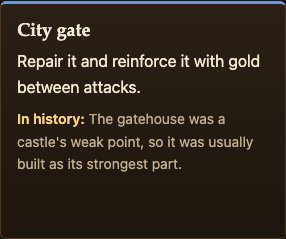
Its card says: "The gatehouse was a castle's weak point, so it was usually built as its strongest part." The attackers prove it. The Battering ram strikes the gate hardest, and Archers, Crossbowmen and Mangonels stop short of the gate to shoot at it. Your towers do the barbican's job: stop them before they arrive. The game gives one line of history per card, not a full account.
Frequently asked questions
What is a barbican on a castle?
An outer defense in front of the gate. English Heritage's glossary calls it the outer defence of a castle or walled city, especially a double tower above a gate or drawbridge.
Is a barbican the same as a gatehouse?
No. English Heritage's glossary describes a gatehouse as a room over a gate, some used as a prison or for living quarters. A barbican stood in front of the gate, as an outer defense.
Where can I see a barbican in England?
English Heritage describes barbicans at Scarborough, Conisbrough, Castle Acre and Dunstanburgh, and barbicans guarding the approach at Helmsley.
Get started
Play Two Towers: it is free and plays in your browser on a computer or a phone. Keep your gate repaired, stop the rams before they reach it, and read the history line on each card as you go.
Comments
No comments yet.
Sign in or make an account to comment.