What Are Embeddings in AI? A Plain Guide for Founders
If you have asked yourself what are embeddings in AI, here is the short answer: an embedding is a list of numbers that stands for the meaning of a piece of text, an image or a sound, so a computer can measure how close two meanings are. Texts that mean similar things get similar numbers. That one idea sits under AI search, recommendations and the way chat models read your words. To see where it fits in the bigger picture, the How Modern AI Actually Works course walks through next-token prediction, how a raw model becomes a helpful assistant, and what AI gets wrong, in three short lessons with their sources listed; sign in with your email and an emailed code to open it.
What are embeddings in AI? The one-sentence answer
An embedding turns something messy, like a sentence, into a fixed-length list of numbers, called a vector, where distance between vectors tracks difference in meaning.
Age of AI Entrepreneur teaches you how modern AI works and how to build, launch and grow a business with it, in short hands-on lessons that cite real sources, so ideas like this one turn into things you can use.
Keep the sentence above in your head. Everything below is detail on how those numbers get made and what you can do with them.
How text becomes numbers: tokens, vectors and meaning
Computers cannot compare words directly. They compare numbers. So the first job is to split text into small pieces called tokens. A token is often a word or part of a word. "Refunding" might become "refund" and "ing".
Each token then gets looked up in a table. That table maps every token to a vector, a list of a few hundred or a few thousand numbers. These numbers are not written by a person. They are learned during training, as the model gets better at its task. A well-known 2013 paper, Efficient Estimation of Word Representations in Vector Space, learned word vectors from a 1.6 billion word data set in less than a day and tested them on how well they captured similarities between words.
Here is a toy version with only three numbers per vector, so you can picture it:
- "refund" might be
[0.8, 0.1, 0.3] - "money back" might be
[0.7, 0.2, 0.3] - "weather" might be
[0.1, 0.9, 0.6]
The first two lists look alike. The third does not. Real embeddings have far more numbers and no single number has a clean label, but the principle holds: meaning becomes position.
There is one more step for most products. You usually want one vector for a whole sentence or document, not one per token. An embedding model reads the full text and returns a single vector that sums up its meaning. When people say "embed this document," that is what they mean.
Why similar ideas land close together in vector space
Picture every vector as a point in a huge space with hundreds of directions. Training pushes points around until things used in similar ways end up near each other. Words that show up in the same kinds of sentences drift together. So "invoice" sits near "bill" and far from "giraffe".
To measure closeness, most systems use cosine similarity. It looks at the angle between two vectors. A score near 1 means they point the same way, so the meanings match. A score near 0 means they have little to do with each other.
Try this worked example in your head. A customer writes: "I was charged twice, can I get my money back?" Your help center has three articles:
- "How to request a refund for a duplicate payment"
- "Changing your billing address"
- "Our office holiday schedule"
The customer never typed "refund" or "duplicate". A plain keyword search might miss article 1. But the embedding of the question lands close to the embedding of article 1, because "charged twice" and "duplicate payment" mean nearly the same thing. Cosine similarity ranks article 1 first, article 2 second, and article 3 last. That is semantic search in one example.
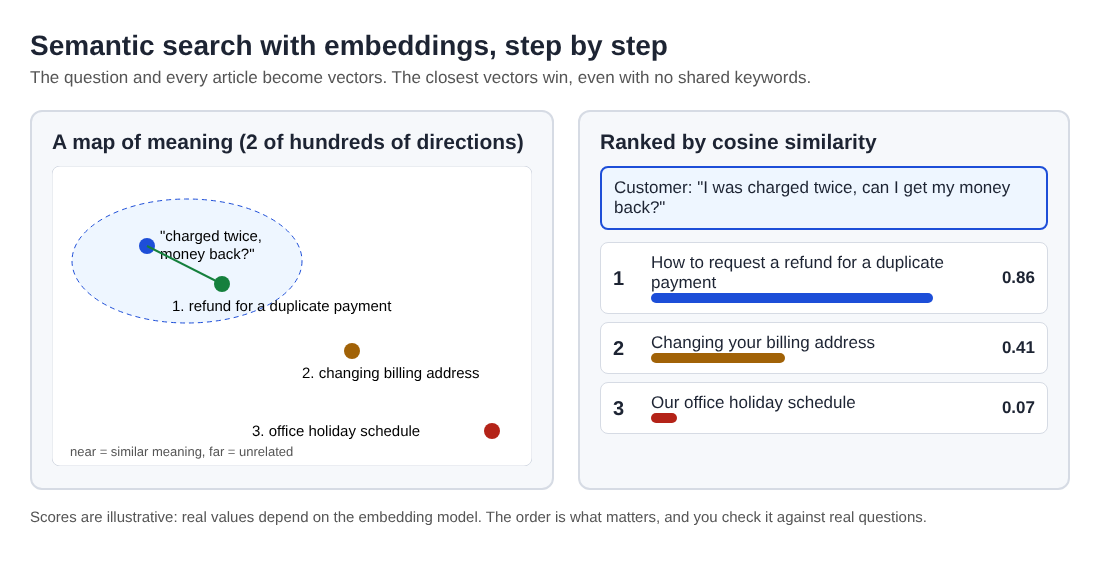
The question lands closest to the refund article, so it ranks first. The scores are illustrative.
Where embeddings sit inside a modern AI model
Embeddings are not only a separate tool. They are the front door of every large language model. When you type a prompt, the model splits it into tokens, turns each token into a vector, and passes those vectors through many layers. Each layer updates the vectors using the context around them. By the end, the vector for "bank" in "river bank" has moved away from the one in "bank account". A 2018 paper, Deep contextualized word representations, showed this kind of vector, one that changes with how a word is used in context, improved the state of the art on six language tasks, including question answering.
The model then uses the final vectors to predict the next token. That prediction step is the core of how chat models write, and it is the first lesson in the How Modern AI Actually Works course. Once you see that a model reasons over vectors, tricks like asking it to show its steps make more sense; the guide on chain-of-thought prompting covers that side.
The layers that update those vectors are a neural network; if that word is still fuzzy, start with what a neural network is. And because every token becomes a vector the model must hold at once, there is a limit to how much text it can take in, explained in what a context window is.
What founders can build with embeddings: search, recommendations and clustering
You do not need to train anything to use embeddings. You call an embedding model through an API, store the vectors, and compare them. Three product patterns come up again and again.
Search that understands meaning
Embed every document once and store the vectors. When a user searches, embed the query, find the nearest vectors, and show those documents. This is the help center example above. It works for contracts, recipes, job posts or code.
Retrieval for a chat assistant
A model only knows what it saw in training. To answer questions about your data, you find the most relevant chunks with embeddings and paste them into the prompt. This pattern is called retrieval. The AI Product Stack course has a lesson on it, "Giving Models Your Data: Retrieval," next to one on tokens and what a request costs.
Recommendations and clustering
If a user liked one item, show items whose vectors sit nearby. If you have 5,000 support tickets, group vectors that cluster together and you will see your top complaint themes without reading them all. A simple workflow:
- Export your tickets as text.
- Embed each one.
- Run a clustering step to group close vectors.
- Read five tickets from each group and name the theme.
That last step matters. The math finds groups. You still decide what they mean.
Costs, limits and mistakes to know before you build
Embeddings are useful, but they fail in quiet ways. Know these before you ship.
- Vectors from different models do not mix. Each model builds its own space. If you switch models, you must re-embed everything.
- Exact terms can slip. Product codes, names and numbers like "SKU 4471" may not land where you expect. Many teams combine embedding search with plain keyword search.
- Chunk size changes results. Embed a 40-page file as one vector and the meaning blurs. Split long documents into passages first.
- Stale data stays stale. When a document changes, its stored vector does not update by itself. Plan a re-embedding step.
- Bias comes along. Embeddings learn from human text, so they can carry its skews. Check results across the groups your product serves.
- "Looks right" is not a test. Write 30 real queries with the answers you expect, and score your search against them. The Evals: Shipping AI That Works course shows how to build that kind of eval set.
On cost: providers charge per token for embedding, the same unit used for chat (see LLM token pricing for how a request is counted). You pay once to embed your documents and a little more for each new query. Check your provider's pricing page and multiply by your total tokens before you commit.
Frequently asked questions
Are embeddings the same as a large language model?
No. An embedding is a vector that represents meaning, while a large language model is a full system that uses embeddings inside it to predict text. An embedding model returns vectors, not words.
Do I need a vector database to use embeddings?
Not at first. For a few thousand items you can keep vectors in a file or a regular database and compare them all in memory. A vector database helps once you have many vectors and need fast lookups.
How much does it cost to create embeddings?
Providers price embeddings per token, and rates differ by model and change over time. Count the tokens in your documents, check the current price on your provider's pricing page, and add the cost of embedding each new query.
Can embeddings work for images and audio, not just text?
Yes. Models exist that embed images and audio, and some place text and images in the same space, so a text query can find a matching photo. The idea is the same: similar meaning, nearby vectors.
Get started: learn how modern AI works in the Age of AI Entrepreneur course
Embeddings make more sense once you see the whole path from tokens to a finished answer. The How Modern AI Actually Works course covers next-token prediction, how a raw model is turned into a helpful assistant, and where AI goes wrong. Each lesson takes about nine minutes and lists its sources. Sign in with your email and an emailed code to open the course, then use the glossary when a term is new to you.
Start Age of AI Entrepreneur: short hands-on lessons on how to build a business in the age of AI, with every side of the debate and the sources to read next.
Building a business in the age of AI, from a first project to a company.
Visit aientrepreneur.vlvd.net↗


Comments
No comments yet.