What counts as a brisk walk? The talk test, plainly
What counts as a brisk walk? The NHS gives a plain answer: a brisk walk is about 3 miles an hour, faster than a stroll, and you are walking briskly if you can still talk but cannot sing the words to a song. You do not need a watch or a tracker to check it. This guide covers the talk test, how brisk differs from a stroll and from vigorous effort, how much you need each week, and a two-week plan to find your pace.
The advice here comes from the NHS pages "Walking for health" and "Physical activity guidelines for adults aged 19 to 64", and from Harvard Health's "Step up your running and walking workouts", all opened for this article.
What counts as a brisk walk? The short answer
A brisk walk is a moderate intensity activity. The NHS says moderate activity raises your heart rate and makes you breathe faster and feel warmer. For walking, it puts a number on it: about 3 miles an hour. If you do not know your speed, the talk test does the job.
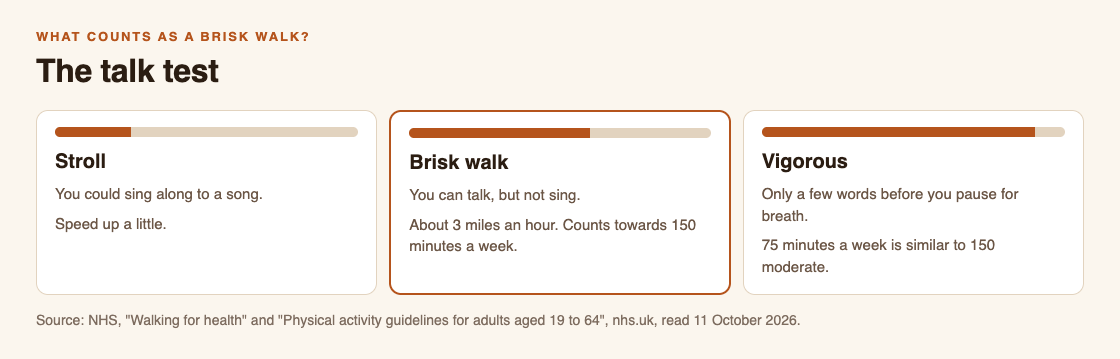
The talk test, from the NHS's activity guidelines.
The talk test: talk, but not sing
The NHS uses the same test for walking and for moderate activity in general: if you can still talk, but not sing, you are working at a moderate level. Here is how to use it on a walk:
- You could sing along to a song: you are strolling. Speed up a little.
- You can chat, but singing would be hard: that is a brisk walk.
- You can only say a few words before pausing for breath: that is vigorous, by the NHS's description.
Brisk walking versus a stroll and a hard workout
The NHS describes vigorous activity as making you breathe hard and fast. At that level you will not be able to say more than a few words without pausing for breath. It says that, in general, 75 minutes of vigorous activity a week can give similar health benefits to 150 minutes of moderate activity, and that most moderate activities can become vigorous if you put in more effort.
A stroll is the other end. The NHS says a brisk walk is faster than a stroll, so if you are ambling and chatting easily enough to sing, you are below brisk.
How much brisk walking do you need?
The NHS guidelines for adults aged 19 to 64 say:
- do some type of physical activity every day
- do at least 150 minutes of moderate intensity activity a week, or 75 minutes of vigorous activity
- spread exercise evenly over 4 to 5 days a week, or every day
- do strengthening activities on at least 2 days a week
- reduce time spent sitting or lying down
A brisk walk counts towards the 150 minutes. The NHS says even a brisk 10-minute daily walk has lots of health benefits. It also says to speak to your GP first if you have not exercised for some time, or if you have medical conditions or concerns.
A two-week plan to find your brisk pace
Here is a simple plan that uses the talk test, with two ideas from Harvard Health: set small goals and write them down, and race against yourself.
- Days 1 to 3, find the pace: walk 10 minutes a day. Every few minutes, check the talk test. Speed up until you can talk but not sing, and hold it.
- Day 4, time a set distance: Harvard Health suggests timing how long it takes to walk a set distance, such as a mile around your neighbourhood. Write the time down.
- Days 5 to 7, add short bursts: Harvard Health suggests walkers speed walk for one to two minutes, then walk at a normal or slower pace to recover, and repeat that five times.
- Days 8 to 13, build the minutes: walk briskly on most days. If you are not very active yet, the NHS says to increase your distance gradually.
- Day 14, race yourself: walk the same distance as day 4 and try to meet or beat your time. Then set a new small goal.
If you are just starting out, our beginner's five-week walking plan goes more slowly.
Keep it brisk on real streets
The NHS says walking while listening to music or a podcast can take your mind off the effort, and can get you into a rhythm that helps you walk faster. You do not need special kit either: it says any shoes or trainers that are comfortable, give enough support and do not cause blisters will do.
Harvard Health adds that signing up for a 5K race or a similar event can be a useful carrot, since you are more likely to follow through once you have paid the entry fee.
The NHS says to add variety to your walks. For ideas, see our guide to finding new walking routes near you. A partner helps too, and the talk test is easy with two: if you can chat but not sing, you are both walking briskly. Our guide on how to find a walking partner has a plan for two.
A reason to keep walking: Cat Go
Cat Go is a game that plays in your web browser: "Walk anywhere, photograph a real cat, lure it with food and catch it." You collect kibble and tuna at treat stops on a map, so walking between stops gives your brisk walk somewhere to go. When you meet a cat, you photograph it, pick its breed and keep it in your Catdex, with the place you found it.
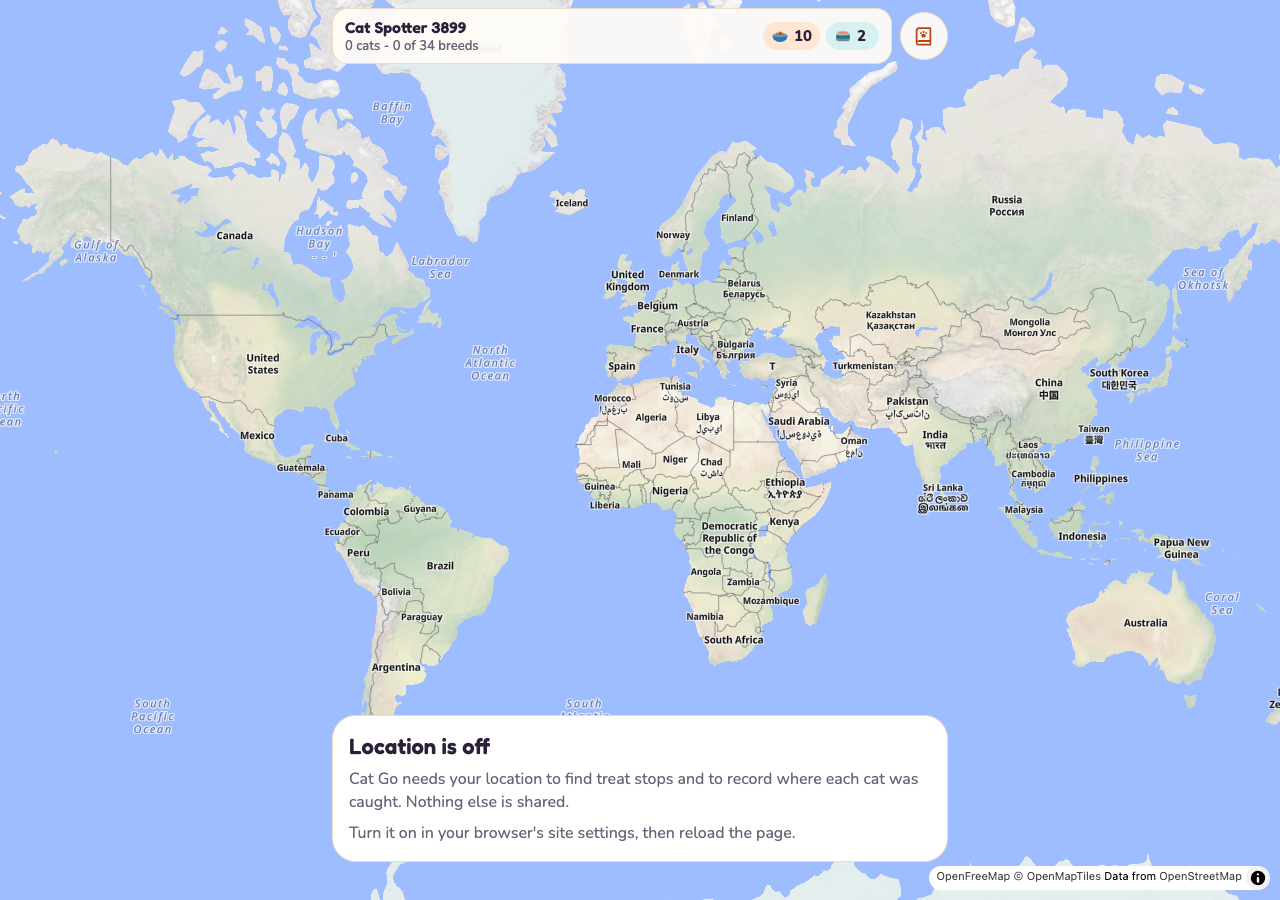
Cat Go's map: treat stops to walk to, and a count of cats and breeds.
Walk briskly between stops, then slow down when you see a cat. The food and the catch are all in the game.
Frequently asked questions
How fast is a brisk walk?
The NHS says about 3 miles an hour, which is faster than a stroll.
How do I know if I'm walking briskly?
Use the NHS talk test: you are walking briskly if you can still talk but cannot sing the words to a song.
Does a 10-minute brisk walk count as exercise?
Yes. The NHS says a brisk 10-minute daily walk has lots of health benefits and counts towards the 150 minutes of weekly activity it recommends for adults.
When does brisk walking become vigorous?
The NHS says vigorous activity makes you breathe hard and fast, so you cannot say more than a few words without pausing. It says most moderate activities can become vigorous if you increase your effort.
Get started
On your next walk, try the talk test: speed up until you can talk but not sing, and hold it for 10 minutes. Then time a set distance and write it down.
Play Cat Go in your browser: walk anywhere, photograph a real cat, lure it with food and catch it.
Comments
No comments yet.
Sign in or make an account to comment.