What Is a Chasing Enemy in Games? Drones That Hunt You
What is a chasing enemy in games? It is an enemy that heads for you instead of for a fixed spot. It works out where you are, steps toward you, and works it out again every time you move. You cannot beat it by memorizing a pattern, because there is no pattern to memorize.
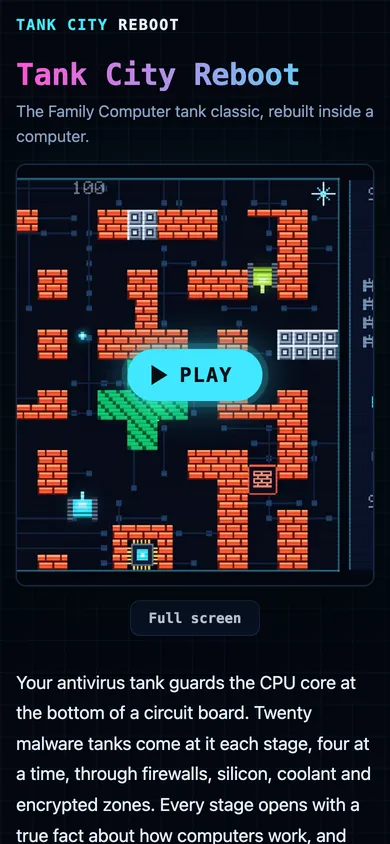
If you want to meet one in a small, readable form, Tank City Reboot is a free browser site with two tank games, and the second one, Tank City Zero Day, has botnet drones that hunt your tank and a page that explains the idea behind each name.
What is a chasing enemy in games, and what does it do?
A guard holds a spot. A patroller walks a loop. A chaser treats you as its objective. That changes how a fight feels: a guard is a puzzle you solve once, but a chaser is a problem that keeps updating, so you keep deciding.
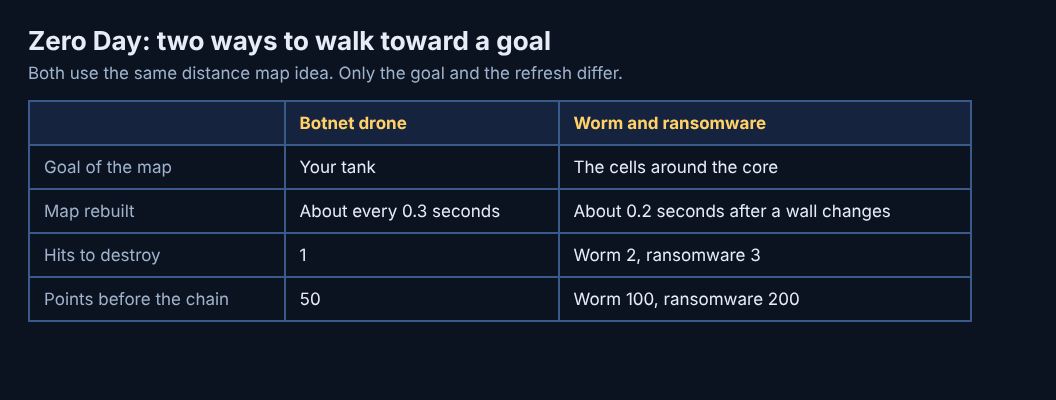
In Zero Day the chaser is the botnet drone. It is fast, it comes in threes, and it hunts you, not the core you are protecting. It dies in one hit and scores 50 points before the chain multiplier. It is weak on its own, which is why it works: the pressure comes from having to keep moving.
How chasing enemies find you
Most chasers do not see you the way a person does. The game gives every open cell a number, the distance from that cell to the target. The enemy looks at its neighbors and steps to the lowest number. Repeat that every frame and it walks downhill toward you.
Zero Day builds that map with Dijkstra's algorithm, a standard method for finding shortest routes, over a grid of 25 by 25 cells. A few rules make the chase believable:
- A normal step costs 1. A step onto firewall costs 4, because the enemy has to shoot through it first.
- Silicon, coolant and the core cannot be stood on, so the route goes around them.
- Steps go in eight directions, but a diagonal step is skipped if either corner it cuts across is blocked.
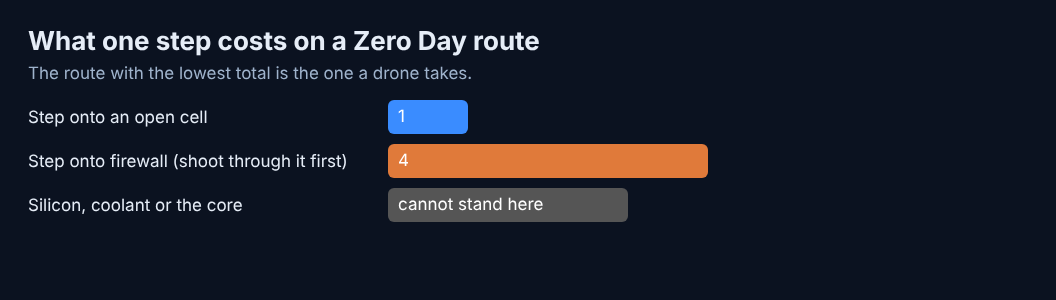
The drones' map has your tank as its goal and is rebuilt about every 0.3 seconds. That is why a drone follows you around a corner instead of running into the wall where you used to be. Worms and ransomware use a different map that leads to the cells around the core, so they mostly ignore you.
Two small rules stop a group from acting like one blob. A walker skips a cell another enemy is already heading to, and a walker blocked by another tank for about 1.4 seconds steps to a random neighbor. Together they spread a trio out.
A worked example: one trio of drones
Wave 2 starts. Waves 1 and 2 send only drones and worms, so the game is teaching you the difference. The worms head for the core. A trio of drones comes in through a gate on the top row and heads for you.
- You face the gate and hold Fire, because holding Fire keeps shooting.
- The first drone dies. That is kill 1 in the chain, and the chain window is 2.5 seconds.
- The second drone closes in and dies inside the window. Kills 1 and 2 are still x1.
- The third drone dies inside the window. Kill 3 raises the multiplier to x2, so the pop-up reads
100 X2: 50 points times 2.
The chaser, meant to pressure you, fed your chain. Three weak enemies arriving together are a gift if you kill them fast. The multiplier keeps climbing with the chain, up to x8.
Chasing, patrolling and splitting enemies
- Patrolling enemies follow a route. You learn the loop and slip through the gap. They reward patience.
- Chasing enemies follow you. They reward movement and punish standing still.
- Splitting enemies change the fight after you hit them. Zero Day's worm takes two hits and splits in two. For that idea, read what a splitting enemy is and how worms that split when hit work.
Zero Day mixes them. Worms walk toward the core, so you must decide when to leave your spot. Drones walk toward you, so you cannot ignore them for long. Ransomware and cryptominers add armor and turret fire, and because the threats want different things, you are always choosing which problem to solve first.
How to beat a chasing enemy
Use the dash as a reset
Your dash lasts a fifth of a second, you cannot be hit during it, and it recharges in 1.5 seconds. The page's own tip is to dash through shots. Save it for when a crowd closes in, not for the first sign of danger.
Shoot at the gate
Enemies enter from three gates on the top row. A chaser is easiest to kill right after it appears, before it has room to flank you.
Keep the chain alive
Every kill within 2.5 seconds of the last one extends the chain, and losing your tank resets it. Clear the close targets first.
Let your shots cancel theirs
Your shots cancel enemy shots, so a well-timed shot opens a gap when fire and drones arrive together.
Upgrades that help against chasers
After each wave, Patch Tuesday offers three upgrades and you pick one.
- Multithreading fires more shots in a spread: 1, then 2, 3 and 5 by level 3. It covers three drones coming from different angles.
- Cache fires 30% faster, dropping the wait between shots from 0.3 seconds to 0.225 at level 1, so you can finish a trio inside the chain window.
- Encryption lets each shot pass through one more enemy per level. Chasers line up behind each other, so one shot can hit several. See what piercing shots are and how bullets that pass through work.
- Overclock makes you move faster and dash more often, cutting the dash recharge from 1.5 seconds to 1.05, then 0.6.
Take something that kills trios quickly first, then add a safety net. If you want that net to recharge, see how rechargeable shields and recharge timers work.
Designing chasers that feel fair
- Keep chasers fragile. A one-hit drone is a tempo threat, not a wall of health.
- Use groups of three. A trio makes the player think about spacing without complicated rules.
- Refresh the path on a timer. A rebuild every 0.3 seconds keeps the enemy sharp without making it perfect.
- Give the player an escape. The dash is why being hunted feels tense, not hopeless.
- Escalate slowly. Ransomware arrives from wave 3, cryptominers from wave 4, and a boss below half health calls in two more drones every seven seconds.
Frequently asked questions
What is a chasing enemy in a game?
It is an enemy that moves toward the player and updates its path as the player moves, unlike a patrolling enemy that follows a fixed route.
How do chasing enemies know where I am?
Usually the game gives each open cell a distance to the target and the enemy steps to the neighbor with the lowest distance. In Zero Day the drones' map is rebuilt about every 0.3 seconds.
Do botnet drones attack the core?
No. In Zero Day, botnet drones hunt your tank. Worms and ransomware are the ones that head for the core.
What is the best way to deal with a group of chasers?
Kill them near the gate, keep your chain going and save your dash for when they close in. Spread shots and piercing shots help against groups.
Get started
You can meet a chasing enemy in about a minute. Open Tank City Zero Day, click the game so it takes your keys, move with the arrow keys or WASD, fire with Space, J or Z, and dash with Shift, K or X. It is free, runs in your browser on a computer or a phone, and needs no account to play. The first game, Tank City Reboot, is on the home page.
The Family Computer tank classic, rebuilt inside a computer.
Visit tankcityreboot.vlvd.net↗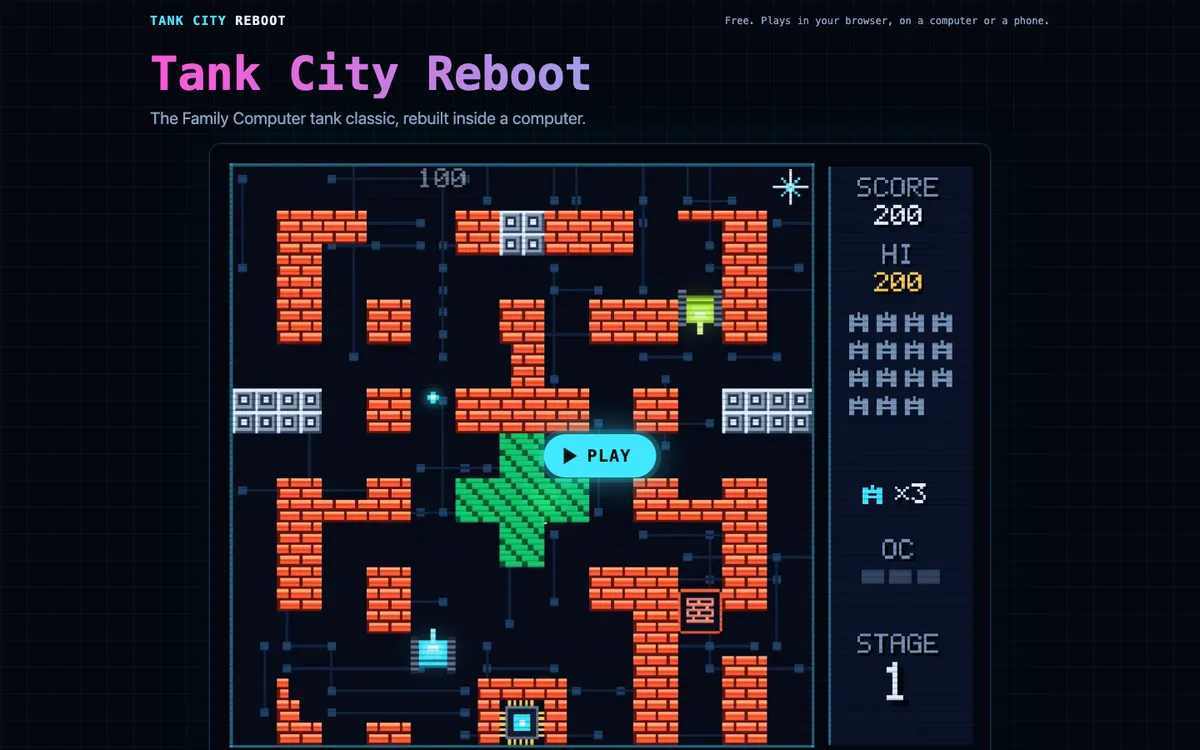
Comments
No comments yet.
Sign in or make an account to comment.