What Is a Splitting Enemy in Games? Worms That Split When Hit
What is a splitting enemy in games? It is an enemy that, when you destroy it, turns into two or more smaller enemies instead of simply disappearing. In Tank City Zero Day, the worms that split in two when hit are a clean example: you break the worm, and two smaller pieces keep coming.
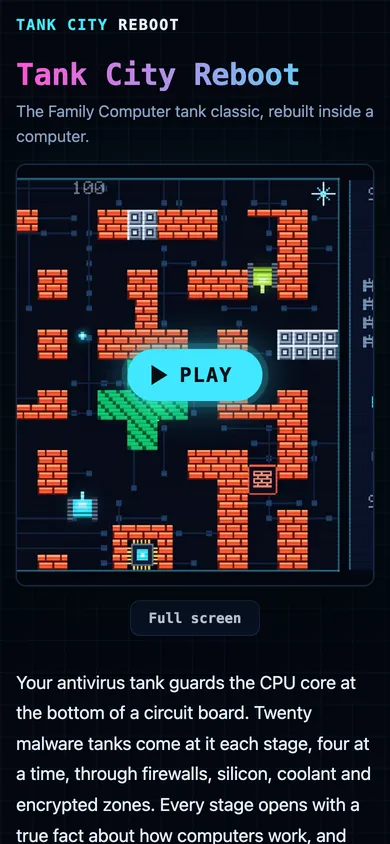
If you want to see one for yourself, Tank City Reboot is a free site with two tank games that run in your browser, on a computer or a phone, with no account needed to play. The splitting worm lives in the second game, Tank City Zero Day.
What is a splitting enemy in games?
A splitting enemy has two lives in one body. The first is the big version. The second is the set of smaller versions that appear when the big one dies.
The idea is simple, but it changes how a fight feels. You do not clear a threat with one kill. You clear it with a short chain of kills, and the second part of that chain is often harder to hit than the first.
Most splitting enemies follow three rules:
- The parent is tougher or slower than the pieces.
- The pieces are weaker, so each one dies quickly.
- The total effort is higher than for a single enemy of the same size.
How worms that split in two when hit work
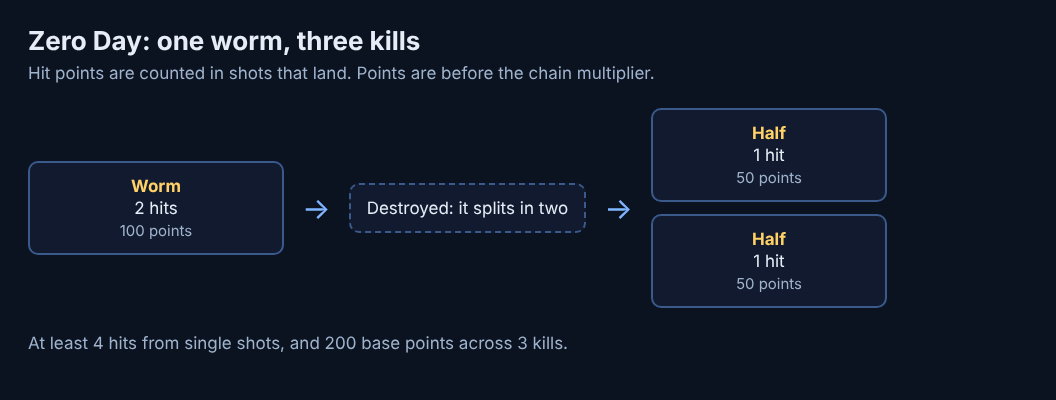
In Tank City Zero Day, the Worm is one of the threats. Its card puts it plainly: it takes two hits and splits in two when destroyed. Each half then takes one hit.
The game's own numbers show how much extra work this creates:
- A drone takes 1 hit.
- A worm takes 2 hits.
- Each half of a split worm takes 1 hit.
Every shot that hits an enemy takes 1 hit point. So with plain single shots, one worm costs you at least four hits: two for the worm and one for each half. That is as many hits as it takes to destroy four botnet drones.
Worms also show up early. Waves 1 and 2 send only botnet drones (in groups of three) and worms. Ransomware starts at wave 3 and cryptominers at wave 4. So the worm is the first enemy that teaches you to think about what happens after a kill.
Where worms go
Worms do not hunt you. Botnet drones do that. Worms and ransomware walk toward the cells around your core. Under the hood the game works out the shortest route with a pathfinding method (Dijkstra's algorithm), and a step onto firewall costs more than a step onto open ground, because the firewall has to be shot through first. A worm blocked by firewall stops and shoots it.
That matters when you plan where to stand: a worm is heading for the core, not for you, so you can shoot it from the side while it keeps walking its route.
A worked example: the score from one worm
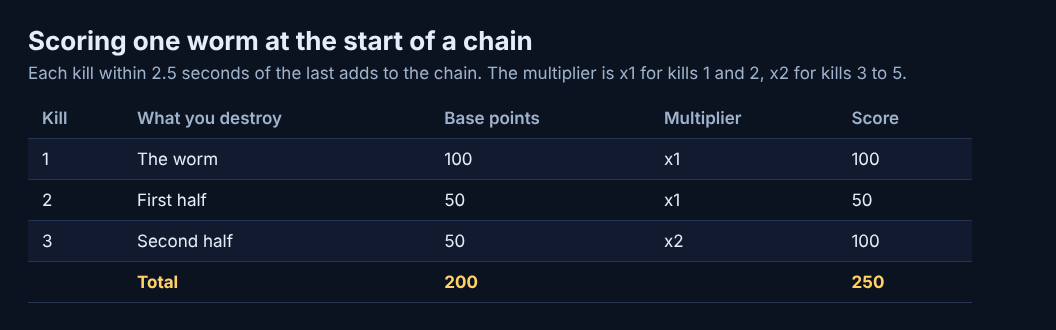
Say you start a fresh chain on a worm. The chain adds 1 for every enemy destroyed, and each kill must come within 2.5 seconds of the last one. The multiplier is x1 for kills 1 and 2, then x2 for kills 3 to 5.
- You destroy the worm. That is kill 1. It scores 100 times x1, so 100.
- You destroy the first half. Kill 2. It scores 50 times x1, so 50.
- You destroy the second half. Kill 3. It scores 50 times x2, so 100.
The total is 250 points, against a base value of 200. One worm gives you three kills for the chain, not one. A splitting enemy is a small gift to a player who keeps shooting, because the pieces help you reach the next multiplier step. If the 2.5 second window runs out before your next kill, the chain goes back to 0.
Why designers use splitting enemies
A designer can use splitting for a few practical reasons.
- It makes a kill feel like the start of something. The enemy does not just vanish. The screen changes, and you have to react.
- It rewards positioning. Where you stand when the worm splits decides how easy the next two shots are.
- It scales difficulty without new art. A smaller copy of an existing enemy is cheap to add, yet it changes how a wave plays.
- It punishes sloppy shooting. If you wildly spray a big enemy, you end up with a crowd of small ones.
Common types of splitting enemies
Across games, splitting usually comes in a few forms. These are general patterns, not rules from Tank City.
- Split on death. The enemy breaks into a fixed number of smaller copies when its health runs out. This is how the Zero Day worm works.
- Split on every hit. Each hit spawns a new copy, so a lot of shooting makes the problem worse.
- Repeated splitting. The pieces split again, in several stages, until they are tiny.
- Split by cause. Some enemies split only if hit in a certain way, such as by a certain weapon or from a certain side.
The Zero Day worm is the simple kind: it splits once, into two pieces, and the pieces do not split again. That keeps it readable. You always know the worst case.
How splitting changes your aim and weapon choice
Splitting turns one target into a short sequence. That changes what a good shot looks like.
With a single enemy, you aim for the center and fire. With a splitter, you think two steps ahead. After the first kill, you want your tank lined up for the pieces, not turned away from them.
Your fire rate matters more, too. In Zero Day the wait between shots is 0.3 seconds, and each level of the Cache upgrade multiplies it by 0.75. That gives 0.3, 0.225, about 0.17 and about 0.13 seconds. Holding Fire shoots again as soon as the wait is over. Against a worm, a shorter wait means you finish all three kills sooner, which keeps the chain alive.
Multithreading helps in a different way. It fires several shots at once in a spread: 1 shot, then 2 (at plus and minus 6 degrees), then 3, then 5 at the top level. A spread covers more angles, which helps when you cannot line up a single shot. As with any upgrade, you pick it after a wave from three offered cards, and upgrade levels and limits decide how far you can take it.
Piercing and ricochet shots against splitters
Two upgrades in Zero Day change how your shots deal with groups, and both are useful against worms.
The first is Encryption. It lets each shot pass through one more enemy per level, up to 2 levels. This is the idea behind piercing shots. When a worm's halves are lined up, one piercing shot can hit more than one of them.
The second is Load balancer. Each shot gets one bounce per level off silicon or the arena edge, up to 2 levels. That is a ricochet shot. A bounced shot can reach targets you are not facing. One limit to remember: firewall breaks and stops the shot, so it does not bounce off it.
The two work well together, and you can take both in one run. You get three cards after each wave, and the cards are drawn from upgrades that are not yet at their limit. If fewer than three are open, a Two-factor card (one extra life) fills the gap.
Tips for beating splitting enemies
- Keep firing. The game's tip is to hold fire. The halves are small and quick to kill, and the chain window is only 2.5 seconds.
- Do not retreat after the first hit. Backing away costs time, and the chain window is only 2.5 seconds. Stay at the angle you already have.
- Watch the lanes into the core. Worms walk toward the core, not toward you, so the worm is the enemy to catch before it reaches the core.
- Cancel their shots. Your shots cancel enemy shots, so a shot fired at the right time clears the lane and hits the target.
- Dash when it gets crowded. A dash lasts 0.2 seconds, and you cannot be hit during it. It recharges in 1.5 seconds. Read more on the dash move.
- Keep the core whole. Clearing a wave adds a bonus that grows with how much core integrity you have left, so guard it while you chase the pieces.
Frequently asked questions
What is a splitting enemy in games?
It is an enemy that breaks into smaller enemies when you destroy it. The fight continues after the first kill, so it takes more shots and more attention than a single enemy.
How many hits does a splitting worm take in Tank City Zero Day?
The worm takes 2 hits, and each of its two halves takes 1 hit. That is at least 4 hits with plain single shots.
Do worms split in the first Tank City game?
No. In the first game the Worm is the basic tank: slow, and it dies in one hit. The splitting worm is part of Tank City Zero Day.
Do splitting enemies help your score?
They can. A worm is worth 100 points and each half 50, times your chain multiplier. Every piece counts as a kill for the chain, so clearing all three quickly raises the multiplier.
Get started with Tank City Reboot
The fastest way to learn how a splitting enemy feels is to shoot one. Open Tank City Zero Day, play the first two waves, and watch what the worm does when it breaks. The page also explains the computer idea behind each name.
Play Tank City Reboot: it is free, plays in your browser on a computer or a phone, and needs no account.
The Family Computer tank classic, rebuilt inside a computer.
Visit tankcityreboot.vlvd.net↗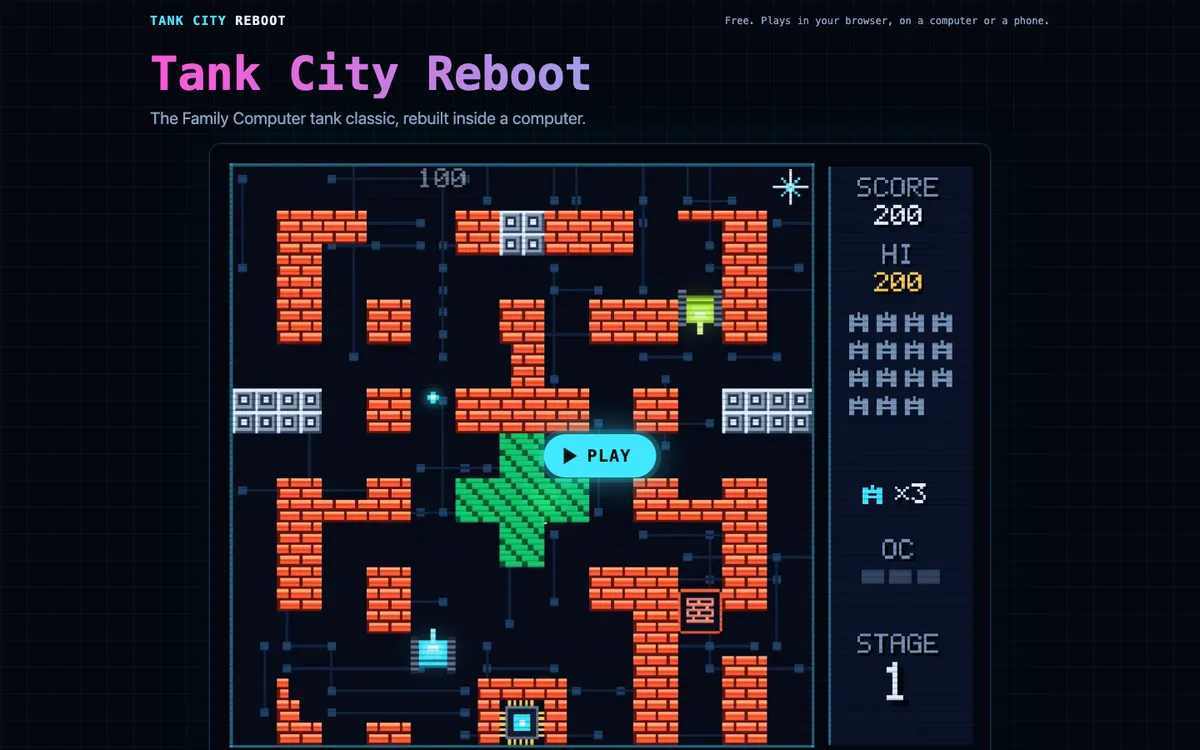
Comments
No comments yet.
Sign in or make an account to comment.