What is a Lykoi cat? The werewolf cat's coat explained
What is a Lykoi cat? It is a breed with a partly hairless, grizzled coat that gives it a "werewolf" look. The Cat Fanciers' Association (CFA), a cat breed registry, lists its coat length as "Shorthair", its characteristics as "Partial hairlessness, and unique roan patterned coat" and its personality as "Fun loving and intelligent". This guide follows the CFA's Lykoi breed page and its breed standard, opened for this post, and then shows how Cat Go handles the question "Which breed is it?"
Cat Go is a game you play in your browser: walk anywhere, photograph a real cat, lure it with food and catch it, and pick its breed from a list that has a mixed breed answer too.
What is a Lykoi cat? The short answer
The Lykoi (the name is Greek for "wolves") is a breed that came from a naturally occurring coat mutation found in the feral cat population. The CFA says it is not a "designer breed" or any sort of hybrid. What people notice is the coat and the face: a roan-patterned coat with a mask of bare skin around the eyes and muzzle.
The CFA says the breed is so unusual that people have stood in long lines just for a look at one. Its standard sums up the overall impression as an inquisitive, intelligent, striking cat with large expressive eyes and a partial hairlessness that gives it a mythical, werewolf-like appearance.
Where the Lykoi comes from
According to the CFA, the first Lykoi were discovered in Virginia in 2010. They looked so unusual that at first their health was questioned. Other cats with the same appearance were found in Tennessee the following year.
After extensive medical and genetic testing, and test matings, the gene behind the roan coat was found to be recessive and unrelated to any other mutation. The first intentionally bred Lykoi kitten, Daciana, was born on 14 September 2011. Over 200 more Lykoi were then produced through extensive outcrossing, to keep genetic inbreeding low and keep the look. The CFA accepted the breed for registration in 2018 and advanced it to championship status in 2023.
Three traits and a mask that set the Lykoi apart
The breed standard says a combination of three traits distinguishes the Lykoi from every other breed:
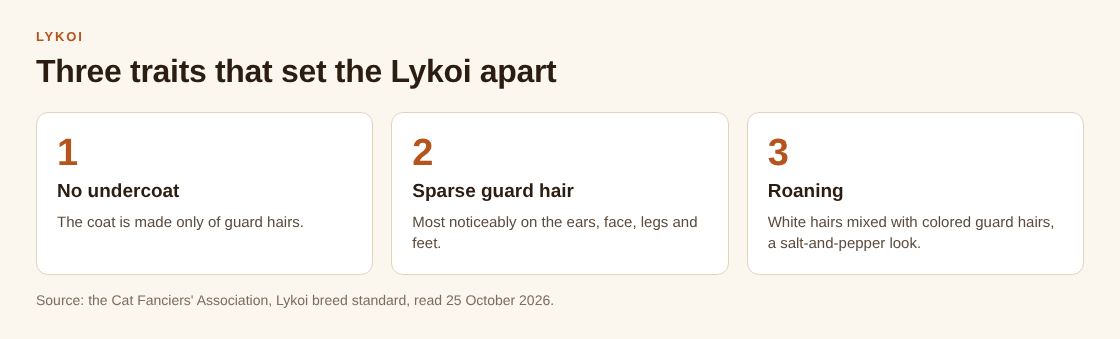
The three coat traits in the CFA's Lykoi breed standard.
"Roaning" is the salt-and-pepper look: white hairs mixed with darker colored guard hairs. The standard says all base colors are accepted, the ideal degree of roaning is about 50%, and the pattern is less apparent on lighter areas of the coat. The CFA adds that kittens are born with coats that look normal, and the roaning appears in a week or two.
The CFA describes a lean, muscular and graceful cat. The standard lists these features:
- Face: hairless, fleshy whisker pads and a hairless, leathery nose. Bare skin around the eyes joins the muzzle to look like a face mask, ideally clover-shaped.
- Eyes: large, walnut shaped and slanting upward, with an open expression.
- Ears: tall, set high on the head and rounded at the tips, angled slightly out to look alert.
- Legs and feet: sparsely haired, with refined oval feet and toes that look long.
- Tail: shorter than the body and tapering to a point.
The coat comes and goes
The Lykoi coat is not fixed. The CFA says that as the cat matures it goes through its own coat growth cycle, from almost completely hairless to almost fully coated, and it is likely to molt most of the coat at least once. The standard says coverage varies with age, molting stage and regrowth, and that the coat can look wiry and rough but feels soft, silky and slightly textured.
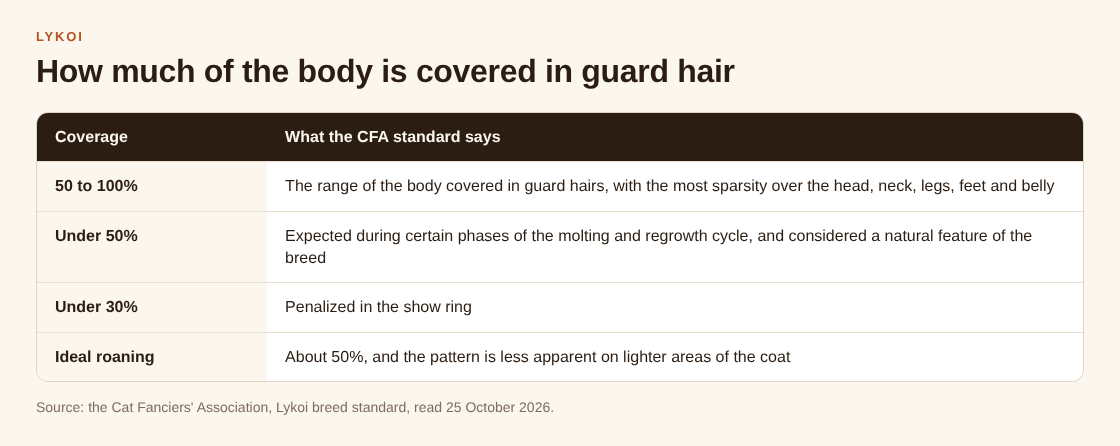
Coat coverage in the CFA's Lykoi breed standard.
So the same cat can look different from one month to the next. The standard also lists a longhaired Lykoi class, with a soft, silky, wispy, semi-long coat and no undercoat.
Temperament: active, curious and talkative
The CFA calls Lykoi very active and curious cats who would generally rather hunt than cuddle. They still thrive on human attention, and the CFA says they will seek you out to insist on it. It is amusing, it says, to watch a Lykoi play, because they patiently stalk their toys, and even their people, before a sudden pounce.
In new situations a Lykoi may be somewhat reserved at first. The CFA says they quickly warm up to new people and new pets, and once that happens they are loyal and form strong bonds. They chirp, trill, purr and meow, but the CFA says they are not excessively vocal unless they feel neglected.
Grooming, sun and health, as the CFA describes them
- Grooming: regular, but it need not take a lot of time. With no undercoat, shedding is minimal except during a molt.
- Skin: it can become oily and need an occasional bath. The CFA says to ask the breeder for product advice, because human shampoos should not be used on cats. The ears and toes need special attention.
- Sun: the skin can be vulnerable to the sun, and too much exposure can speed up molting. The CFA suggests controlling the amount of sunbathing and considering a pet-safe sunscreen.
- Warmth: with no undercoat, the CFA says these cats do best in a warm environment.
- Health: the CFA says no breed-specific health issues have been noted to date, but the sparse coat needs special precautions, and ingrown hairs may occur during a molt. For your own cat, ask your vet.
The CFA calls the Lykoi a minority breed, though the number shown in CFA is increasing every year. Because breeders are few, you may have to wait for a kitten. It suggests visiting a show to meet a breeder, and has a Find-A-Breeder website.
How to check a roan-coated cat on a walk
Here is a worked example. On a walk you see a cat with a grizzled, thin coat and a bare face, and you wonder whether it is a Lykoi.
- Look at the face. The standard describes bare skin around the eyes and muzzle, like a mask.
- Look at the coat. Salt-and-pepper roaning, thin hair on the legs and feet, and a body mostly covered in guard hairs.
- Look at the ears. Tall, high set and rounded at the tips.
- Allow for the cycle. A Lykoi can be nearly bare or nearly fully coated, so a thin coat on its own proves nothing.
- Do not stop at the coat. A thin or patchy coat can have other causes, and a cat that looks unwell needs a vet, not a breed guess. Our post on telling whether a cat is mixed breed gives the longer checklist, and our post on the Sphynx covers another cat with very little hair.
At the end you have a guess, not an answer. Only papers can settle a breed.
Where Cat Go comes in
After a cat is spotted, Cat Go asks "Which breed is it?" and gives you a list with a search box. The game also says "Most cats you meet are mixed breed. Rarer breeds are warier." and "Mixed breed is always a safe pick."
That fits what you just read. A cat with a thin, grizzled coat can be a Lykoi or something else, and you choose the breed yourself. The game counts 34 breeds, and every catch is saved to your Catdex with its breed and the place you found it. It needs the camera and location allowed in your browser, and its camera screen says to fit the whole cat in the frame, which helps here, since the coat and the face mask are the clues and they need to be in the photo.
Frequently asked questions
Why is it called the werewolf cat?
The CFA says the partial hairlessness gives the Lykoi a mythical, werewolf-like appearance. The breed name is Greek for "wolves".
Is the Lykoi a hybrid?
No. The CFA says it is not a "designer breed" or any sort of hybrid, but comes from a naturally occurring coat mutation found in the feral cat population.
Do Lykoi shed?
The CFA says that with no undercoat, shedding is minimal except during a molt, when the cat is likely to lose most of its coat at least once.
Do Lykoi need sun protection?
The CFA says the skin can be vulnerable to the sun and over-exposure can accelerate molting. It suggests controlling sunbathing and considering a pet-safe sunscreen.
Can you tell a Lykoi from a photo?
Not reliably. A roan coat and a bare face mask are clues, but they are not proof of a breed, and most cats you meet are mixed breed.
Get started
You do not need a pedigreed cat to enjoy looking at cats. Play Cat Go in your browser: walk anywhere, photograph a real cat, lure it with food and catch it. The game needs your camera and location allowed in the browser. Each catch is saved to your Catdex with its breed and the place you found it.
Walk anywhere, find a real cat, and catch it.
Visit catgo.vlvd.net↗
Comments
No comments yet.
Sign in or make an account to comment.