What Is a Moat for an AI Startup? Five Kinds Explained
So, what is a moat for an AI startup? It is anything that keeps customers with you after a competitor copies your AI product. There are five kinds that matter for an AI startup: proprietary data, workflow and switching costs, distribution and brand, network effects, and deep domain expertise and trust. Most startups have one at best, and many have none yet.
Age of AI Entrepreneur gives you short hands-on lessons on how to build a business with AI, including a course on distribution and moats, with sources listed for every lesson.
What is a moat for an AI startup?
The word comes from castles. A moat is the water around the wall that makes attack expensive. In business it means a lasting advantage that is hard to copy, even when a rival can see exactly what you do.
A feature is not a moat. A good prompt is not a moat. A nice interface is not a moat. Each of those can be rebuilt in a weekend. A moat is the thing that is still true after the weekend.
A simple test: imagine a well-funded competitor clones your product tomorrow. Why would your customers stay? If you can answer in one specific sentence, you have a candidate moat. If the answer is "ours is a bit better," you do not.
Most AI products are built on a model someone else trains. You rent the intelligence through an API. So does everyone else. When the underlying model improves, it improves for you and for every rival at the same moment.
That makes the core capability a shared resource. It also explains why thin products that only wrap a model are fragile: if the wrapper is the whole product, the model provider or any competitor can reproduce it. We cover that risk in the blog post on thin wrappers around ChatGPT.
The question then shifts. It is no longer "can we build this?" It is "what do we have that the model, and everyone else using it, does not?" The five moats below are the usual answers. For the older pattern behind this, read why software is eating the world, which shows how each platform shift rewards those who build on it with something extra.
Moat 1: Proprietary data
Data is a moat when you hold information that others cannot get and that makes your product measurably better. The key words are cannot get and measurably better.
Example. A tool that reads invoices for a small trade, say plumbing suppliers. After a year, you have thousands of corrected invoices from real customers, each fixed by a human. A new rival starts with a general model and no corrections. Your accuracy on that narrow task is higher, and every new customer widens the gap.
What fails. Public data is not a moat. Scraped web text is not a moat. Data you hold but never use to improve the product is not a moat either. Ask whether the data creates a loop: more usage, more data, better product, more usage.
Moat 2: Workflow and switching costs
A product becomes hard to leave when it sits inside how a team works every day. Their templates, approvals, integrations and habits live in it. Leaving means retraining people and rebuilding connections.
Example. An AI assistant that is wired into a company's ticketing system, its style guide and its review steps. Replacing it costs weeks of setup. A cheaper rival has to be much better to justify that pain.
What fails. A chat box that people can abandon with no loss. If a customer can copy their work out in a minute and paste it into another tool, switching costs are close to zero. Build for depth of use, not just breadth of sign-ups.
Moat 3: Distribution and brand
Sometimes the advantage is simply that people hear about you first, or trust your name. Distribution means you have a reliable way to reach customers at low cost: an audience, a partnership, a marketplace listing, a community, a search presence.
Example. A founder who writes useful guides for accountants for two years has an email list and a reputation. When she launches an AI tool for accountants, she has buyers on day one. A rival with a slightly better product has to pay for every customer.
What fails. Paid ads alone. If you rent attention and the price rises, your advantage disappears. Owned channels last longer. The distribution channels post on the site's blog walks through the options, and the lesson Building on Someone Else's Model sits in the course on Distribution and Moats.
Moat 4: Network effects
A network effect exists when each new user makes the product more valuable for the others. Marketplaces, shared libraries and collaboration tools often work this way.
Example. A platform where freelancers share and rate AI-built templates for a specific job. More templates attract more buyers. More buyers attract more template makers. A newcomer with an empty marketplace has nothing to show.
What fails. Calling something a network effect because you have many users. The test is whether user number 1,001 makes the product better for user number 1. Many AI tools are single-player: your use does not help anyone else. Those do not have this moat, and that is fine, as long as you do not pretend otherwise.
Moat 5: Deep domain expertise and trust
In fields where mistakes are costly, such as law, health, finance or safety work, buyers pay for confidence. Knowing the rules, the edge cases and the buyer's fears takes years. A model cannot supply the trust that comes from a track record.
Example. A founder who spent ten years in compliance builds an AI tool that checks documents against real regulations. She knows which errors matter and how auditors think. She writes the tests that prove it works. Buyers believe her because she has been in their seat.
What fails. Claiming expertise you cannot show. Trust comes from evidence: clear tests, honest limits and references. Learning to measure whether your product is right is its own skill, and the advanced courses cover evals for exactly that reason.
How to tell if your moat is real
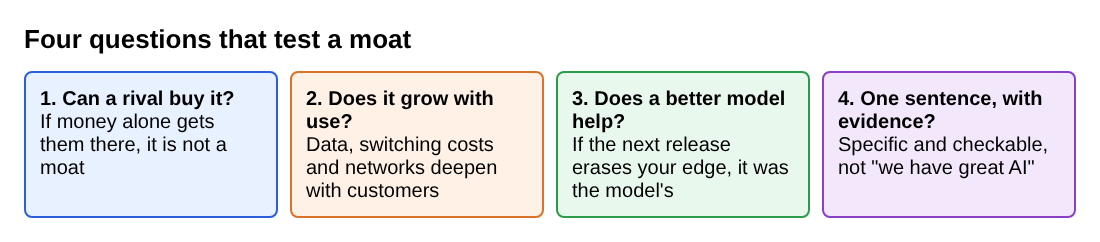
Run each claimed moat through four questions.
- Can a rival buy it? If money alone gets them there, it is not a moat. Money can buy ads and engineers. It cannot buy your history.
- Does it grow with use? Real moats usually deepen as you add customers. Data loops, switching costs and networks do. A static feature does not.
- Does the next model release help or hurt? If a better base model erases your edge, you were relying on the model. If it makes your product stronger, because you own the data or the workflow around it, you are on firmer ground.
- Can you state it in one sentence with evidence? "Customers keep our product because their 40,000 corrected documents live here and improve it" is specific. "We have great AI" is not.
Also be honest about timing. Early on, you probably have no moat. You have speed and focus, and a real problem to solve; see product-market fit first. That is acceptable. The job is to decide which moat you are building and to make each week of work add to it. Economics matter too: a moat that costs more to maintain than it earns is not helping, which is why the lesson Revenue, Costs and Unit Economics belongs alongside this topic. Our post on unit economics for an AI product shows how to count it.
Be careful not to confuse a plausible story with a tested one. Hypotheses about what keeps customers need checking against what customers actually do, not just what you assume they do.
Frequently asked questions
Is a good prompt a moat for an AI startup?
No. A prompt can be copied or rewritten quickly, and a better model may make it unnecessary. Treat it as a feature, not a lasting advantage.
Do I need a moat before I launch?
Not usually. Early on you need to find real demand. But pick which moat you are building from the start, so your early customers, data and relationships add to it.
Can a solo founder build a moat?
Yes. Domain expertise, a small loyal audience and a workflow deeply tied to a narrow group of customers are all within reach of one person. Narrow focus helps.
Which of the five moats is strongest?
It depends on the market. Many durable businesses combine two or three, such as workflow lock-in plus trusted expertise. No single kind is safe on its own.
Get started
Moats are easier to judge once you have seen how past platform shifts played out and how a business actually makes money. Age of AI Entrepreneur covers that in short lessons of about nine minutes, with hands-on activities, questions, and a list of sources on every lesson. Where researchers disagree, it sets out the sides instead of picking one. Lessons are free to anyone with an account, as the terms page explains. You sign in with your email and an emailed code.
Comments
No comments yet.
Sign in or make an account to comment.