What is a motte and bailey castle? The first Norman castles
A motte and bailey castle had two parts: a high earth mound with a tower on top (the motte), and a fenced or walled yard beside or below it (the bailey). It was one of the most common castle designs in England after the Norman Conquest of 1066, and the outline of hundreds of them can still be seen as grassy mounds.
This guide explains each part and what it was for, using English Heritage, and walks through Totnes Castle in Devon, where you can still see the shape clearly. It compares Berkhamsted, a motte and bailey that faced a real siege, and ends with how the free browser game Two Towers turns the change from timber to stone into part of play.
The two parts of a motte and bailey
English Heritage's history of castles through time describes motte and bailey designs as very common, with a mound, the motte, topped by a wooden tower or keep, and a defended enclosure, the bailey, alongside.
- The motte was the high ground. A tower on top gave a view over the land around and a last place to hold if the yard fell.
- The bailey was where people lived and worked. It was larger and lower, and held the main buildings.
It was not the only early design. English Heritage also describes ringworks, which had banks and ditches forming a rough circle with a wooden fence on top, and castles such as Eynsford, which had no motte at all, just a strongly walled enclosure.
Why the Normans built them
These castles housed Norman nobles and their families, and they made the new rulers visible. English Heritage's history of Totnes says the castle there "visually declares an unmistakable message of authority". It was set at the town's highest point, and its layout cuts across the existing street plan, proving that it was imposed on a town that already existed.
Timber and earth were quick to work. A lord with labour and a hill could raise a motte and bailey far faster than a stone castle, and replace the wood with stone later.
A worked example: Totnes Castle, Devon
English Heritage's history of Totnes Castle lets you follow one castle from earth and timber to stone. Here it is step by step:
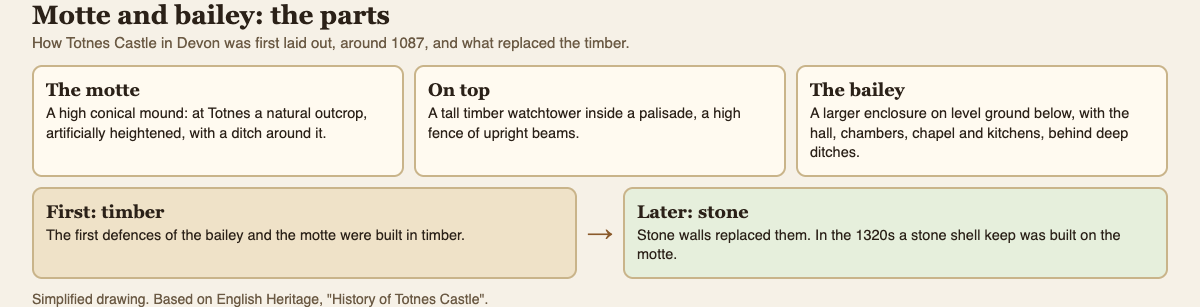
Totnes as first laid out, and what replaced the timber.
- The founder. After the Conquest, William the Conqueror gave one of his supporters, Judhael of Brittany, a large estate in Devon, with Totnes as its chief town. Judhael founded the castle around 1087.
- The motte. Probably from the start, the castle had a high conical mound. English Heritage says it is thought to be a natural outcrop, artificially heightened. A ditch once ran round it, since filled in.
- On top. Excavation and comparison with other castles suggest the motte was first crowned with a tall timber watchtower inside a palisade, a high wooden fence of upright beams.
- The bailey. Below lay a larger enclosure on level ground, with the castle's main buildings: the hall, chambers, chapel and kitchens. Deep ditches round its north side were probably dug when the castle was first built.
- Timber to stone. The first defenses of the bailey and the motte were timber. Stone walls replaced them later. By 1273 a survey found the stone defenses on the motte near to collapse, and in the 1320s William, 1st lord Zouche, built the shell keep you see today: a circular wall enclosing a courtyard and buildings on top of the motte.
One more detail: Totnes saw no sieges or battles. It slowly declined through the Middle Ages and was effectively abandoned in the 16th century, which is part of why its shape is so easy to read today.
A motte and bailey under siege: Berkhamsted
Not every motte and bailey had such a quiet life. English Heritage's history of Berkhamsted Castle describes one that was tested:
- Built fast. William the Conqueror received the submission of the English at Berkhamsted after the Battle of Hastings. His half-brother, Robert of Mortain, built a timber castle there in about 1070, in the classic Norman motte and bailey form, with a conical mound and an oval bailey below.
- Placed with care. It controlled the northern approach to London, 30 miles away.
- Defended by water. Its water-filled ditches prevented tunnelling under the wall, and the motte could protect the bailey.
- Tested in 1216. Prince Louis of France besieged it for two weeks, battering it with huge stones flung from siege weapons. It surrendered in the end on the orders of the king.
By then Berkhamsted had a stone curtain wall, which shows the same pattern as Totnes: the motte and bailey plan stayed, and the timber did not.
What to look for on a visit
If you visit a motte and bailey site, look for three things. First, the mound: steep sided, often with a stone wall or keep on top. Second, the bailey: a flatter area beside or below it, usually larger. Third, the ditches, which may now be dry, filled in or grassed over. At Totnes, for example, English Heritage says the ditch that once ran round the motte has since been filled in, while the deep ditches on the north side of the bailey still mark the line of the first defenses.
For how these castles were defended once they were in stone, see our guide to how castles defended against a siege, and for the stones Louis threw at Berkhamsted, see medieval siege weapons explained.
Timber to stone in Two Towers
In Two Towers, a free tower defense game in your browser, you hold a city gate with towers that grow with you. Every five stages your towers are rebuilt stronger, from Timber to Legendary. The game calls these the Ages.
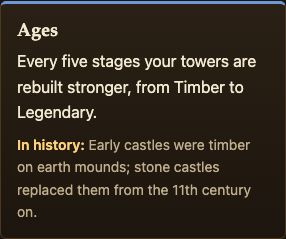
The Ages card puts the history in one line: "Early castles were timber on earth mounds; stone castles replaced them from the 11th century on." That is the Totnes story in a sentence. The game gives one line of history per card, not a full account.
Frequently asked questions
What is a motte and bailey castle?
A castle with a high earth mound topped by a tower (the motte) and a defended yard beside it (the bailey), very common in England after 1066.
What was the bailey used for?
Living and working. At Totnes the bailey held the hall, chambers, chapel and kitchens.
Were motte and bailey castles made of wood?
At first, usually. Totnes and Berkhamsted both began in timber, and both were later rebuilt in stone.
Get started
Play Two Towers: it is free and plays in your browser on a computer or a phone. Hold the gate through five stages and watch your towers move from Timber into the next age.
Comments
No comments yet.
Sign in or make an account to comment.