What Is a Random Drop in Games? How Loot and Power-Ups Appear
A random drop in games is an item, power-up or reward that appears based on chance instead of a fixed script. If you have ever asked "what is a random drop in games? how loot and power-ups appear", the short answer is this: the game rolls a number, checks it against a list of possible rewards, and gives you whatever the number lands on.
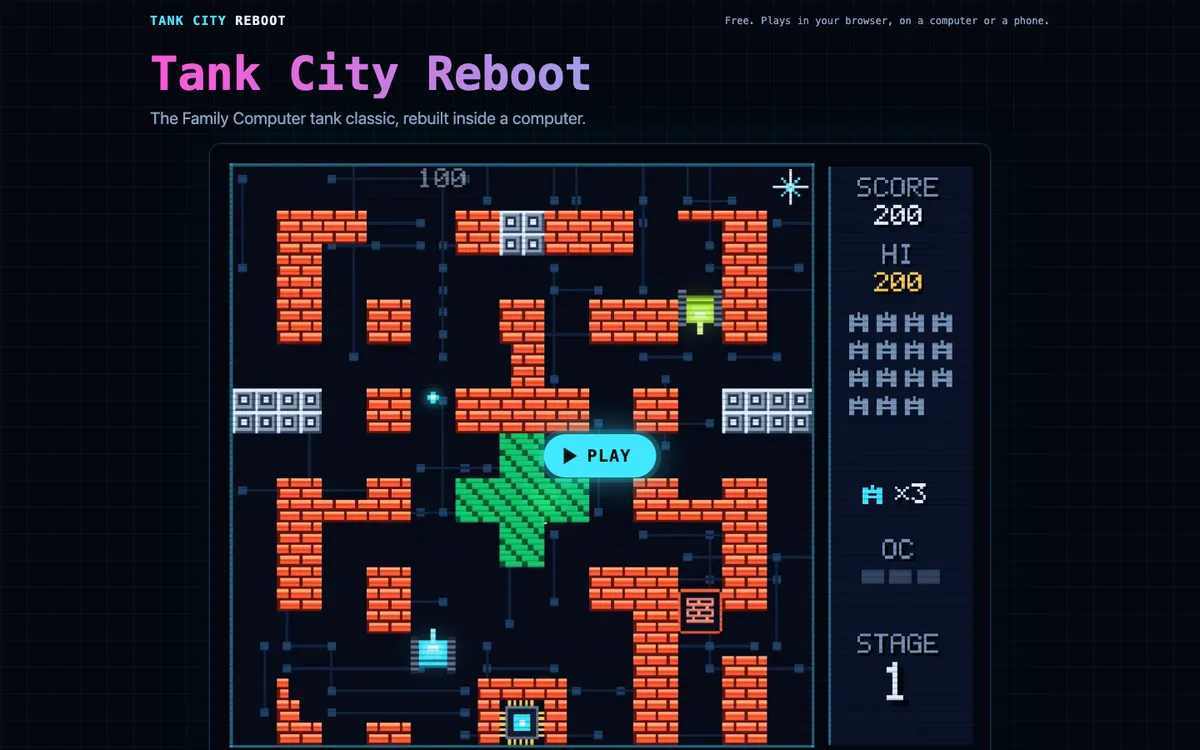
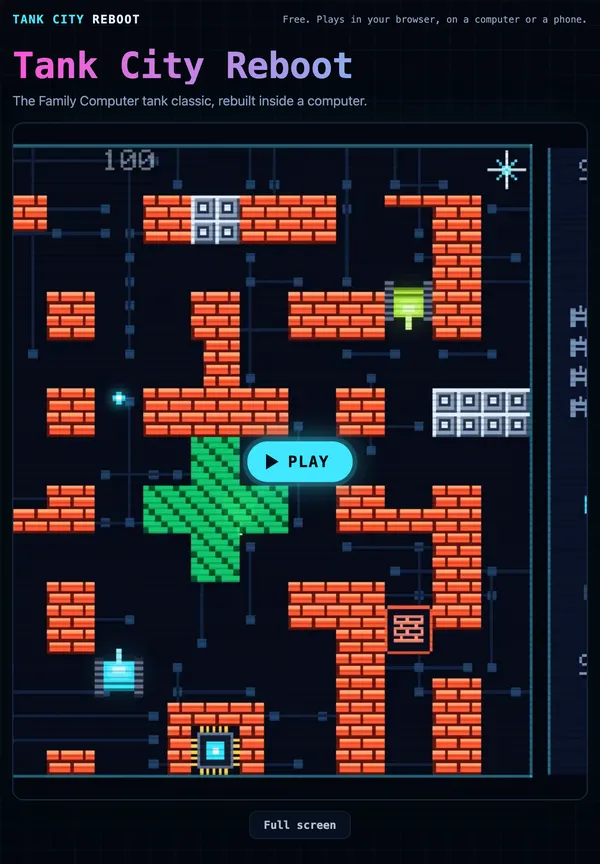
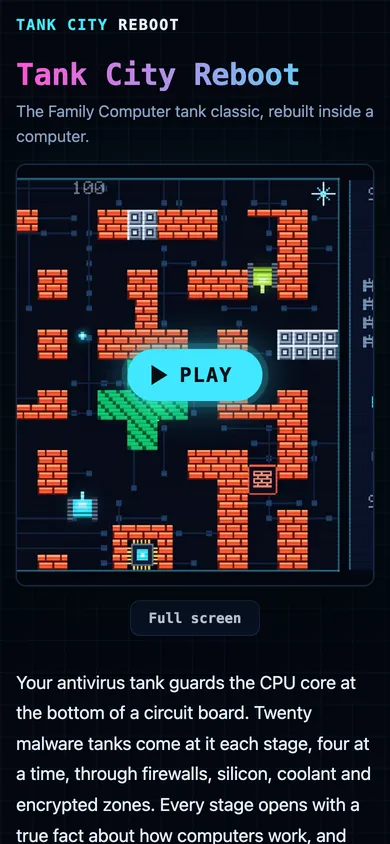
If you want to see the idea in action rather than read about it, Tank City Reboot is a free browser game where certain enemy tanks carry a power-up that drops at a random spot when you hit them, with nothing to install and no account needed.
What is a random drop in games? How loot and power-ups appear
A random drop is any reward whose type, timing or place is decided by chance. The enemy you beat, the chest you open or the wave you clear triggers a roll. The game then picks from a set of options.
Three things can be random:
- Whether something drops at all.
- What drops, out of the possible items.
- Where it lands, such as a random spot on the map.
Some games randomize all three. Others fix one or two so the result feels fair. Knowing which parts are random helps you plan.
How drop tables and weights decide what appears
Behind most random drops sits a drop table. It is a list of possible rewards, each with a number attached. That number is the weight. A bigger weight means a bigger share of the rolls.
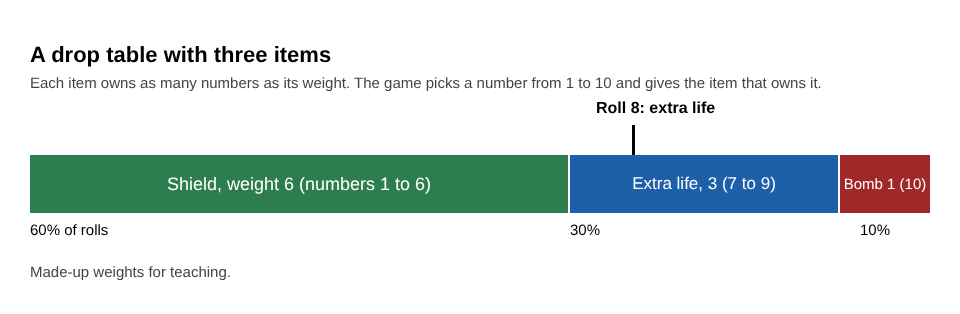
Here is a simple worked example. Say a table has three items:
- Shield, weight 6
- Extra life, weight 3
- Bomb, weight 1
The weights add up to 10. The game picks a number from 1 to 10. A result of 1 to 6 gives a shield, 7 to 9 gives an extra life, and 10 gives a bomb. So a shield shows up 60 percent of the time and a bomb only 10 percent.
If every weight is equal, the table is called uniform. Each item has the same chance. That is the simplest case, and it is common for small games with a short list of rewards.
Loot drops vs power-up drops: what is the difference?
The two ideas overlap, but they feel different to play.
Loot drops
Loot is something you keep. A sword, armor piece or currency goes into your inventory and stays there across sessions. Because it lasts, loot is often tied to rarity, trading and long-term goals.
Power-up drops
A power-up is temporary or tied to a single run. You grab it, it helps for a few seconds or until you lose a life, and then it is gone. Power-ups are about the moment: do you risk crossing the open ground to pick it up?
The roll works the same way in both. The difference is how long the reward lasts and how much it changes your next ten minutes versus your next ten hours.
Rarity tiers and drop rates explained
Many games sort rewards into tiers, such as common, uncommon, rare and so on. Each tier gets a different weight. Common items have a high weight and rare ones have a low weight.
The drop rate is the share of rolls that give a certain item. If an item has a 2 percent drop rate, you should expect it about once in 50 rolls on average. Notice the words "on average". You might get it on roll three or not until roll 120.
This is the part people misread most. A 2 percent chance does not mean you are owed a drop after 50 tries. Each roll is independent, so the odds on roll 51 are the same 2 percent. Weighted odds are covered in weighted random choice.
Why random drops keep players coming back
Random rewards are interesting because you cannot fully predict them. A fixed reward is a checklist item. A random one is a small event.
A few reasons they work:
- Variety. Two runs of the same level end up different, so you adapt instead of memorizing.
- Anticipation. You look at an enemy and wonder what it might leave behind.
- Decisions. A drop in a dangerous spot forces a choice between safety and gain.
There is also a cost. Too much randomness feels unfair, because skill stops mattering. Designers try to keep the dice from deciding the whole outcome, which leads to the next topic.
How pseudo-random systems and pity timers keep drops fair
Computers do not roll real dice. They use a pseudo-random number generator, a formula that produces numbers that look random. Given the same starting value, called a seed, it gives the same sequence every time. That is useful: developers can reproduce a bug, and a level can be rebuilt from a seed.
For how a seed makes a random sequence repeatable, see what a random seed is.
Designers also add rules on top of the dice to soften bad luck:
- Fixed reward slots. Certain enemies always carry a reward, so you never go a whole level with nothing.
- Replacement rules. A new drop can take the place of an old one that is still waiting, so the field does not fill up.
- Expiry timers. A reward disappears after a set time, which keeps you moving.
- Pity timers. A hidden counter rises with each miss and forces a drop once it reaches a limit.
Pity timers are the strongest fix for the "I have been unlucky for an hour" problem. They trade a little pure randomness for a promise that bad streaks have an end.
Random drops in tank games like Tank City Reboot
Tank City Reboot is a good small example, because its drops mix fixed rules with chance in a way you can see on screen.
In the first game, your antivirus tank defends the CPU core against 20 malware tanks per stage. The 4th, 11th and 18th tank of each stage carry a power-up and blink so you can spot them. That part is fixed. You always know which tanks matter.
The random part comes after. The first hit on a carrier drops its power-up, even if the tank survives. The kind is one of six picked at random: Patch, Overclock, Breakpoint, Garbage collection, Firewall rebuild or Backup. It also lands on a random spot on the board.
Then the fairness rules kick in:
- The power-up waits 20 seconds and blinks in its last 4, so you get a warning before it vanishes.
- A new drop replaces one that is still waiting.
- Picking one up scores 500 points.
Here is how that plays out. Say the 4th tank blinks and you hit it. A power-up appears across the map, right next to a column of enemies. You now have 20 seconds to decide. If it turns out to be Breakpoint, every enemy freezes for eight seconds, which makes the trip worth it. If it is a Backup, you gain one extra life. Either way, you had to weigh the risk before you knew the exact result.
One detail is worth knowing. If you use Garbage collection, which wipes out every enemy on the field, a carrier destroyed that way drops nothing. So the strongest power-up also closes off future drops from those tanks.
The second game, Tank City Zero Day, uses chance in a different place. Every wave is a freshly generated arena drawn from a seed, and the game draws it again from the next seed if it is unfair. After each wave you pick one of three upgrades, each a different one not yet at its limit, so what you get is your choice and not a roll.
For more on the rewards themselves, read what each power-up does and what a power-up is.
Frequently asked questions
What does "random drop" mean in a video game?
It means a reward appears because of a chance roll instead of a fixed script. The game may randomize whether it drops, what it is, and where it lands.
What is a drop rate?
A drop rate is the share of rolls that give a particular item. A 2 percent rate means about one in 50 rolls on average, but each roll is independent, so a streak of misses does not raise your odds.
What is a drop table?
A drop table is the list of possible rewards for an event, with a weight on each one. Higher weights come up more often.
Are random drops really random?
Mostly they are pseudo-random. A formula produces numbers that look random, and designers often add rules such as fixed reward carriers, expiry timers or pity counters to keep results fair.
What is a power-up drop?
It is a temporary reward, such as a shield or a freeze, that helps for a short time or until you lose a life. Unlike loot, it does not stay in an inventory.
Get started
The best way to understand drop tables, timers and risk is to watch one work. Hit a blinking tank, see what lands, and decide whether to run for it.
Play Tank City Reboot: it is free, plays in your browser on a computer or a phone, and needs no account.
Comments
No comments yet.
Sign in or make an account to comment.