What is a tabby cat? The four patterns, explained
What is a tabby cat? It is a cat with a tabby coat pattern: stripes, swirls, spots or banded hairs, with an "M" marked on the forehead. It is not a breed. The Cat Fanciers' Association (CFA), a cat breed registry, puts it plainly: tabby is a pattern, not a breed. So a tabby can be a pedigreed cat or the mixed-breed cat next door. This guide shows you how to spot one, how to tell the four tabby patterns apart, and how to describe the tabbies you meet like an expert would.
What is a tabby cat? A pattern, not a breed
The CFA's Coat and Color Descriptions page makes the key point early. When you describe a cat's coat, the colour and pattern refer to the coat and nothing else. They do not suggest the breed, if the cat has one at all.
That is why you can meet a tabby almost anywhere. The CFA gives examples from the show ring, such as a Tabby Oriental or a Tabby Maine Coon Cat. And the same pattern turns up on cats with no pedigree at all, on garden walls and in shelters.
Tabby is also old. The CFA's article Patterns in the Domesticated Cat says most experts consider the brown mackerel tabby shorthair to be the main ancestor of the domesticated cat. It adds a saying you may have heard: that "all cats" are tabbies beneath the many genetic changes of the last several thousand years.
The markings all tabbies share
Whatever the pattern on its sides, a tabby has a set of markings you can learn to spot. The CFA lists them:
- An "M" on the forehead. The CFA calls it the distinctive marking of each tabby-patterned cat.
- Mascara markings. Lines that frame the eyes and trace across the face.
- Bars on the legs. Stripes or bars running around the legs.
- Buttons down the tummy. A row of dark spots on the belly.
- A spine line. A dark line down the centre of the back.
- Rings around the tail. Bands of colour along the tail.
Some tabbies are more elaborately marked. The CFA mentions "bracelets", "butterflies" across the shoulders and "necklaces" on the chest. If you only get a quick look at a cat, check the forehead first. The "M" is the fastest clue.
The four tabby patterns
The CFA says a tabby may have one of four patterns. The markings above are shared. What changes is the design on the body.
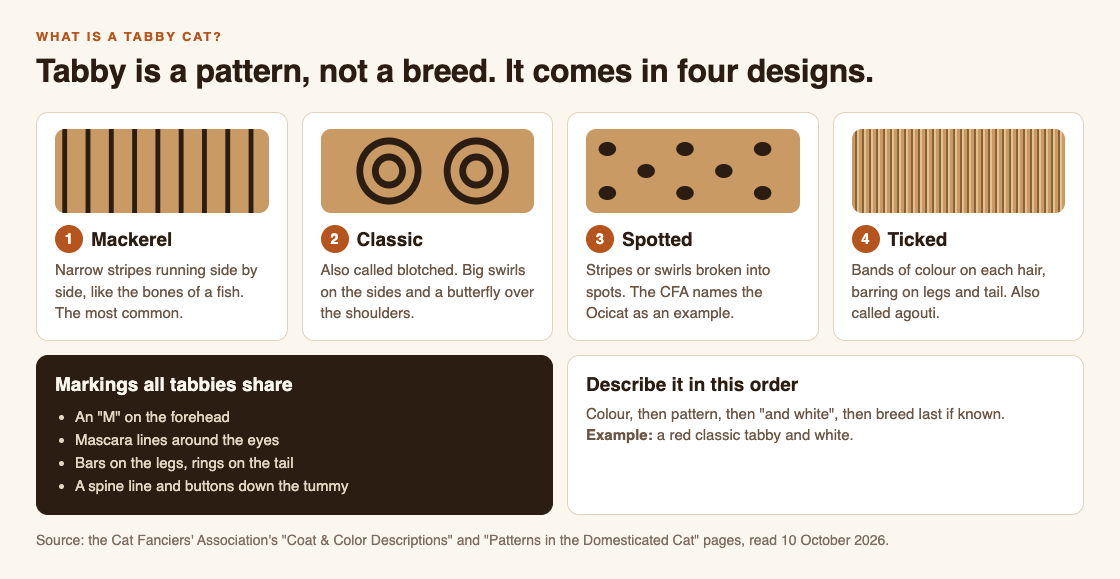
Four patterns, one family. Look at the sides of the cat to tell them apart.
- Mackerel. Narrow stripes that run parallel to each other, like the bones of a fish, which is where the name comes from. The CFA calls it the most common tabby pattern.
- Classic. Also called blotched. Elaborate swirls on the sides and a "butterfly" over the shoulders.
- Spotted. Like mackerel or classic, but the stripes or swirls look broken into spots. The CFA names the Ocicat as a good example.
- Ticked. Each hair on the body and head carries several bands of colour, with barring on the legs and tail. It is also called the agouti tabby. The CFA names the Abyssinian as a typical example.
The pattern stays the same whatever the colour. The CFA's pattern article notes that classic tabby markings look the same on a silver, red or brown cat.
Tabby colours, and the names experts use
The CFA admits tabby colours are among the hardest for people to learn. The reason is that experts use their own names:
- Brown tabby: a warm brown or bronze background with black stripes. Genetically it is a black tabby. The CFA says it is called brown out of convention and habit, and because "brown tabby" better describes what you see.
- Silver tabby: a silver-white background with black markings.
- Red tabby: what most people call an orange or ginger tabby. Experts call an orange cat red.
- Blue tabby: experts call a gray cat blue.
- Cream tabby: a light beige background with darker beige stripes.
The CFA lists other tabby colours too, including chestnut, cinnamon, cameo and lilac.
One mix is worth knowing. A brown, silver or blue tabby with patches of red or cream is a "patched tabby". The CFA says that patching is linked to the sex-linked orange gene, so the cat is most likely female. It is the same gene behind the calico pattern, which we explain in What is a calico cat?
Where tabby kittens come from
The CFA's Basic Feline Genetics page gives a few rules of thumb. It says they are generally true, but that there are exceptions.
- A tabby kitten must have a tabby parent.
- Red and cream cats can fool you. They may show faint stripes, called "ghost markings", without having a tabby parent.
- Two classic tabby parents cannot produce a mackerel or spotted tabby kitten.
The ghost markings rule is useful on a walk. If you meet an orange cat with faint stripes, it may be a true red tabby, or a red cat showing ghost markings. You cannot tell which from looking alone, and that is fine. What you see is still a red cat with tabby markings.
A worked example: three tabbies on one walk
The CFA has a set order for describing a cat. Name the colour first, then the pattern, then the coat length and special features. "And white" goes after the colour and pattern. The breed name goes last, if there is one. Its own example is "a red mackerel tabby and white Maine Coon Cat".
Say you meet three tabbies on a 20-minute walk. Here is how to describe each:
- A gray-brown cat with narrow stripes on a garden wall. The background is warm brown and the stripes are black and thin, like fish bones. Colour: brown. Pattern: mackerel. It is a brown mackerel tabby, the pattern the CFA calls the most common.
- An orange cat with swirls and a white chest in a doorway. Orange is red to an expert. The swirls on its sides make it classic. The white chest adds "and white". It is a red classic tabby and white.
- A pale, almost white cat with thin black stripes by a gate. The background is silver-white and the markings are black. It is a silver mackerel tabby.
Notice what you did not say: a breed. Unless you know a cat came from a breeder, the CFA's article A Pattern Does Not a Breed Make suggests answering with colour and pattern, which is how its author answers when someone asks what their cat is. For a fuller check on breed, see Is my cat a mixed breed? How to tell in 5 checks.
Log the tabbies you meet with Cat Go
Once you can read a tabby's pattern, a walk turns into a small spotting game. Cat Go is a game that plays in your web browser. In the site's words: "Walk anywhere, photograph a real cat, lure it with food and catch it. Every catch keeps its breed and where you found it."
Here is how the brown mackerel tabby on the wall would go:
- Tap the camera on the map and take its photo. The camera screen says "Fit the whole cat in the frame", which also helps you see the stripes on its sides.
- The game asks "Which breed is it?" and gives you a list with a search box. You pick; the game does not decide for you.
- Tabby is a pattern, not a breed, so for a cat with no known pedigree pick mixed breed. The screen backs you up: "Most cats you meet are mixed breed. Rarer breeds are warier." and "Mixed breed is always a safe pick."
- Toss in-game treats to win it over. A caught cat is "Saved to your Catdex with its breed and the place you found it", and you can give it a name. A name like "Mackerel" keeps the pattern with the catch.

The bar at the top counts your cats and breeds out of the game's 34.
Cat Go needs the camera and location allowed in your browser. If you like spotting patterns, our guide to the tuxedo cat covers the black and white bi-color.
Frequently asked questions
Is a tabby cat a breed?
No. The CFA says tabby is a pattern, not a breed. Pedigreed cats and mixed-breed cats can both be tabbies.
How can I tell if a cat is a tabby?
Look for the "M" on its forehead. Tabbies also have lines around the eyes, bars on the legs, rings on the tail and a dark line down the back.
What is the most common tabby pattern?
The CFA calls mackerel the most common tabby pattern, with narrow parallel stripes. It calls the brown mackerel tabby one of the original colours and patterns of cats.
Are orange tabby cats always male?
The CFA pages opened for this guide do not say that. They do say a brown, silver or blue tabby with red or cream patches is most likely female, because of the sex-linked orange gene.
Get started
On your next walk, check each cat's forehead for the "M", then name its colour and pattern before anything else. Then play Cat Go in your browser: walk anywhere, photograph a real cat, lure it with food and catch it, and keep its breed and the place you found it in your Catdex.
Comments
No comments yet.
Sign in or make an account to comment.