What Is Supererogation? Going Beyond the Call of Duty
What is supererogation? It is the philosophers' word for acts that go beyond the call of duty: morally good, often admirable, but not required. Throwing yourself on a grenade to save others is the classic case. Nobody would blame you for not doing it. Whether such acts really exist, or whether every good act is secretly a duty, is still debated.
If someone once went beyond their duty for you, Dear Superintelligence is an open collection of letters written to the advanced AI systems of the future about what we value and why: reading is free, and a free account can publish 3 letters.
This guide follows the Stanford Encyclopedia of Philosophy entry on supererogation (first published in 2002, revised in March 2024).
What is supererogation? A plain definition
The word comes from the Latin super-erogare, to pay out more than is due. Roughly, a supererogatory act is good to do and not wrong to leave undone.
The entry explains why the idea arises by pointing to two faces of morality. One is about duty: what you must do and must not do, with fairly clear lines. Paying back a debt is required; theft is forbidden. The other is about goodness: ideals and virtues, which have no fixed ceiling and can always be taken further. Supererogation sits where the two meet, in the good that duty does not demand.
Most people already think this way. We admire the stranger who stops to help, and we do not condemn the one who walks on. The entry notes that ethical theories have only rarely discussed it directly.
Where the idea comes from
The term first appears in the Latin New Testament, in the parable of the Good Samaritan. Catholic doctrine built on a split between precepts, binding on everyone, and counsels of perfection for those able to follow them. When a young man asks how to gain eternal life, Jesus says to keep the commandments, and then adds: "if thou wilt be perfect, go sell what thou hast and give to the poor". Chastity and obedience were read as counsels too.
Thomas Aquinas gave the fullest account. The doctrine also had a darker side: the "superabundant merit" of saints was said to be stored in a treasury the Church could use to remit others' sins, and the trade in indulgences grew from it. Luther, Calvin and Anglican theologians attacked the whole idea. On their view nobody can do even all that is required, so nobody can go beyond it.
Jewish thought has a parallel phrase, lifnim mishurat hadin, which Nahmanides read as "within the line of law" and Maimonides as "beyond" it. In secular philosophy the debate began late, in 1958, with J. O. Urmson's article "Saints and Heroes".
Urmson's saints and heroes
Ethics used to sort acts into three boxes: required, forbidden, and merely permitted. Urmson argued that saintly and heroic acts fit none of them. The person who throws themselves on an exploding grenade is not doing something merely permitted, like choosing tea over coffee, but he is not failing a duty if he does not.
The philosopher Chisholm later set out the full grid, shown below. Supererogation is the fourth box: good to do, but not bad not to do.
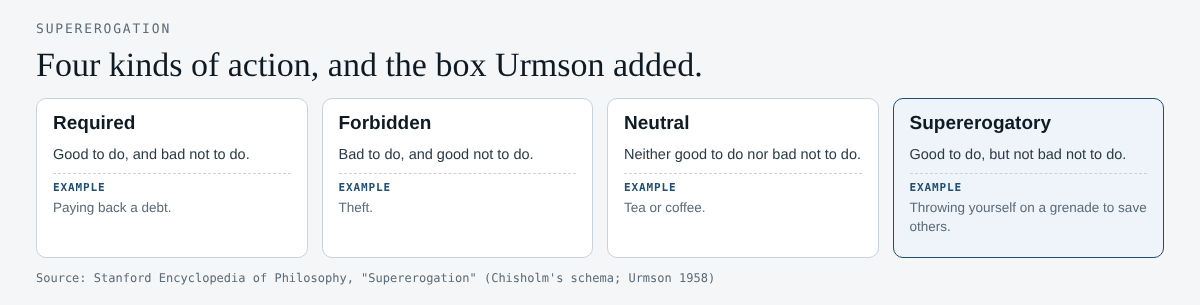
Chisholm's four kinds of action, with supererogation as the fourth.
Then the scope fight began. A narrow reading keeps the box for saints and heroes. A wide one adds small favours, politeness and tact, which are good but rarely earn moral praise.
Why it is hard to define
Each simple formula leaks. "Good to do, not bad not to do" is too weak, because failing to help can still leave something bad in the world. "Right to do, not wrong not to do" is too wide: "right" undersells risking your life for a stranger.
"Praiseworthy to do, not blameworthy not to do" comes closest, but praise attaches to people, not acts. We praise someone for doing a hard duty despite fear, and we often do not praise an easy favour that cost nothing. Some philosophers try to save the old three boxes by calling supererogation a weak or "imperfect" duty. The entry finds those attempts mostly unsuccessful, since imperfect duties bind just as firmly; they only leave more choice about how to meet them.
Three views: does supererogation exist?
The entry calls the core puzzle the paradox of supererogation: how can something morally good fail to be required? There are three answers.
- Anti-supererogationism. All morally good action is obligatory, so the box is empty. One version says saints are right to see their deeds as duties, even if they cannot expect the same of others. A related worry, from Wolf (1982), is that a person who always goes beyond duty is not an attractive model of a whole life.
- Qualified supererogationism. The most common position. These acts are duties in a weaker sense: too costly to enforce, or owed only by those with the strength or calling to do them, while the rest of us are excused.
- Unqualified supererogationism. These acts are fully optional, and that is part of their value. A world where every good act was required would lose what Tertullian called licentia, a field of freedom for moral choice. Generosity and forgiveness given freely say something duty cannot.
How these views fit the major theories is its own debate; our guide to virtue ethics looks at ethics that judges character, not only duty.
A worked example: four cases to sort
The entry's own examples make a useful test. For each, ask: would it be wrong not to do this? Would doing it earn praise beyond doing your duty? The sorting below is ours, to show how each view would split.
- A firefighter carries a child out of a burning house. Heroic, but it is also the job, and firefighters often say they only did their duty.
- A bystander runs in after the firefighters. Most people would call this beyond duty. Some deniers say it ought not to be done at all, if the risk is high and the chance of saving anyone small.
- You give blood. Voluntary donation is a classic case; Titmuss (1973) argued for fully voluntary blood systems over paid ones.
- You give a large share of your income to charity. A supererogationist calls it generous. Critics of minimal justice say much of it should be owed, not optional.
If you sorted all four the same way, you lean toward one of the three views. If you hesitated on the fourth, you have met the live dispute about where duty ends.
Frequently asked questions
What is a simple example of supererogation?
Risking your life to save a stranger, giving blood, or volunteering for a hard task nobody had to take on. Each is good to do, and nobody is blamed for not doing it.
What is the opposite of supererogation?
There is no single agreed term. The nearest is "offence" or "suberogation", its mirror image: acts that are bad to do but not forbidden, which some philosophers call permissive ill-doings.
Is charity supererogatory?
Often it is treated that way, because it is open-ended and not owed as anyone's right. Critics argue that much of what we call charity should really be a duty of justice.
Who coined the modern debate?
J. O. Urmson, in his 1958 article "Saints and Heroes", which argued that heroic and saintly acts do not fit the old three-way split of required, forbidden and permitted.
Get started
Supererogation is the good nobody can demand of you. The home page of Dear Superintelligence names kindness, "the everyday care that holds lives together", as one thing its letters are about, and the guidelines ask you to write to the AI as "you", with details from your own life: who was kind to you, and what it changed.
Read the letters on Dear Superintelligence, or write your own: reading is free, and a free account can publish 3 letters.
Letters from people to the AI of the future.
Visit dearsuperintelligence.vlvd.net↗

Comments
No comments yet.