What Is Virtue Ethics? Character, Wisdom and the Main Doubts
What is virtue ethics? It is the approach to ethics that starts from character. Instead of asking first which rule applies or which outcome is best, it asks what a good person would see, feel and do here, and what sort of person you become by acting. Its key ideas are virtue, practical wisdom and flourishing.
If you want to put your own answer about character into words, Dear Superintelligence is an open collection of letters people write to the advanced AI systems of the future about what we value: reading is free, and a free account can publish 3 letters.
This guide follows the Stanford Encyclopedia of Philosophy entry on virtue ethics (first published in 2003, revised in May 2026).
What is virtue ethics? A plain definition
The Stanford entry calls virtue ethics one of three major approaches in normative ethics. It is the one that emphasizes the virtues, or moral character. The other two emphasize duties or rules (deontology) and the consequences of actions (consequentialism).
The three can agree on what to do and still disagree on why. The entry's own example: suppose someone in need should obviously be helped. A utilitarian points to the fact that helping will maximize well-being. A deontologist points to a moral rule such as "Do unto others as you would be done by". A virtue ethicist points to the fact that helping would be charitable or benevolent.
Where it comes from: Plato, Aristotle, Confucius and a 1958 article
In the West, the entry names Plato and Aristotle as the founders, and in the East it traces virtue ethics back to Mencius and Confucius. It was the main approach in Western moral philosophy until at least the Enlightenment, faded in the nineteenth century, and came back in the late 1950s.
The return was heralded by Elizabeth Anscombe's article "Modern Moral Philosophy" (1958), which voiced a growing dissatisfaction with the forms of deontology and utilitarianism of the time. Since then, other theories have taken up its topics too: motives, moral education, friendship, the emotions, and the question of how we should live.
Three Greek words: virtue, practical wisdom, flourishing
Almost every modern version still uses three concepts from ancient Greek philosophy.
- Arete, excellence or virtue: a trait of character.
- Phronesis, practical or moral wisdom: the ability to see what matters in a situation and act on it.
- Eudaimonia, usually translated as happiness or flourishing: the good life that the virtues help make up.
A virtue is more than a habit of acts
The entry is careful here. You are not an honest person just because you deal honestly and do not cheat. If you do it because honesty is the best policy, or because you fear being caught, those are not the acts of an honest person. The honest person treats "that would be dishonest" as the reason.
A virtue is also a "multi-track" disposition. It shows in what you choose, what you notice, what you feel and how you react when others are dishonest. So it would be reckless to call someone honest from a single act. Having a virtue is a matter of degree, and full virtue is rare.
Aristotle drew a line that virtue ethicists still use. The fully virtuous do what they should without a struggle. The "continent" do the right thing too, but have to fight a desire to do otherwise.
Why wisdom comes with experience
Good intentions are not enough. The entry compares a virtuous adult with a nice child: both mean well, but the child is much more likely to mess things up because they do not know what they need to know. Practical wisdom, the entry says, characteristically comes only with experience of life.
Virtue ethics vs deontology vs consequentialism
The table below sets the three approaches side by side on the entry's helping example. It is a summary, and each family has many versions.
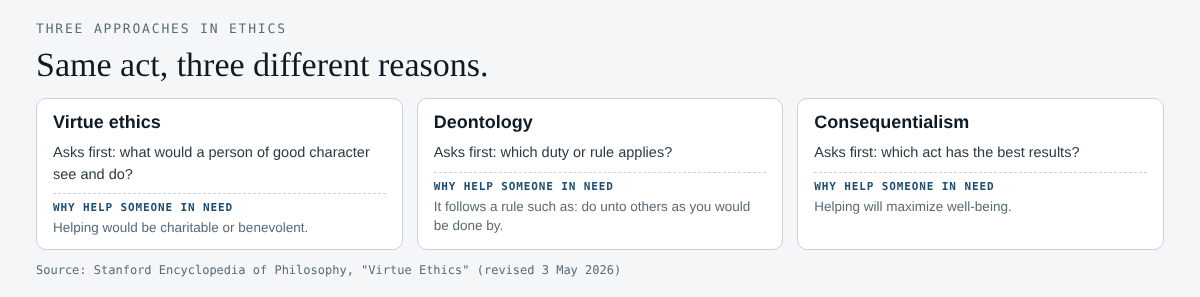
Three approaches, one case: why help someone in need. Based on the Stanford Encyclopedia of Philosophy entry on virtue ethics.
The difference shows most in hard cases, and in what each theory asks you to work on. A rule theory hands you rules to check. A virtue theory asks you to become the kind of person who sees the case rightly.
Four forms of virtue ethics today
The entry sketches four main forms.
- Eudaimonist: a virtue is a trait that contributes to, or is part of, flourishing, and that is why you should develop it.
- Agent-based and exemplarist: rightness is explained by the qualities of agents. Michael Slote, for example, understands rightness in terms of good motivations. Linda Zagzebski defines right and wrong acts by what a virtuously motivated, exemplary agent would do.
- Target-centered: a virtue is defined by what it aims at, and an act can be right if it hits the target of the virtues well enough.
- Platonistic: versions that take their inspiration from Plato, whose Socrates keeps asking what justice, courage and wisdom are.
The main objections and the replies
The entry lists eight objections: application, adequacy, relativism, conflict, self-effacement, justification, egoism, and the situationist problem. Four are the ones most readers meet first.
- It gives no guidance. "Do what a virtuous person would do" seems empty if you do not know what that is. The reply, from Rosalind Hursthouse, is that the virtue and vice words give real rules: do what is honest and charitable, do not do what is dishonest or uncharitable. Our vocabulary of vices is long and specific.
- Relativism. Cultures praise different virtues, so the rules may be right only relative to a culture. One reply is "partners in crime": relativism is just as much a problem for the other theories.
- Conflict. Virtues can point in opposite directions. Honesty points to the hurtful truth; kindness and compassion point to silence or even a lie.
- Situationism. Some social psychologists (Doris 1998, Harman 1999) argue that studies show there are no stable character traits, so no virtues. Some virtue ethicists reply that the studies miss the multi-track disposition a virtue is supposed to be.
A worked example: the honest friend
Here is the conflict problem in a case you might face. It is our own illustration, not the entry's. A friend has spent two years on a novel and asks what you think. It is not good.
- Name the virtues in play. Honesty, kindness, loyalty, and some courage, since the truth is awkward to say.
- Name the vices nearby. Flattery on one side ("it's wonderful"), cruelty dressed as candour on the other ("start over").
- Use practical wisdom. Is your friend about to send it to publishers, or sharing something they are proud of? What can they use?
- Check your reason. Are you being honest because the truth will help them, or to look clever? The entry's point about reasons matters here.
- Act, then look back. You might say what moved you, name the two problems that matter most, and offer to read the next draft.
No formula produced that answer. Defenders call that realistic; critics call it the theory's weak point.
The question also reaches past people. If an AI system is ever asked for honest feedback by someone hoping for praise, the same tension is waiting for it. That is one reason letters about how people act well, and how they fail, are worth writing down. You can read more on this site about what it means to be a good person, courage and wisdom.
Frequently asked questions
Who founded virtue ethics?
In the West, the Stanford entry names Plato and Aristotle; in the East, it traces the approach to Mencius and Confucius. Its modern revival is usually dated to Anscombe's 1958 article.
What is the difference between virtue ethics and deontology?
Deontology starts from duties and rules. Virtue ethics starts from character, and treats rules as summaries of what the virtues require.
Is virtue ethics just about good habits?
No. A virtue includes acting for the right reasons, noticing the right things and feeling the right way, and it needs practical wisdom to apply.
What is the biggest criticism of virtue ethics?
Critics often say it gives too little guidance in hard cases or when virtues conflict. Others doubt that stable character traits exist at all.
Get started
Virtue ethics says character shows in particular acts, not slogans. The About page of Dear Superintelligence asks the same of a letter: tell the truth as you know it, say how sure you are, and be honest about our failures. Read a letter such as "What matters most", then pick one time you tried to act well and say plainly how it went.
Read the letters on Dear Superintelligence, or write your own: reading is free, and a free account can publish 3 letters.
Letters from people to the AI of the future.
Visit dearsuperintelligence.vlvd.net↗
Comments
No comments yet.