2048 on a 3x3 board: is it harder than 4x4?
Playing 2048 on a 3x3 board sounds like an easier warm-up: fewer squares, fewer tiles to track. In practice it is the opposite. With 9 squares instead of 16, the board fills in a few dozen moves, and a simple count shows that a plain 3 by 3 board can never make a 2048 tile at all. This guide explains what changes on the smaller board, what our test games on a 3 by 3 face showed, and how a cube gives the room back.
What changes on a 3 by 3 board
The original 2048 is played on a 4 by 4 grid. You can see it in the game's code on GitHub, which builds a board of size 4, and in Wikipedia's 2048 article), which also notes that versions with bigger and smaller grids have been made. The rules stay the same on a smaller grid: slide, merge equal tiles, and a new 2 or 4 drops into an empty square after every move.
What changes is room:
- 9 squares, not 16. That is 7 fewer places for new tiles to land.
- Rows of three. Each row and column holds only three tiles, so you have fewer ways to line up a merge.
- Less space for a plan. The usual plan of a big tile in a corner with a full row of large tiles beside it uses 4 of the 16 squares on a big board. On a small board, the same row is a third of everything you have.
The game still ends the same way: no empty squares and no two equal tiles side by side.
Three in a row: the merge rule that matters more
On a 3 by 3 board, three equal tiles in one row is common. Wikipedia gives the rule: when three equal tiles slide together, only the two farthest along the slide merge. Slide 2, 2, 2 to the left and you get a 4 then a 2, not an 8.
On a big board you can often wait for a fourth tile and merge two pairs at once. On a row of three you cannot, so one tile is always left over. That leftover takes up one of only nine squares.
Is 2048 on a 3x3 board harder than 4x4?
Yes, and not only a little. Here is a count anyone can check. To make a tile, you need two of the size below it. While the first one waits on the board, you have to build the second one, which needs two of the size below that, and so on. So at the last moment before the big merge, the board has to hold one tile of every size from the biggest down, plus a pair at the bottom.
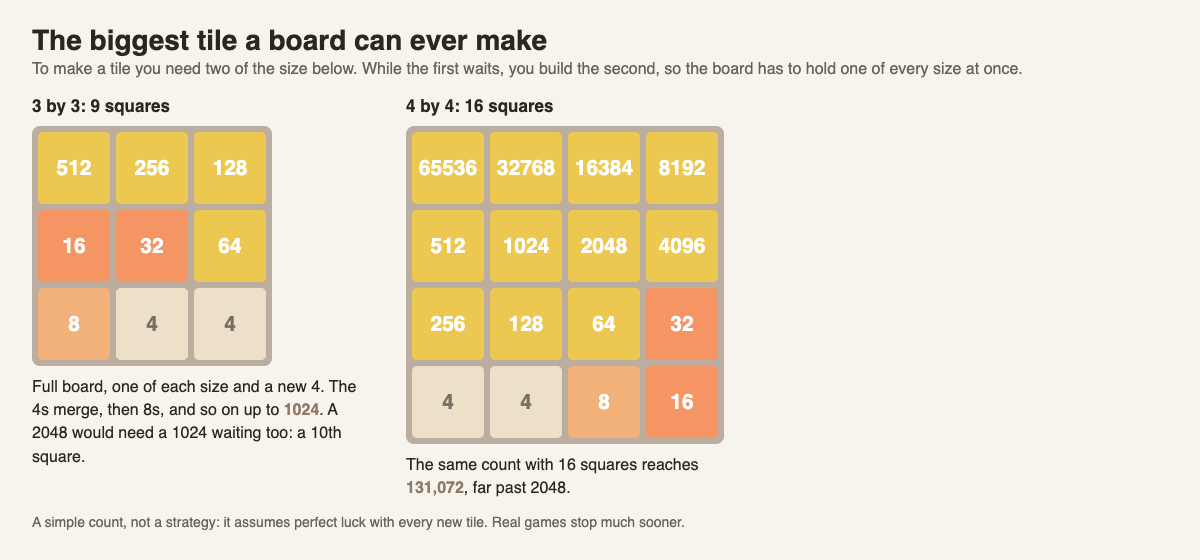
The longest chain each board can hold, if every new tile lands just right.
A new tile can be a 4, so the smallest pair is two 4s. On 9 squares the best you can hold is 512, 256, 128, 64, 32, 16, 8, 4 and a new 4. Merge from the bottom up and you reach 1024. To reach 2048, you would need a 1024 waiting on the board as well, and that is a tenth tile with no square to sit on. The same count on 16 squares reaches 131,072.
This count assumes perfect luck with every new tile. Real games stop long before it, as our tests show.
What our test games on a 3 by 3 face showed
3D 2048 puts 2048 on a cube like a Rubik's cube. Each face is 3 by 3, and you slide the front face as in 2048. If you never twist or turn the cube, the front face plays like a plain 3 by 3 game. We ran six short games that way, in a browser, signed out, with a simple script that only slid the front face. Each is one game, not an average, and a script with fixed rules is not a skilled player:
- Stuck at move 46, score 332, best tile 32.
- Stuck at move 42, score 260, best tile 32.
- Stuck at move 37, score 220, best tile 32.
- Stuck at move 32, score 180, best tile 32.
- Stuck at move 31, score 148, best tile 16.
- Stuck at move 28, score 160, best tile 32.
No game got past 32 or past move 46. Each time the face filled up and the game showed: "Nothing moves that way. Try another way, or twist a row."
A worked example: give the face more room
That message is the way out. 3D 2048 has six faces of nine squares, 54 in all, and two more kinds of move. A twist drags a row on the right face sideways, or a column on the top face, and carries its tiles round to the next face. A turn moves the whole cube so you can use its other sides, and turning is free. A twist needs one empty square for the new tile it adds.
Here is how to use them when the front face fills up:
- Slide until the front is nearly full. Play it like a 3 by 3 game, with your biggest tile in a corner.
- Twist a row away before you are stuck. Carry a row of small tiles onto the next face. If the row that comes in from the other side is empty, the front gets empty squares back.
- Twist tiles back next to their match. When a side face holds a tile equal to one on the front, twist it round beside it and slide to merge.
- Keep one face with room. When the game ends, it says: "Next time, keep room on one face so a twist can still bring tiles round to their match."
In one longer test game, our script slid until the front face was stuck and then twisted. It reached 64 at move 36 with every tile still on the front, then 128 at move 118, with tiles spread over four faces. That is four times the best tile of any slides-only game.
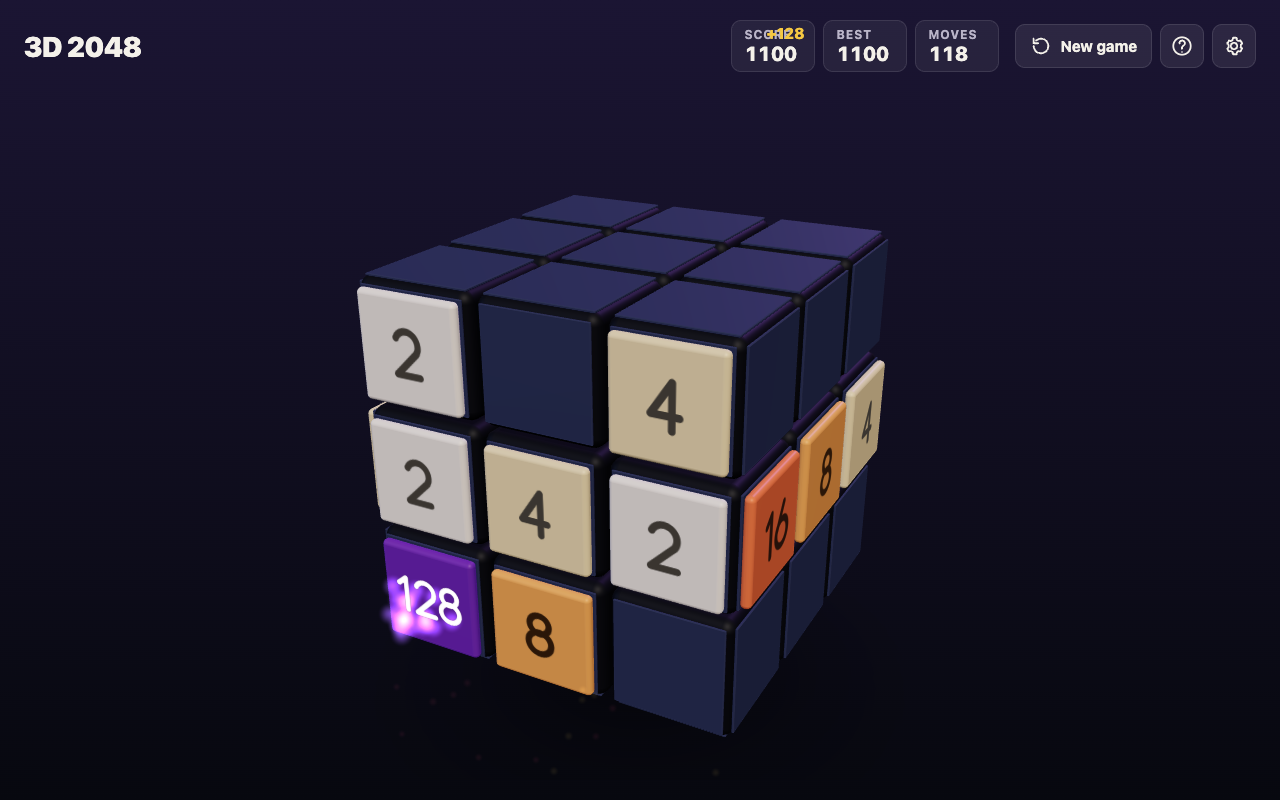
Move 118 of the longer test game: a 128 on the front, with tiles parked on the right face.
That game filled all 54 squares at move 165, with a score of 1160 after 39 twists. Our 3D 2048 tips post goes through it step by step, and how many squares a cube like this has explains where the 54 come from.
Frequently asked questions
Can you make 2048 on a 3x3 board?
Not on a plain 3 by 3 board. By the count above, its biggest possible tile is 1024, because a 2048 needs ten tiles on the board at once.
Why does a 3x3 game end so fast?
Nine squares fill quickly, and rows of three leave a tile over when three equal tiles meet. In our slides-only tests, the face filled within 28 to 46 moves.
Is 3D 2048 a 3x3 game?
Each face is 3 by 3, but the cube has 54 squares. Twists carry tiles between faces, so the front face does not have to hold everything.
Get started
Try one game with slides only, and note your best tile when the front face fills. Then play again and twist a row away before you are stuck. If the controls are new, how to play 3D 2048 explains the slide, the twist and the turn.
Play 3D 2048: it is free and plays in your browser on a computer or a phone.
Comments
No comments yet.
Sign in or make an account to comment.