What Is Well-Being? Pleasure, Desire and the Objective List
What is well-being? In philosophy, your well-being is how well your life is going for you: what is good for you, in itself, and not only as a means to something else. Pleasure and friendship are the usual examples. Philosophers agree on that much and disagree on the rest. The three main theories say well-being is pleasure, getting what you want, or having a list of goods such as knowledge and friendship.
If thinking about what makes a life go well leaves you with something to say, Dear Superintelligence is an open collection of letters people write to the advanced AI systems of the future about what we value: reading is free, and a free account can publish 3 letters.
This guide follows the Stanford Encyclopedia of Philosophy entry on well-being (first published in 2001, revised in January 2026).
What is well-being? "Good for you" in plain words
Outside philosophy, "well-being" usually means health. A clinic can call itself a well-being clinic. Philosophers use the word more broadly: health may be part of your well-being, but it is not all of it.
The key words are "good for". A Vermeer painting can be beautiful, but its beauty is not good for the painting. Giving money to a charity can be morally good, but whether it is good for you is a separate question. Well-being is this third kind of value, sometimes called prudential value: what makes a life worth living from the point of view of the one living it.
Two more points shape the debate. Well-being can be judged over a whole life or at one time, and some philosophers think the shape matters: a life that starts badly and gets better may be better than one that goes downhill, even with the same total. And well-being can be negative. A life of terrible agony can be worse for the person than no life at all.
Well-being, happiness and health
In everyday speech, "happiness" often means a short feeling: "you look happy today". The entry prefers "well-being" for the wider question, partly so it can allow that a plant's life may go well for the plant without talking about a happy plant. Our post "What is happiness?" covers the feeling itself.
Positive psychology studies happiness too, usually as contentment or life satisfaction measured with self-reports and daily questionnaires. The entry notes that many researchers in the field seem to assume a pleasure-based view, while some reject it. Martin Seligman suggested studying positive emotion, engagement, relationships, meaning and accomplishment, known as PERMA, instead of happiness alone.
Most philosophers hold one account of well-being for everyone whose life can go well or badly. The entry notes that this would include non-human animals, and perhaps AI.
Hedonism: the balance of pleasure over pain
Hedonism says well-being is the greatest balance of pleasure over pain. Socrates and Protagoras state it in Plato's Protagoras, and Jeremy Bentham made it famous: pleasure and pain are our "two sovereign masters".
The first objection is that this puts every pleasure on a par. Thomas Carlyle called it the "philosophy of swine". The entry's test: before you are born, you may choose an 80-year fulfilling human life or the life of a barely sentient oyster with faint pleasures, as long as you like. If simple hedonism were right, some length of oyster life would win. Many people say no length would. John Stuart Mill answered by adding quality to Bentham's duration and intensity: some pleasures, like reading Shakespeare, are higher by nature, as people who have tried both can judge.
The weightier objection is Robert Nozick's experience machine. It could give you any experience you like, writing a great novel or bringing about world peace, and you would never know you were plugged in. Would you plug in for life? Nozick said no: "We want to do certain things". Hedonists reply that this intuition comes from common sense, and that pleasure is best pursued indirectly anyway. The entry warns against dismissing hedonism on this one case.
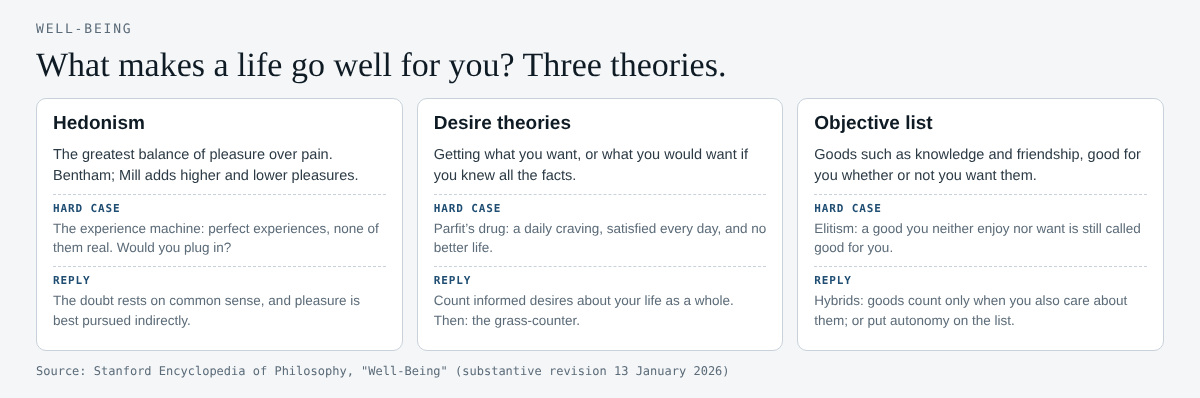
Three theories, each with the case that troubles it most.
Desire theories: getting what you want
Desire theories say your life goes well when your desires are fulfilled. They answer the experience machine: you wanted to write a novel, not to seem to. They also suit economics, which reads people's preferences from their choices instead of guessing at feelings inside their heads.
The simplest version, present desires, fails fast. The entry's case is an angry teenager who, refused a night out, wants to harm himself. Nobody thinks that would make his life go well. Counting all desires over a life runs into Derek Parfit's addictive drug: it gives no pleasure, only a strong daily craving that it satisfies. More satisfied desires, but no better life.
Ranking desires about your life as a whole fixes that, but meets the orphan monk, who stays a monk because he cannot picture any other life. So some move to informed desires: what you would want if you knew all the facts. Then comes John Rawls's case of a brilliant mathematician who, fully informed, wants only to count blades of grass. Some say that life would be best for her; others cannot accept it. The deeper worry, going back to Aristotle, is that we want things because we think they are good, not the reverse.
Objective list theories: goods whether or not you want them
Objective list theories name goods that make a life better whether or not they bring pleasure or are wanted, for example knowledge or friendship. The hard part is the list: leave out one real good and the theory is wrong. Some explain the list by human nature (perfectionism, after Aristotle), others by basic needs.
The common objection is elitism: telling people something is good for them even if they neither enjoy nor want it. One answer is a hybrid: goods benefit you only when you also enjoy or care about them. Another is to put autonomy on the list, so that living your own life for yourself is itself a good. The entry also notes that a theory of well-being does not by itself license anyone to run your life for you.
A worked example: the well-paid job far from home
The entry uses a choice many people meet: a highly paid job many miles from your friends and family. Here is a way to test the three theories on it. The questions are ours, built from the entry's cases.
- Pleasure. Over the next five years, which life holds more enjoyment and less pain? Count the lonely evenings as well as the bigger flat.
- Desire. Which do you want, and would you still want it if you knew what the first winter there would be like? That is the informed desire question.
- The list. Which life has more of the goods you would name even on a bad day: friendship, learning, work you are proud of?
- The machine check. If a machine could give you the feeling of either life, would you still care which one was real? If yes, pleasure is not all you think matters.
If the three answers agree, the choice is easy. If they split, you have found which theory you lean on. The philosopher T. M. Scanlon doubted we need "well-being" at all to choose, but the entry replies that people weigh exactly these trade-offs, like a visit to the dentist now against pain later.
Well-being, morality and what we owe each other
Well-being matters in every moral theory. Welfarism goes further: well-being is the only thing of value, and the force of any moral reason comes from it. Utilitarians, who say we should maximize total well-being, need a theory of it most.
Others push back. G. E. Moore in 1903 doubted that "good for me" adds anything to "good". Scanlon, in What Do We Owe to Each Other? (1998), argued the notion does less work in ethics than it seems. A related question, whether being good is good for you, runs through virtue ethics.
Frequently asked questions
What is the simplest definition of well-being?
How well your life is going for you: what is good for you in itself, not just as a means. Philosophers disagree about what that consists in.
Is well-being the same as happiness?
Not quite. Happiness often means a passing feeling or satisfaction with your life, while well-being covers everything that makes your life go well for you, which may include goods like friendship or knowledge.
What are the three theories of well-being?
Hedonism (the balance of pleasure over pain), desire theories (getting what you want, or would want if fully informed) and objective list theories (goods such as knowledge and friendship). The three-way split is from Derek Parfit (1984).
What is the experience machine?
Robert Nozick's 1974 thought experiment: a machine that gives you any experience you want. If you would refuse to plug in for life, something besides pleasant experience seems to matter to you.
Get started
Every theory here tries to say what makes a life go well. The guidelines of Dear Superintelligence ask letters for the evidence a theory leaves out: details from your own life over general arguments, written to the AI as "you". The About page asks for the things only someone living now would include, like what an ordinary Tuesday actually involved, and for a letter that says how sure its author is.
Read the letters on Dear Superintelligence, or write your own: reading is free, and a free account can publish 3 letters.
Letters from people to the AI of the future.
Visit dearsuperintelligence.vlvd.net↗
Comments
No comments yet.