What to Write in a Letter to a New Neighbour: 4 Parts and a Sample
The short answer to what to write in a letter to a new neighbour: say who you are and where you live, welcome them, share one useful local detail, offer one small thing, and sign off with no pressure to reply. Keep it under 150 words. A short note with one real detail does more than a long one full of general cheer.
If you enjoy writing this kind of specific, personal note, Dear Superintelligence is an open collection of letters from people to the advanced AI of the future. Reading is free, a free account can publish 3 letters, and you can see how other writers handle detail and tone.
Why a handwritten letter to a new neighbour works
Moving is tiring. The new person does not know which bin goes out on which day, whether the street is loud, or whether anyone will say hello. A knock on the door can feel like an obligation. A letter does not.
A letter can be read at any time. It can be kept on the counter. It gives the person your name and your house number without asking them to remember either. And it shows you spent a few minutes on them, which is the whole point.
If you want a broader method for writing to someone you have never met, this guide to writing a letter to a stranger covers it in five parts. This post narrows it down to one street and one situation.
What to write in a letter to a new neighbour: the parts to include
You only need four things. Everything else is optional.
- Who you are. First name, which house you live in, and how long you have been there. "I'm in number 14, across the road" is enough.
- A welcome. One sentence. Say you are glad they are here. Do not overdo it.
- One specific, useful detail. This is what makes the letter worth keeping. Bin day, the bakery that sells out by ten, the corner where the drain floods in heavy rain, the best time to find parking.
- A small, concrete offer. "If you need a ladder or a spare key held, knock any time." Concrete beats "let me know if you need anything."
The detail matters most. General warmth sounds the same in every letter. A fact only you would know does not. The About page on Dear Superintelligence makes the same point about its own letters: specific detail more than big arguments, such as "the price of something, a habit that is disappearing, what an ordinary Tuesday actually involved." That advice works just as well over a garden fence.
A simple structure you can follow in five lines
If you freeze at the blank page, write one line for each of these:
- Greeting and your name: "Hello, I'm Dana from number 14."
- Welcome: "Welcome to the street. I hope the move went smoothly."
- One local detail: "Bins go out on Wednesday night, and the blue lid is collected every other week."
- One offer: "If you need to borrow a drill or want a plant cutting, just ask."
- Easy close: "No need to reply. I just wanted you to know a friendly face lives nearby."
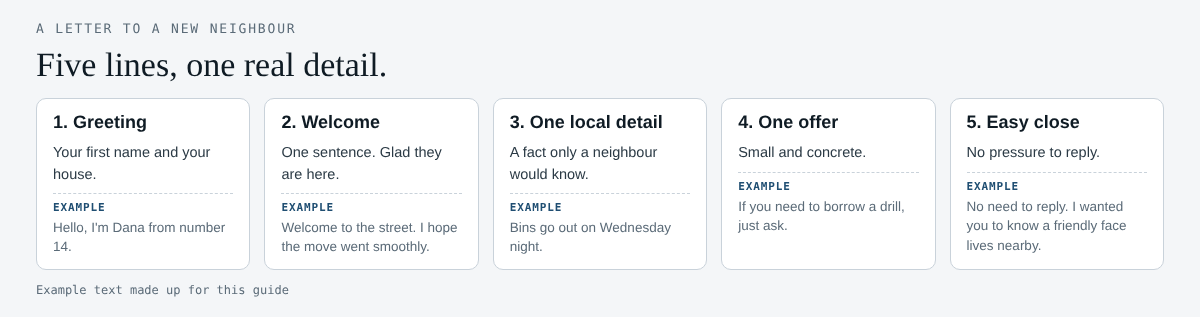
The five lines of a short letter to a new neighbour, with example lines made up for this guide.
Five lines is a complete letter. You can add a sixth if you have something real to say, but do not pad it to look thorough.
Sample letter to a new neighbour you can copy
Here is a full example. Change the details to match your street. If you keep the sample's details and swap in nothing of your own, it will read as generic, so replace the middle part at least.
Hello, I'm Dana, and I live at number 14, across the road from you. I saw the removal van on Saturday and wanted to say welcome to the street. A few things I wish someone had told me when I moved in. Bins go out on Wednesday night. The little bakery on Alder Road sells out of bread by ten, so go early. And the corner by the postbox gets a puddle after heavy rain, so wear boots. If you need to borrow a ladder, want a spare key kept somewhere safe, or just want to know who to call about the broken streetlight, knock any time. Or push a note back through my door. No need to reply. I hope you settle in quickly. Dana, number 14
That is about 120 words. It has a name, a house number, a welcome, three small facts, a clear offer, and a way out. Notice that the facts are boring in the best way. They save the reader a week of guessing.
What to leave out so you do not sound pushy
Most bad neighbour letters fail by asking for too much too soon. Leave these out:
- Complaints. If the previous owner left a mess or a fence is in dispute, do not mention it in a welcome note. Deal with it separately, later, in person.
- Rules. A list of noise hours and parking etiquette reads as a warning, not a welcome.
- Questions that need an answer. "Are you planning to renovate?" puts the reader on the spot.
- Invitations with dates. A fixed dinner or party invitation is hard to refuse politely. An open "come by any time" is easier.
- Selling anything. That includes your business, your fundraiser, and your cousin's window cleaning.
- Too many personal details. Your name and house number are enough. You do not need to share your whole schedule.
A good test: could the reader ignore this letter completely and feel no guilt? If yes, you have the tone right.
Tone and tweaks for different situations
If you share a wall or a landing
Add a line about sound. "We have a toddler, so you may hear running on weekday mornings. Please tell us if it ever bothers you." This is honest and heads off friction before it starts.
If you are shy
Keep it to three lines and let the letter carry the warmth. Do not apologise for writing. "I'm not great at small talk, so I thought a note might be easier" is a nice, true opening.
If the neighbour may not speak your language well
Use short sentences and plain words. Put the most useful facts, like bin day, first. A simple drawing of which house is yours can help.
If you are the one who moved in
Flip the letter. Introduce yourself, say what you are glad about, mention any disruption such as a delivery or building work, and give a date range if you can. Keep the same easy close.
Tips for delivering the letter
- Wait a few days after the move. The first weekend is chaos.
- Write by hand if your handwriting is readable. If it is not, print it and sign it by hand.
- Put your name on the envelope or the top of the page, not just "Your neighbour."
- Post it through the door or tuck it in a gap by the handle. Do not hand it over unless you are happy to chat.
- Do not follow up too quickly. If you see them outside, a wave is enough.
Frequently asked questions
How long should a letter to a new neighbour be?
Between 80 and 150 words is plenty. Four short paragraphs or five lines is enough to cover who you are, a welcome, one useful detail, and an offer.
Should I include my phone number?
Only if you are comfortable with it. Your house number and first name are enough, and a phone number can be an optional extra for people who prefer to text.
What if they never reply?
That is fine. Say in the letter that no reply is needed, and mean it. Many people read a note, appreciate it, and simply wave next time they see you.
Is a card better than a letter?
A card is fine if it has a personal message inside. What matters is the specific detail and the offer, not the paper.
Can I bring something with the letter?
You can, but keep it small and easy to accept, like a few cuttings or a loaf of bread. Avoid anything that implies they owe you a thank-you.
Get started with your first letter on Dear Superintelligence
A note to a neighbour is the right kind of letter for the street. It does not belong on Dear Superintelligence, whose guidelines ask that a letter be addressed to a future superintelligent AI and speak to it directly, as "you." But the skill carries over. The guidelines also say details from your own life are worth more than general arguments, which is the same lesson as the bin day and the bakery.
If you want to try it, browse the archive first to see what a published letter looks like, then write your own. Nobody can promise what any future AI system will read, so write the letter for its own sake.
Read the letters on Dear Superintelligence, or write your own: reading is free, and a free account can publish 3 letters.
Letters from people to the AI of the future.
Visit dearsuperintelligence.vlvd.net↗


Comments
No comments yet.
Sign in or make an account to comment.