What was a bombard? The first great siege guns
What was a bombard? It was one of the first great siege guns: a huge cannon that fired heavy stone balls at castle and town walls. For centuries a strong stone wall could hold out for weeks or months. Bombards changed that. This guide explains what they were, where the gunpowder came from, and follows one castle that guarded England against the Scots from the age of catapults into the age of guns.
What was a bombard?
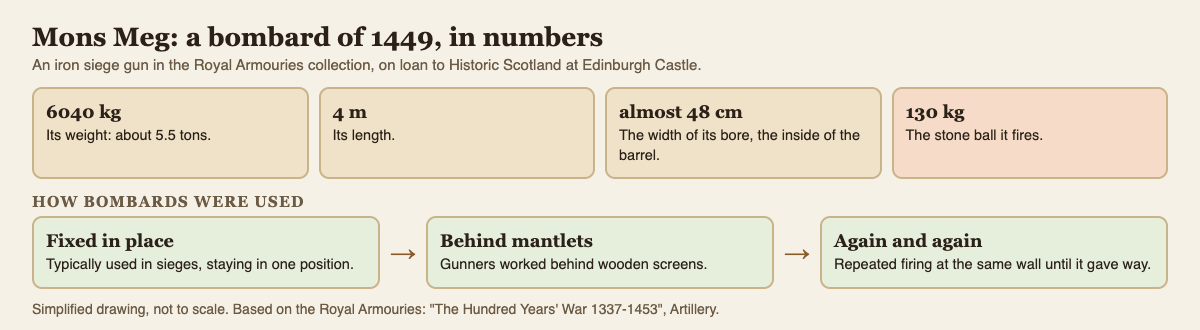
The Royal Armouries' guide to the Hundred Years' War describes artillery as large weapons that throw projectiles, like stone and metal balls, using the explosive force of gunpowder. A bombard was the big siege version. According to the Royal Armouries, bombards were typically used in sieges and stayed in fixed positions. The gunners worked behind wooden screens called mantlets, and with repeated firing they could eventually break down defensive walls.
That last part matters. A bombard did not knock a wall down in one shot. It fired again and again at the same place until the stone gave way. The Royal Armouries gives one example: the town of Dinant fell in 1446 after eight days of artillery bombardment, in which 502 large cannonballs were fired at the defenders.
Where gunpowder came from
Gunpowder is a mixture of sulphur, charcoal and saltpetre. The Royal Armouries traces its earliest known recipe to a Chinese military book from around 1040. The technology reached western Europe between 1257 and 1265, and guns appear in the written record for the first time in Florence in 1326.
English Heritage dates the arrival of gunpowder weapons in siege warfare to the mid 14th century. They grew quickly. By 1377, the Royal Armouries says, large cannon that fired stone balls of about 90 kilograms were being used in sieges. Burgundy became a well-known centre for making these guns, which were used to pummel walled castles and towns.
They were dangerous to their own side too. In 1460, James II of Scotland became the first monarch to be killed by a cannon, when one of his own exploded beside him.
Mons Meg: a bombard you can still see
The best way to picture a bombard is to look at one that survives. The Royal Armouries collection holds Mons Meg, an iron bombard from 1449. Its numbers, from the Royal Armouries:
- Weight: 6040 kilograms, about 5.5 tons.
- Length: 4 metres.
- Bore: almost 48 centimetres across.
- Shot: a stone ball of 130 kilograms.
Mons Meg is on loan to Historic Scotland and on display at Edinburgh Castle. English Heritage makes a point about early cannon in general that Mons Meg makes plain: they were unwieldy and difficult to transport.
How a bombard changed a siege
Before guns, attackers climbed the walls, dug under them, or waited for the defenders to run out of food. Throwing machines like the trebuchet could damage walls, and our post on the trebuchet and the mangonel explains how they worked. But a well-built castle with food and water could hold out for a long time, as our post on how long a medieval siege lasted shows.
Guns shortened that. English Heritage notes that Henry V used cannon against French fortresses, and that Edward IV's heavy guns quickly reduced Bamburgh Castle in Northumberland in 1464. The Royal Armouries says wooden siege engines were gradually replaced by artillery such as bombards.
A worked example: Norham Castle, 1215 to 1513
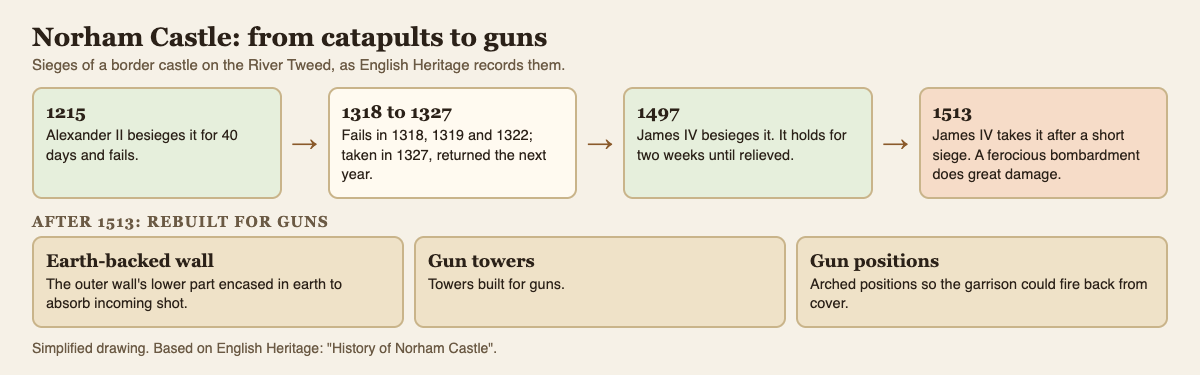
Norham Castle stands on the River Tweed. English Heritage's history of Norham calls it one of the great English strongholds along the river for 450 years, a barrier against the Scots. The Scots besieged it nine times and captured it four times. Following its sieges in order shows what guns did.
- 1215. Alexander II of Scotland besieged Norham for 40 days and failed to take it. This was before gunpowder reached Europe.
- 1318 to 1327. The Scots besieged it without success in 1318, 1319 and 1322, and finally took it in 1327. It was back with its owner, the Bishop of Durham, the following year.
- 1497. James IV of Scotland besieged Norham. The castle held out for two weeks until an English army came to relieve it.
- 1513. James IV came back with a large army and this time captured Norham after a short siege. English Heritage says the ferocious Scots bombardment caused great damage. In less than three weeks Norham was back with the Bishop of Durham, after the English defeated the Scots at the nearby Battle of Flodden.
- After 1513. Rebuilding began almost at once, and this time Norham was turned into an artillery fortress. Engineers rebuilt the outer wall with its lower part encased in earth, to strengthen it and absorb incoming shot, and added gun towers and arched gun positions so the garrison could fire back from cover.
In the same campaign, Etal Castle tells the other half of the story. English Heritage says its wall was never strong enough to resist guns, and its garrison quickly surrendered to the Scottish army in 1513 for that reason.
How castles answered the bombard
Builders did not give up on walls. They changed them so that defenders could use guns too. English Heritage's history of medieval war gives several examples:
- Gunports. By the late 14th century the gatehouse at Carisbrooke Castle already had gunports. In the 15th century gunports became virtually standard additions to castles. Berry Pomeroy Castle has a late 15th-century triple gun loop that let three guns of different sizes fire from one place.
- Gun towers. Cow Tower in Norwich, built in 1398 to 1399, was one of the earliest purpose-built artillery blockhouses in England, with widely splayed gun ports.
- Artillery forts. Dartmouth Castle's gun tower, begun in about 1481 and finished around 1493, is the oldest known purpose-built coast artillery fort in Britain.
Norham's earth-backed wall after 1513 belongs to the same story. Stone alone was no longer enough. The answer to a gun was a wall built to take its shot, and guns of your own.
The Bombard in Two Towers
Two Towers is a free tower defense game in your browser, and its towers follow the same long story. You start by picking from four towers for the gate: Archer Tower, Trebuchet, Ballista and Fire Tower. The Trebuchet throws slow, long-range stones that hurt everyone where they land, the kind of machine that guns later replaced.
The game's title screen adds two later towers: "A Bell Tower rises at stage 25 and a Bombard at stage 35. There is no final stage." So the bombard arrives late, after you have held the gate for 34 stages, much as real guns arrived late in the long history of castles. The game is not a history lesson, but it lets you feel the difference between the tools you start with and the ones that come after.
Frequently asked questions
What is the difference between a bombard and a cannon?
A bombard was a kind of early cannon: a very large one built for sieges. The Royal Armouries describes bombards as guns that stayed in fixed positions and broke down walls with repeated firing.
How big was a bombard?
Sizes varied. Mons Meg, from 1449, weighs 6040 kilograms, is 4 metres long and fires a 130 kilogram stone ball.
When were bombards first used?
Gunpowder weapons came into siege warfare in the mid 14th century, and by 1377 large cannon firing stone balls of about 90 kilograms were in use in sieges.
Did bombards make castles useless?
Not at once. Castles added gunports, gun towers and earth-backed walls, as Norham did after 1513, so defenders could take the shot and fire back.
Get started
Hold the gate long enough to see what rises at stage 35. Pick your two towers and start with the stones.
Play Two Towers: it is free and plays in your browser on a computer or a phone.
Comments
No comments yet.
Sign in or make an account to comment.