What was a castle keep for? Inside the great tower
A castle keep was the great tower of a castle, and at castles such as Goodrich and Middleham it is the oldest part, the core the rest grew around. English Heritage often calls it the "great tower or keep", and both names are right. But what was a castle keep for? The honest answer is several things at once: a home, a store, a stronghold and a statement. The clearest way to see that is to climb one, floor by floor.
What a castle keep was
A keep is a large stone tower inside a castle's enclosure. At Conisbrough, a high stone wall encloses the inner bailey (courtyard) around it. At Middleham, a curtain wall was probably built around the keep more than a century after the keep itself. English Heritage describes Middleham growing out from the core of its great tower.
English Heritage's teachers' guide to Goodrich Castle puts the job description in one sentence: castle keeps "were used for storage and accommodation as well as for defence". Keep that list in mind as we go up a real one.
A worked example: Conisbrough's keep, floor by floor
Conisbrough Castle in South Yorkshire has a keep described floor by floor in English Heritage's description of the castle. It was built in the late 12th century as a massive limestone cylinder with six wedge-shaped buttresses, rising from a sloping base and faced in stone English Heritage calls "of superb quality". Here it is from the bottom up.
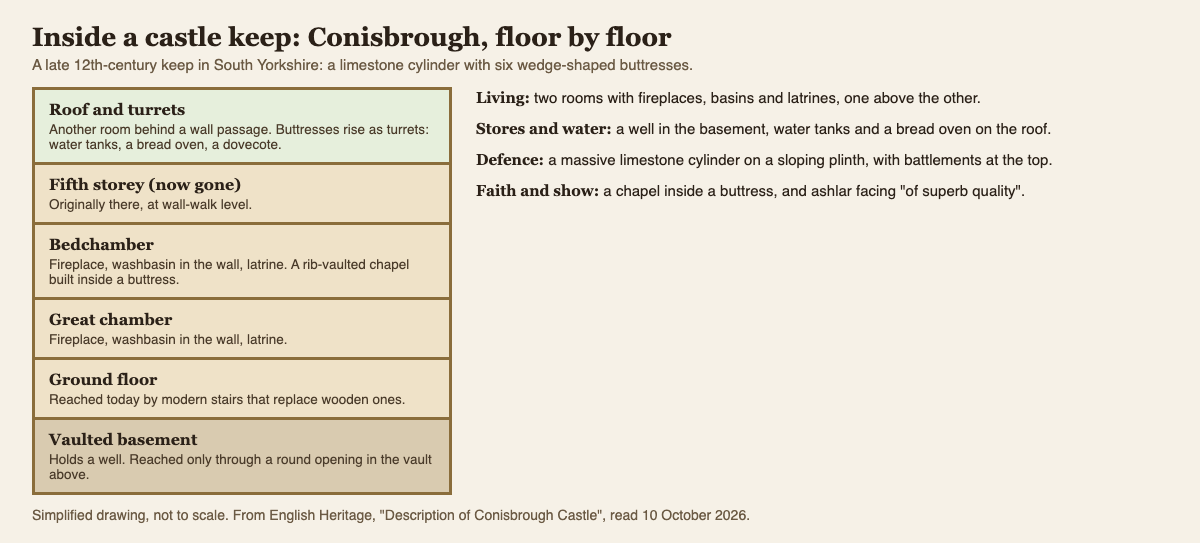
- The basement. A vaulted room with a well in it. You could only reach it through a round opening in the vault above. The well was inside the tower itself.
- The ground floor. Today you enter here by modern concrete stairs, which replace the original wooden ones. From here, stairs built inside the thickness of the wall lead from one floor to the next.
- The great chamber. On the first floor: a fireplace, a washbasin set into the wall, and a latrine in a small chamber in the wall.
- The bedchamber and the chapel. Above it, a second room with its own fireplace, washbasin and latrine. On this floor too is a chapel with a rib-vaulted ceiling, built inside one of the buttresses.
- The top. There was originally a fifth storey at wall-walk level, and at roof level at some point another room. The buttresses rose above the battlements as turrets. Two were solid; the others seem to have served as water tanks, a bread oven and a dovecote.
Now sort what you have seen into the four jobs. Living: two rooms with fireplaces, basins and latrines. Stores and water: a well at the bottom, water tanks and a bread oven at the top. Defence: a massive stone tower with battlements. Faith and show: a chapel in the wall and finely finished stone. One building, four jobs, stacked on top of each other.
Getting in: the first-floor door
Some keeps were entered well above the ground. At Scarborough, Henry II built a vast square keep between 1159 and 1169, over 27 metres high with walls 3.5 metres thick. It was entered by a flight of stone steps that rose along one face through a forebuilding, a smaller block built against the keep, to the first floor.
Goodrich's keep, in Herefordshire, also had a first-floor entry door. The teachers' guide lists it with the keep's thick walls and high battlements as signs of a significant defensive purpose, and adds that the doorway was elaborate and "designed to impress". The same door kept people out and showed off to those who were let in.
Was a keep for defence or for show?
The sources used here point both ways, and it is fairer to set out each view than to pick one.
- A keep was a stronghold. Thick walls, a raised door, battlements and a well inside all make sense for a building meant to hold out. Goodrich's guide calls its keep "a key defensive feature", and Rochester's keep was the target of King John's miners in 1215.
- A keep was a statement of power. The same guide says Goodrich's keep was built "as a symbol of Norman authority and power", that its uses "are not clear", and that it is "very small for accommodation". Its height alone "would have made an impression of authority in the landscape".
The keeps here did both, and at Middleham the balance changed over time. At Middleham in North Yorkshire, the keep was probably built in the 1170s and is one of the largest in the country. In the early 14th century a curtain wall was probably built around it, and over the following centuries the castle grew into a great family residence, one of the childhood homes of Richard III.
When the keep was attacked
A keep was strong, not safe. In 1215, at Rochester, King John fired a mine under the castle keep using fat from pigs, and brought down one of its turrets; he took the castle after a siege of well over a month. Our post on undermining a castle explains how such a mine worked.
Centuries later, in 1645, Scarborough's keep was bombarded during a siege of the Civil War, and its western wall collapsed. What you see today is an open-sided shell that still stands over 27 metres high.
The keep was not the only strong building in a castle. Our post on the castle gatehouse covers the other one attackers had to face first.
Timber, stone and Two Towers
One more detail from Goodrich: until about 1204 the castle, other than the keep, was likely made largely of wood. The keep was its stone core; the rest was probably reinforced in stone later, under William Marshal.
In Two Towers, your towers go through something like that change. Every five stages they are rebuilt stronger, through ages that run from Timber to Legendary. The job in the game is the city gate, not a keep: if the gate falls, the game is over. But the idea that a defence starts in timber and earns its stone over time runs through both. The game is a tower defense game, not a history lesson; the comparison is ours, not the game's.
Frequently asked questions
What is the difference between a keep and a castle?
The keep is one building, the great tower, inside a castle. The castle is the whole site: the keep, the walls, the gatehouse and everything inside them.
What was inside a castle keep?
At Conisbrough: a well in the basement, a great chamber and a bedchamber with fireplaces, basins and latrines, a chapel in a buttress, and water tanks, a bread oven and a dovecote at the top.
Why were keep doors on the first floor?
English Heritage's Goodrich guide counts a first-floor door among a keep's defences, with thick walls and high battlements. At Goodrich the doorway was also elaborate, designed to impress.
Is a great tower the same as a keep?
Yes. English Heritage uses both names, often together, as in "the great tower or keep".
Get started
Next time you visit a castle, find the keep and ask which of its four jobs each floor did. Then try holding a gate yourself. Play Two Towers: it is free and plays in your browser on a computer or a phone.
Comments
No comments yet.
Sign in or make an account to comment.