Which cat breeds have curly fur? A plain guide
Which cat breeds have curly fur? Five recognized breeds are known for it: the Cornish Rex, the Devon Rex, the Selkirk Rex, the LaPerm and the American Wirehair. Each has a different kind of curl, from a tight wave to loose ringlets to a coat that feels like wire. This guide shows how to tell them apart, where each curl came from, and what to think when you meet a curly-looking cat on the street.
Which cat breeds have curly fur? The short answer
The Cat Fanciers' Association (CFA), a cat breed registry, currently recognizes 46 breeds. Five of them are defined by a curly or crimped coat. The CFA describes each one on its own breed page, and all the facts below come from those pages.
- Cornish Rex: a short, soft coat in a tight marcel wave.
- Devon Rex: a short coat in soft, open waves.
- Selkirk Rex: separate, well-defined curls, in a short or a long coat.
- LaPerm: soft yet springy curls, in a short or a long coat.
- American Wirehair: a crimped, springy coat that stands off the body.
"Rex" in three of the names is borrowed. The woman who found the first Cornish Rex had experience with Rex rabbits, and she gave her new breed of cat the same name.
One name to watch: the American Curl is on the CFA's breeds list too, but its curl is in the ears, which curl back away from the face. The name is about the ears, not the coat.
The five curly-coated breeds, one by one
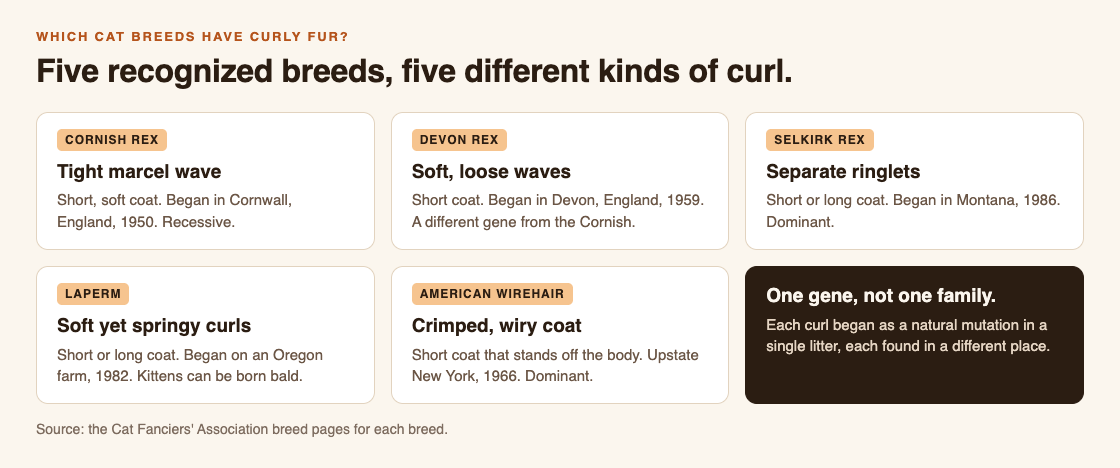
Five breeds, five different kinds of curl.
Cornish Rex
The CFA's Cornish Rex page traces the breed to Cornwall, England, in 1950. A curly-coated cream kitten named Kallibunker turned up in a litter of barn cats on Nina Ennismore's farm. The coat has no outer guard hairs, the longer, coarser hairs most cats have on top. That makes it very soft and tightly waved, but also fragile. The CFA notes these cats are easily chilled in cold weather, and that a blow dryer will ruin the curls.
Devon Rex
Nine years later, in 1959, a single curly-haired male kitten called Kirlee was born in a garden in Devon, England. People first assumed he carried the Cornish gene. Test breedings proved them wrong. The CFA's Devon Rex page says Devons have a few very sparse, short guard hairs, which gives an open wave, a looser look than the Cornish. Even the eyebrows and whiskers curl, though they are fragile and can break off.
Selkirk Rex
The Selkirk Rex began with a litter born in Montana in 1986. The CFA says it is the only cat breed named after a person: its founder used her stepfather's family name. Its curls are separate ringlets that seem to go every which way. They can be short and slightly crisp, or long. The CFA accepted it for registration in 1992.
LaPerm
The LaPerm started with one kitten, Curly, born on an Oregon farm in 1982. She was bald at birth and had a full curly coat by four months of age. The CFA describes the coat as soft yet springy, in short and long versions. It accepted the breed for registration in 2000.
American Wirehair
The odd one out. The American Wirehair's coat is crimped and springy rather than curly, and the CFA compares its texture to steel wool. It appeared in a litter of barn cats in upstate New York in 1966. Even the whiskers and the hair inside the ears should be crimped or bent. In its breed standard the coat carries 45 points, more than the coat of any other breed.
Why each curl looks different
All five coats began the same way: a natural change in a gene, a mutation, that showed up by chance in one litter. But they began in different places, years apart, and the genes are not the same.
That matters for how the curl passes on. The CFA says the Cornish Rex curl is recessive: a kitten needs the gene from both parents to show it. The Selkirk Rex and American Wirehair curls are dominant: one copy is enough. The Wirehair's founder, a red tabby and white male, had both wired and straight-coated kittens.
So the five breeds are not one family with one curl. They are five separate surprises that breeders noticed and kept.
Do curly cats shed less?
Often less, but not never. The CFA says Devons shed less than most cats and may be well tolerated by people sensitive to cats. It adds plainly that, contrary to popular belief, they are not hypoallergenic. LaPerms shed little and usually do not mat. American Wirehairs do shed.
Care differs too. A Cornish Rex needs no regular combing. A Selkirk Rex does not mat easily, but the CFA suggests a combing once or twice a month. If you are thinking of a curly cat because of allergies, talk to a breeder and your doctor before you decide.
Spotted a curly cat? A worked example
Say you are on your evening walk and you see a cat on a doorstep with a rumpled, wavy-looking coat. Is it a Devon Rex? Work through it in three steps.
- Look from where you stand. Do not walk up or reach out. Is the whole coat waved, from back to tail, or is it only ruffled in one patch?
- Check the details. Curly whiskers point toward a rex breed. A coat that stands off the body and looks crimped all over points toward a Wirehair.
- Ask where it came from. The CFA's own rule of thumb is that unless a cat is known to come from a breeder of pedigreed cats, it will almost certainly not be of a specific breed. Only about five percent of all domestic cats belong to any recognized breed.
Result: a coat that is only ruffled, on a cat no one can vouch for, is most likely a mixed breed having a bad hair day. A coat that is waved all over, with curly whiskers, is worth a second look. For the full method, see Is my cat a mixed breed? How to tell in 5 checks, and for short-haired cats with no pedigree, What is a domestic shorthair cat?
Spot and log curly cats with Cat Go
A curly cat is a rare find on most streets, which makes it a good one to keep a record of. Cat Go is a game that plays in your web browser. In the site's own words: "Walk anywhere, photograph a real cat, lure it with food and catch it. Every catch keeps its breed and where you found it."
Here is how the doorstep cat would go:
- Tap the camera on the map and take its photo. The camera screen says "Fit the whole cat in the frame", so step back rather than closer.
- The game asks "Which breed is it?". The search box even suggests it: "Search breeds, like Siamese or curly". You pick the breed yourself; the game does not decide for you.
- Not sure? The screen says "Most cats you meet are mixed breed. Rarer breeds are warier." and "Mixed breed is always a safe pick."
- Toss in-game treats to win the cat over. Tuna works much better on wary cats. A caught cat is "Saved to your Catdex with its breed and the place you found it".

The bar at the top counts your cats and breeds out of the game's 34.
The food and the catch are inside the game. The real cat just gets its photo taken from a polite distance. Cat Go needs the camera and location allowed in your browser.
Frequently asked questions
Which cat breeds have curly fur?
The CFA recognizes five: the Cornish Rex, Devon Rex, Selkirk Rex, LaPerm and American Wirehair. The Wirehair's coat is crimped rather than curly.
What is the difference between a Cornish Rex and a Devon Rex?
The Cornish Rex has a tight marcel wave and no outer guard hairs. The Devon Rex has a looser, open wave from a different gene, and its whiskers and eyebrows curl too.
Are curly-haired cats hypoallergenic?
No. The CFA says Devons shed less than most and may suit some people sensitive to cats, but are not hypoallergenic.
How do I log a curly cat in Cat Go?
Photograph it, then type "curly" into the breed search and pick the breed you think fits. If you are unsure, the game says mixed breed is always a safe pick.
Get started
Next time a cat with a wavy coat catches your eye, look for curly whiskers before you guess the breed. Then play Cat Go in your browser: walk anywhere, photograph a real cat, lure it with food and catch it, and keep its breed and the place you found it in your Catdex.
Comments
No comments yet.
Sign in or make an account to comment.