Why are computer chips made of silicon?
Almost every computer chip starts as silicon. So why are computer chips made of silicon, and not copper, carbon or gold? The short answer: silicon is a semiconductor, it is cheap and plentiful, it grows into huge flawless crystals, and its own oxide makes a near-perfect insulator. That mix is hard to beat.
This guide follows Wikipedia's articles on silicon and semiconductors. You will see what silicon is, why it won, and how sand becomes a chip. At the end there is a free browser game where silicon is the toughest wall on the field.
What is silicon?
Silicon is a chemical element. It is the second most common element in Earth's crust, about 28% of it by mass, after oxygen. You almost never find it pure in nature. It is locked up with oxygen in sand, quartz and the rocks called silicates, which make up more than 90% of the crust.
Pure silicon is a hard, brittle crystal with a blue-grey, metal-like shine. It melts at 1414 degrees Celsius. Most refined silicon goes into metal alloys, and silicon compounds go into concrete and glass. Only a small part of refined silicon, under 15%, is purified enough for electronics.
Why are computer chips made of silicon? Five reasons
Wikipedia lists the main advantages of silicon for electronics. In plain words:
- It is a semiconductor. It can be made to conduct electricity or block it, which is exactly what a switch needs. More on that below.
- It is cheap. The raw material is everywhere.
- It grows into large, pure single crystals. A chip needs a perfect, even base to build on.
- Its oxide is an excellent insulator. Heat silicon in oxygen and a thin layer of silicon oxide forms on its surface. Chipmakers use these layers to separate and protect the parts of a transistor.
- It handles heat and layering well. It carries away the heat from its own activity well enough, and it can be shaped and built up in very fine layers.
No single reason is unique to silicon. The mix of all five, at a low price, is what made it the base of the industry. Gallium arsenide, the second most common semiconductor, is used for special jobs such as laser diodes and some solar cells.
Semiconductors and doping: how silicon becomes a switch
A semiconductor conducts electricity better than an insulator but worse than a metal. Very pure silicon at room temperature conducts so little that it acts almost like an insulator. The trick is to change that on purpose.
That trick is called doping): adding tiny, chosen amounts of another element.
- Add phosphorus, arsenic or antimony, and each added atom brings one spare electron. This is n-type silicon.
- Add boron, aluminium or gallium, and the silicon gets places that trap electrons. This is p-type silicon.
Put two differently doped regions next to each other in one crystal and they form a junction. Junctions are what transistors are made of, and a transistor is a tiny switch. A processor holds a huge number of them. Our post on what a CPU core is shows what all those switches add up to.
From sand to wafer: how chip silicon is made
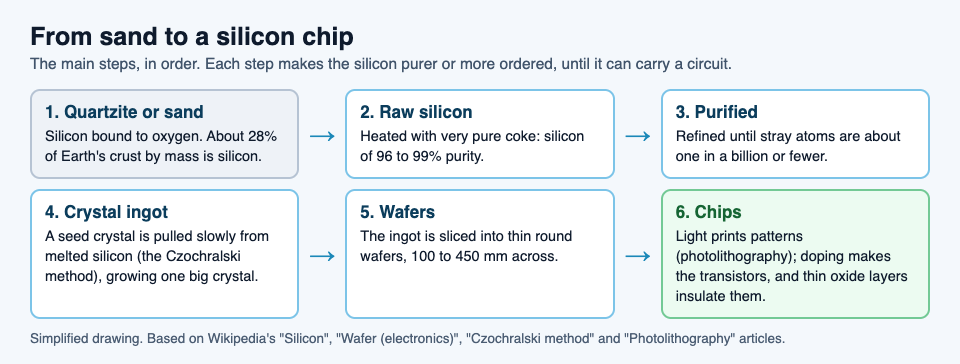
The journey has a few big steps.
- Raw silicon. Quartzite or sand is heated with very pure coke, a form of carbon. This gives silicon that is 96 to 99% pure.
- Purifying. That is nowhere near pure enough. For transistors, stray atoms must be fewer than 1 in 10 billion.
- Growing one crystal. In the Czochralski method, named for the Polish chemist Jan Czochralski, a small seed crystal is dipped into melted silicon, then slowly pulled up and turned. The silicon freezes onto it as one huge round crystal, called a boule or ingot.
- Slicing wafers. The ingot is cut into thin round wafers), 100 to 450 millimetres across. The round shape comes from the ingot.
- Printing the circuit. Photolithography uses light to copy a pattern onto a coating on the wafer. Doping, oxide layers and the connections between parts are then built up, layer by layer, into many chips per wafer. Finally the wafer is diced into separate chips.
Finished chips are then mounted on boards. Our post on what is on a circuit board picks up the story from there.
A worked example: count the nines
Wafer silicon is described as 99.9999999% pure, or "9N", for nine nines. Here is how to read that.
- Write the impurity as a fraction: 100% minus 99.9999999% leaves 0.0000001%.
- Turn it into a ratio: 0.0000001% is 1 part in 1,000,000,000. That is one stray atom in a billion.
- Compare with the transistor rule: fewer than 1 stray atom in 10 billion. That is ten times stricter again, and some special uses need 1 in a trillion.
- Now the twist. After all that cleaning, doping adds chosen atoms back in, in tiny and carefully measured amounts.
So the goal is not just pure silicon. It is silicon where every foreign atom was put there on purpose.
Germanium came first
Silicon was not the first choice. Germanium, the element just below silicon in the periodic table, has similar electronic properties, and it was used for the very first transistors. The first working transistor, built by John Bardeen and Walter Brattain in 1947, was a point-contact transistor.
Silicon won out for the reasons above: cheap raw material, large pure crystals and that excellent oxide. It became so central that the Santa Clara Valley in California picked up the nickname Silicon Valley.
See the idea in Tank City Reboot
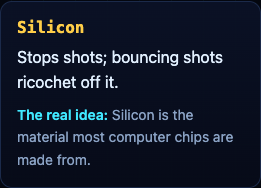
Tank City Reboot is a free tank game set inside a computer. Your antivirus tank guards the CPU core on a circuit board, and every wall is named for a real idea. Silicon is the hardest wall of all, and its card gives the real idea in one line: silicon is the material most computer chips are made from.
- In the first game, silicon stops every shot until your cannon is fully overclocked. The Overclock power-up has three levels, and only the third breaks silicon. Our guide to the power-ups explains the levels. Firewall rebuild turns the wall around the CPU core to silicon for fifteen seconds.
- In Tank City Zero Day, silicon stops shots, but bouncing shots ricochet off it. Pipelining at level 2 breaks it, Hot patch rebuilds the core's wall as silicon every wave, and Ransomware shots lock firewall into silicon.
The game teaches one idea per name. It is not a chemistry or hardware course.
Frequently asked questions
Is silicon a metal?
No. It looks metallic, but it is a non-metal that is sometimes called a metalloid. Electrically it is a semiconductor, in between a metal and an insulator.
Are computer chips made from sand?
In a sense, yes. Sand and quartzite are the raw material, but the silicon is purified until fewer than one atom in ten billion is a stray before it is used for transistors.
Why not use germanium instead?
Germanium was used first and works in a similar way. Silicon won because it is cheaper, grows large pure crystals and forms an oxide that insulates very well.
What is a silicon wafer?
A thin round slice cut from one big silicon crystal. Many chips are built on each wafer and then cut apart.
Get started
Play Tank City Reboot: it is free, plays in your browser on a computer or a phone, and needs no account. Collect three Overclock power-ups and watch your shots finally break through the silicon.
Comments
No comments yet.
Sign in or make an account to comment.