Why is Shakespeare still important today? Five reasons
Why is Shakespeare still important, more than 400 years after he died? He wrote for a London playhouse, borrowed most of his plots, and left few traces of his private life. Yet his plays are still staged across the world and still turned into films. This guide gives you who he was in a few lines, five clear reasons he still matters, an evening's plan to meet one play, and the questions scholars still argue about.
Why is Shakespeare still important? The short answer
William Shakespeare (1564 to 1616) was an English poet, playwright and actor. The World History Encyclopedia article on Shakespeare calls him "arguably the most influential dramatist of all time" and says his plays are performed more often than those of any other playwright. He still matters because his plays are still alive on stage, because he showed how to turn an old story into a new one, and because his way of writing shaped English drama. His fellow playwright Ben Jonson put it in one line: Shakespeare was "not of an age, but for all time."
Who was William Shakespeare?
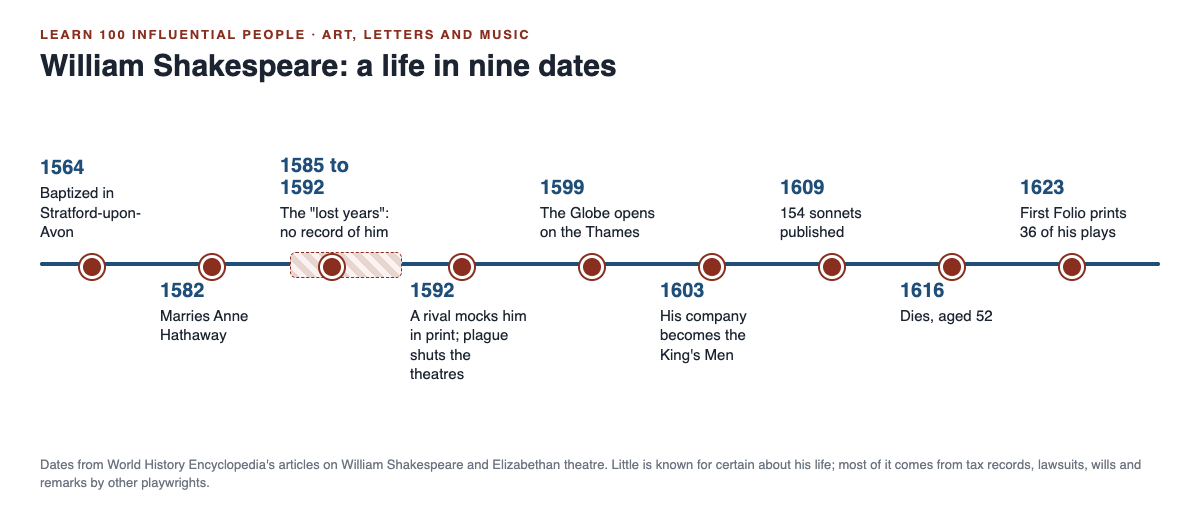
He was baptized in Stratford-upon-Avon, a market town in Warwickshire, on 26 April 1564. His birthday is traditionally kept on 23 April. Most scholars agree he went to the local grammar school, where lessons centred on Latin and Roman writers such as Ovid, but he never went to university. At 18 he married Anne Hathaway, who was 26.
Then he disappears. From 1585 to 1592 there is no record of him at all. By 1592 he was in London, known as an actor and playwright, and famous enough for a jealous rival to mock him in print. He became a part-owner of an acting company, the Lord Chamberlain's Men, which in 1603 became the King's Men under James I. He helped pay for the Globe Theatre, which opened in 1599. He retired to Stratford and died on 23 April 1616, aged 52.
Five reasons he still matters
1. His plays are still on stage
Shakespeare's comedies, such as A Midsummer Night's Dream and Twelfth Night, his tragedies, such as Hamlet and Macbeth, histories like Henry V and late plays like The Tempest are still performed around the world. The World History Encyclopedia article on Elizabethan theatre adds that his works continue to interest modern filmmakers.
2. He showed how to make an old story new
Most of his plots were not his own. Romeo and Juliet came from a poem by Arthur Brooke. History plays such as Richard III drew mainly on Holinshed's Chronicles. What he added was the people and the words: in the encyclopedia's phrase, his "character work and use of language" turned familiar stories into "new and original experiences." That is a lesson every writer, filmmaker and student can use.
3. He shaped the sound of English drama
Many of his lines are in blank verse: lines that do not rhyme but keep a steady beat, often iambic pentameter. He did not invent it. Christopher Marlowe was writing blank verse first, and Thomas Kyd had made revenge tragedy popular. But blank verse became the style most associated with Shakespeare, and his work, the encyclopedia says, significantly shaped the development of English literature.
4. He wrote for everyone in the room
The Globe could hold around 2,000 people, and the playhouses of his day welcomed courtiers and commoners alike, with tickets starting at a penny. His plays mix kings and clowns, jokes and murders. After 1603 he also wrote "problem plays" that blend comedy with darker scenes and fit no neat type. Writing for a mixed crowd may be one reason his plays still work for a mixed crowd now.
5. Someone chose to save his work
None of his plays survives in his own handwriting. In 1623, seven years after his death, 36 of his plays were collected in print in the First Folio. More editions followed through the 17th century, and the first properly edited collection came out in 1709. It is a reminder that influence is not only what a person makes, but what others decide to keep.
If you want to see how these reasons compare with the way people rank other names, our guide to how to judge any list of the most influential people in history gives you a simple test you can apply to Shakespeare too.
Worked example: meet one play in an evening
You do not need to read the complete works to see why he matters. Take Romeo and Juliet and give it one evening, about an hour.
- Ten minutes: the backstory. Read a short summary of the plot and note that it came from Arthur Brooke's poem. Write one line: what was the story before Shakespeare touched it?
- Twenty minutes: read one scene aloud. Pick the first scene, or any scene between the two lovers. Read it out loud, slowly. Mark the lines that do not rhyme but still have a beat: that is blank verse.
- Fifteen minutes: watch the same scene. Find a stage or film version of it. Notice what an actor makes clear that the page did not.
- Ten minutes: three sentences. What did Shakespeare add to the old story? Who is the most alive character? Would it still work on a stage today?
- Five minutes, the next day: quiz yourself. Without notes, write down where the plot came from and what blank verse is. Then check.
Step 5 matters most. In one study, students who tested themselves remembered substantially more on tests days later than students who reread (Roediger and Karpicke, 2006); our guide to how to remember historical figures and what they did shows how to do this with a four-line card.
What scholars still argue about
Because so little is known for certain, much of his life is still debated. Most of what we know comes from tax records, lawsuits, wills and remarks by other playwrights, and no one tried to write his life until decades after his death.
- The lost years. His first biographer, Nicholas Rowe, said he left Stratford after being caught poaching deer. Other traditions say he was a schoolmaster, a soldier in the Low Countries or a butcher's apprentice. None of these is proven.
- His marriage. Anne gave birth six months after the wedding, and some scholars think he was pushed into marriage. Others argue he pursued her. In his will he left her only "my second best bed," a line that has puzzled scholars for centuries.
- His son. His son Hamnet died in 1596, aged 11. Whether that loss shaped his later plays is still debated.
- The sonnets. 154 sonnets were printed in 1609, perhaps never meant for the public. Scholars have tried to name the "Fair Youth" and the "Dark Lady" the poems speak to, and the "Mr. W. H." named at the front, with no conclusive evidence.
- Who wrote what. He often worked with others. It is generally accepted that George Peele co-wrote Titus Andronicus, and late plays such as Henry VIII were written with John Fletcher.
Frequently asked questions
Why is Shakespeare still important today?
His plays are performed more often than those of any other playwright, he showed how to turn borrowed stories into new ones through character and language, and his blank verse shaped English drama. He also wrote for mixed audiences, which is one reason the plays still work now.
Did Shakespeare make up his own plots?
Mostly not. As was usual at the time, he adapted existing stories, such as Arthur Brooke's poem for Romeo and Juliet and Holinshed's Chronicles for his history plays.
How do we know which plays are his?
No manuscripts in his hand survive. The First Folio of 1623 collected 36 of his plays, and historians use the content of the plays and other records of the time to date them.
What is the best Shakespeare play to start with?
Start with one you can also watch, so you hear the lines spoken. Romeo and Juliet works well, because the story is simple and its source is known, so you can see what he added.
Get started
Shakespeare is in Art, Letters and Music, an Intermediate course on Learn 100 Influential People, alongside Homer, Murasaki Shikibu, Leonardo, Michelangelo, Picasso, Bach, Mozart and Beethoven. Intermediate courses cover "How ideas, faiths, inventions and markets spread and changed the world." Lessons take about 9 minutes, cards set out where researchers disagree, and every lesson lists its sources. Questions from lessons you finish come back, spaced out, up to 5 a day. Sign in with your email and an emailed code; accounts are for people aged 13 or older.
Start Learn 100 Influential People: short hands-on lessons on the people who shaped history, with every side of the debate and the sources to read next.
Comments
No comments yet.
Sign in or make an account to comment.