Why was Isaac Newton so important? Five changes, explained
Why was Isaac Newton so important? Because he changed five things at once: he showed that one force of gravity runs the heavens and the earth, set out the laws of motion, proved that white light is a mix of colours, invented the calculus, and insisted that observations, not guesses, decide a theory. This guide explains each change from the sources, gives you a before-and-after answer you can use in an essay or exam, and sets out where historians still disagree.
Why was Isaac Newton so important? The short answer
World History Encyclopedia's article on Newton calls him "widely regarded as the single most important figure in the Scientific Revolution," for his three laws of motion and his universal law of gravity. The Stanford Encyclopedia of Philosophy entry on Newton calls his Principia "the single most important work in the transformation of early modern natural philosophy into modern physical science."
In plain words: before Newton, the study of nature was still part of philosophy, with one set of rules for the sky and another for the ground. After him, physics became a science of forces and laws, written in mathematics and checked against measurement.
Who was Isaac Newton?
Newton was born on 25 December 1642 (by the old calendar) in Woolsthorpe, a village in Lincolnshire, England. His father, a farmer, died two months before he was born. He entered Trinity College, Cambridge, in 1661.
When the plague closed the university, he spent almost all of the time from the summer of 1665 to the spring of 1667 at home. This was his "year of wonder." In that time he made his first discoveries about light and, by late 1666, had worked out the calculus. He became Lucasian Professor of Mathematics at Cambridge in 1669.
Later he moved to London, became Master of the Royal Mint at the end of 1699, became President of the Royal Society in 1703, and was knighted by Queen Anne in 1705. He died on 20 March 1727, aged 84.
The Principia: one law for the sky and the ground
In 1684 the astronomer Edmund Halley asked Newton what path a body would follow under a force that weakens with the square of the distance. Newton's answer was "an ellipse." Halley encouraged him, with words and money, to publish. The result was the Principia, printed in 1687 in roughly three hundred copies.
The book did two big things:
- Three laws of motion. A body at rest or moving in a straight line keeps doing so; a change of motion depends on the force applied; and every action has an equal and opposite reaction.
- Universal gravity. Any two bodies pull on each other with a force that grows with their masses and falls with the square of the distance between them.
The key word is "universal." The Stanford entry on the Principia says its conclusion, that the force keeping planets in orbit is the same kind of force as gravity on earth, ended a view going back at least to Aristotle, that the heavens need one science and the earth another. If you have read our post on Aristotle's contribution to science, this is where that old split ended.
As for the apple, World History Encyclopedia says one "may not have actually fallen from a branch and hit Newton on the head," but watching fruit fall does seem to have set him thinking about the force involved.
Light, the prism and the telescope
Newton passed a narrow beam of light through a prism in a dark room and saw a band of colours. Then, in what he called his "experimentum crucis," he sent a single colour through a second prism. It came out the same colour; it could not be split again. His conclusion was that white light is made up of many colours, each bent by a different amount. The standard view at the time held the opposite.
He also built a reflecting telescope, which used a curved mirror of tin and copper alloy instead of a lens, and magnified 40 times. His full account of light, the Opticks, came out in 1704.
Calculus and a new way of doing science
Calculus is the mathematics of change: how fast something moves, and how much area lies under a curve. The Stanford entry dates Newton's invention of it to the mid to late 1660s, "most of a decade before Leibniz did so independently, and ultimately more influentially." The two men later fought a bitter public dispute over who came first.
Just as important was his method. Newton distrusted what was then called the method of hypotheses: putting forward ideas that reach beyond anything observed, and then testing them. He wanted observations to decide each part of a theory. His fourth Rule of Reasoning says that ideas gathered from observations should be taken as true or nearly true "until yet other phenomena make such propositions either more exact or liable to exceptions." That is why he left some questions open, such as what causes gravity, and whether light is made of waves or particles.
Worked example: a before-and-after answer
If an essay or exam asks why Newton was important, a before-and-after list gives you a clear, checkable answer. Here is one you can build in ten minutes.
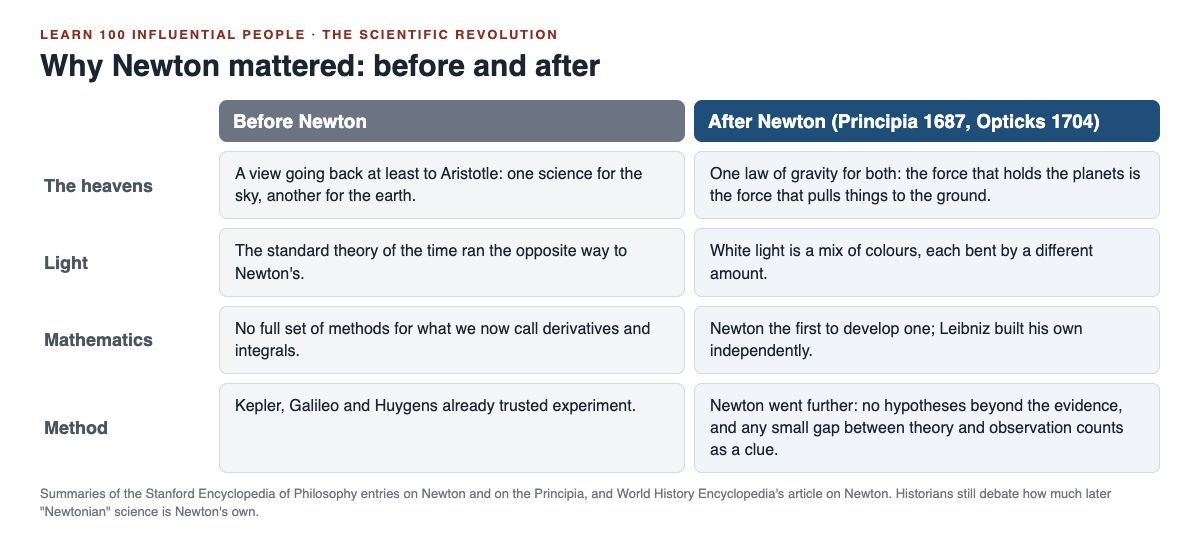
- The heavens. Before: one science for the sky, another for the earth. After: one law of gravity for both.
- Light. Before: the standard theory of the time ran the opposite way to Newton's. After: white light is a mix of colours.
- Mathematics. Before: no full set of methods for what we now call derivatives and integrals. After: Newton was the first to develop one, and Leibniz built his own independently.
- Method. Before: Kepler, Galileo and Huygens already trusted experiment. After: Newton went further, refused hypotheses beyond the evidence, and made any small gap between theory and observation count as a clue.
Now turn the list into a paragraph: "Newton was important because he united the physics of the heavens and the earth under one law, showed that white light is a mixture of colours, created the calculus, and made observation the judge of theory." Then add one source for each claim. That last step is what lifts an answer from a list of facts to an argument.
Where historians disagree
- How much "Newtonian" science is Newton's. The Stanford entry says what textbooks call "Newtonian mechanics" is mostly results achieved on the European continent between 1740 and 1800, by people who built on his work.
- Action at a distance. Christiaan Huygens and Gottfried Leibniz rejected his gravity as an "occult power" acting at a distance, with no contact mechanism to carry the force. Newton said only that no experiment yet decided what causes gravity.
- The private Newton. Newton put as much effort into alchemy and theology as into maths and physics, but most of these papers became public only after the Second World War. Whether one idea joins all his work is, in the Stanford entry's words, "a continuing source of controversy among Newton scholars."
- Newton after Einstein. World History Encyclopedia says Einstein could not overthrow Newtonianism, only extend it. Philosophers of science in the 20th century asked what replacing Newton's theory of gravity with Einstein's says about the limits of scientific knowledge.
Frequently asked questions
What is Isaac Newton best known for?
His three laws of motion and his law of universal gravity, set out in the Principia of 1687. He is also known for showing that white light is a mix of colours and for inventing the calculus.
Did an apple really fall on Newton's head?
Probably not. World History Encyclopedia says an apple may not have hit him, but seeing fruit fall does seem to have set him thinking about gravity.
Who invented calculus, Newton or Leibniz?
Both, independently. Newton's work came first, in the 1660s, but in the end Leibniz's version was the more influential one.
Was Newton's physics proved wrong?
In the 20th century Einstein's general relativity replaced Newton's theory of gravity. Even so, World History Encyclopedia describes Einstein as extending Newtonianism rather than overthrowing it.
Get started
Newton is one of six people in The Scientific Revolution, a Basic course on Learn 100 Influential People, with Copernicus, Galileo, Kepler, Darwin and Mendel. Basic courses cover "The best-known names, no background needed." Lessons take about 9 minutes, questions from the lessons you finish come back up to 5 a day, and every lesson lists its sources. For more names to know, see our list of famous people in history every student should know. Sign in with your email and an emailed code; accounts are for people aged 13 or older.
Start Learn 100 Influential People: short hands-on lessons on the people who shaped history, with every side of the debate and the sources to read next.
Comments
No comments yet.
Sign in or make an account to comment.