Zheng He's Voyages: Where the Treasure Fleet Sailed
Zheng He's voyages took a Ming Chinese fleet across the Indian Ocean seven times between 1405 and 1433, as far as Hormuz in the Persian Gulf and Mogadishu in East Africa. This post follows the treasure fleet stop by stop: who sent it, where it sailed, what it carried, and why China stopped sending it.
If you want Zheng He in context with the other people who tied the world together, Learn 100 Influential People teaches him in short lessons in its Connecting the World course, next to Columbus, with the sources for each lesson.
Who Zheng He was
Zheng He, also written Cheng Ho, was born around 1371 in Yunnan province in southern China, into a Muslim peasant family. His birth name was Ma Ho. His father had made the Hajj, the pilgrimage to Mecca.
When he was about ten, Ming forces captured him. Like many boys taken in war, he was castrated and put into service, in the army of a Ming prince who would later become the Yongle Emperor. He rose to head eunuch and backed the prince in a three-year civil war. When the prince took the throne in 1403, he gave Ma Ho the new name Zheng He. By 1405 Zheng He was an admiral.
The account here follows the World History Encyclopedia's article The Seven Voyages of Zheng He by Mark Cartwright, which you can read in full.
Why the Yongle Emperor sent the fleet
Earlier Ming emperors had been cautious abroad, close to isolationist, mostly out of fear of the Mongols. Yongle took a different line. Historians give several reasons, and they weigh them differently:
- Legitimacy. Yongle had seized the throne. Foreign envoys arriving to present tribute made him look like the rightful ruler.
- The tribute system. Smaller states had long sent tribute to Chinese emperors, often worth less than the gifts they got back. The system had lapsed under the Mongol Yuan dynasty, and Yongle wanted it back.
- The missing emperor. The early voyages may also have hunted for the deposed emperor Jianwen, so he could not raise a rebellion.
- Colonial aims? The sheer size of the fleets has led some scholars to suggest more than diplomacy. The encyclopedia notes this view is not widely held.
The treasure fleet: ships, crews and cargo
The first fleet had 317 ships, built since 1403 at the shipyards of Nanjing. Among them were 62 baochuan, or treasure ships, then the largest ships in the world. They were perhaps up to 55 metres long and 8.5 metres wide, though historians dispute the exact size, so treat any single figure with care.
The ships used watertight compartments, sternpost rudders, magnetic compasses and paper charts. They carried silk, tea, painted scrolls, gold and silver objects, textiles and fine Ming porcelain, all meant to impress foreign rulers.
Estimates for the first voyage run from 20,000 to 32,000 people: diplomats, medical officers, astrologers, sailors and soldiers. Cannons, bombs and rockets meant the fleet could defend itself wherever it went.
Zheng He's voyages one by one
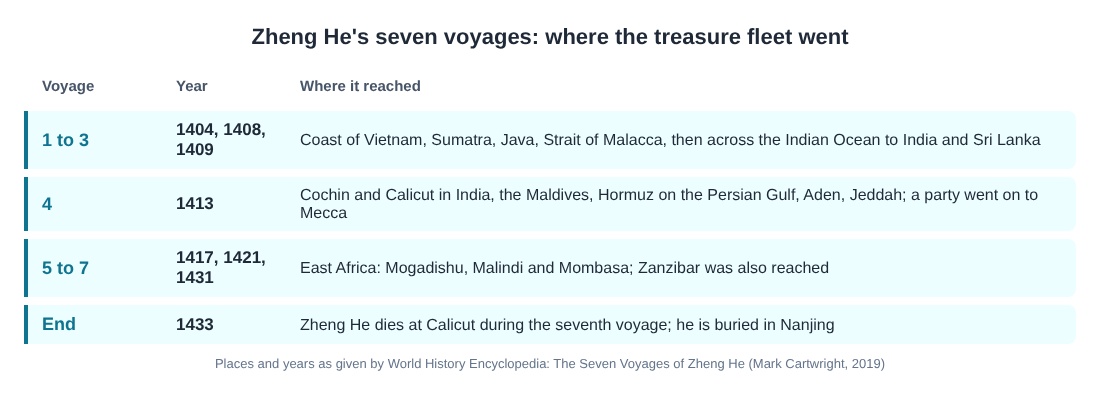
The voyages and where they reached, as the World History Encyclopedia gives them.
A note on dates: the encyclopedia says Zheng He led the fleet out in 1405, but dates the first three voyages to 1404, 1408 and 1409. Expect a year's difference between sources for the early trips.
Voyages one to three: Southeast Asia, India and Sri Lanka
The first three voyages kept to established trade routes. The fleet sailed down the coast of Vietnam, stopped at Sumatra and Java, went through the Strait of Malacca, and crossed the eastern Indian Ocean to India and Sri Lanka.
At each landing, Zheng He brought messages of goodwill and a large load of gifts, and invited the ruler to come to China or send an ambassador. Many accepted and rode home on his ships. Not everyone did. Alagakkonara, the king of Sri Lanka, tried to plunder the fleet. Zheng He took him to China, where he was released after promising regular tribute. On the way back from the first voyage the fleet also captured the pirate Ch'en Tsu-i, and the second voyage settled a local dispute on Java.
Voyage four: the Persian Gulf and Arabia
In 1413 the fleet went round the tip of India to Cochin and Calicut, stopped at the Maldives, crossed the Arabian Sea to Hormuz, then sailed to Aden and up the Red Sea to Jeddah. A party travelled on to Mecca. A report says 19 foreign rulers sent tribute and missions to the emperor because of this voyage.
Voyages five to seven: East Africa
The last three voyages, in 1417, 1421 and 1431, reached Mogadishu, Malindi and Mombasa on the East African coast, and Zanzibar too. Zheng He is the first Chinese visitor to the Swahili coast that the records attest.
The fleet brought back lions, leopards, camels, ostriches, rhinos, zebras and giraffes, along with gems, spices, medicines and cotton cloth. In China the giraffe was taken as a living qilin, a creature of good fortune. A painted silk scroll from the time shows a giraffe given to the emperor by the king of Bengal.
Zheng He's death and how far he went
Zheng He died during the seventh voyage, at Calicut in 1433. His body was taken back to China and buried in Nanjing.
A year earlier he set up a tablet in Fujian that claims the fleets had covered more than 100,000 li, about 27,000 nautical miles, "traversing those savage waves as if we were treading a public thoroughfare."
To compare him with the explorer who sailed the other way at the end of the same century, read what changed after Columbus's voyages of 1492.
Why the voyages stopped
The Xuande Emperor, who ruled from 1426, at first backed the voyages, then ended them. He banned building ocean-going ships and kept the ones that existed in Chinese coastal waters. The encyclopedia gives several reasons:
- A renewed threat from the Mongols.
- The huge cost of rebuilding parts of the Great Wall, which called for cuts elsewhere.
- Cost against return: the gifts and the fleets cost more than the tribute that came back.
- Many foreign states wanted trade but did not accept that China was the centre of the world.
So was it a failure? On its own terms, mostly: tribute outside Southeast Asia did not last. But the encyclopedia also argues the goods and knowledge Zheng He brought home raised China's interest in foreign lands and its later role in world trade. Both readings are worth holding.
A quick check before you move on: put these in the order the fleet first reached them, without looking back: Hormuz, Sri Lanka, Malindi, Java. If you said Java, Sri Lanka, Hormuz, Malindi, you have the shape of the story.
Frequently asked questions
How many voyages did Zheng He make?
Seven, between 1405 and 1433. The first six were under the Yongle Emperor and the last under the Xuande Emperor.
Did Zheng He reach Africa?
Yes. His fifth, sixth and seventh voyages reached Mogadishu, Malindi and Mombasa, and Zanzibar too, and brought back animals such as giraffes.
How big were Zheng He's treasure ships?
The largest were perhaps up to 55 metres long and 8.5 metres wide, but the exact size is disputed among historians.
Where did Zheng He die?
He died at Calicut in India in 1433, during his seventh voyage, and was buried in Nanjing.
Get started
Zheng He is in the Advanced course Connecting the World, with Columbus, Ada Lovelace, Alan Turing and Tim Berners-Lee. Lessons take about 9 minutes, each lists its sources, and where researchers disagree you get every side.
The quick check above is the kind of question you will meet there: the 272 questions ask you to choose, put in order, match, sort and estimate a number, and questions from lessons you finish come back later, up to 5 a day. You sign in with your email and a code sent to it, and accounts are for people 13 and over. More is on the about page.
Start Learn 100 Influential People: short hands-on lessons on the people who shaped history, with every side of the debate and the sources to read next.
100 people who shaped history, from Moses to the web.
Visit influentialpeople.vlvd.net↗


Comments
No comments yet.