66 Days to Form a Habit: What the Research Shows
The number behind 66 days to form a habit comes from one real study, and it is an average, not a deadline. The quickest person in that study took 18 days. The slowest took far longer than 66. This post explains where the number comes from, what changes the timing, and how to run your own 66 day trial without treating day 67 as a finish line.
If you want a place to practise while you build the habit, How to Find Your Meaning is a free web app of short hands-on lessons on Stoicism, healthy habits and your own story, with a daily Stoic practice of about ten minutes you can use as the habit itself.
Where the 66 days to form a habit number comes from
The figure comes from a 2009 paper by Phillippa Lally and colleagues, published in the European Journal of Social Psychology. It was titled "How are habits formed: Modelling habit formation in the real world."
The setup was simple. 96 volunteers each chose an eating, drinking or activity behaviour to do daily in the same context, for example "after breakfast", for 12 weeks. Each day they filled in a short habit questionnaire and recorded whether they had done the behaviour. 82 gave enough data to analyse, and the researchers fitted a curve to each person's "automaticity" scores over the 84 days to see when it levelled off. The curve fitted 62 of them, and 39 fitted well. You can read the abstract at doi.org/10.1002/ejsp.674.
The average time to reach a plateau came out at 66 days, the figure quoted everywhere since. That is the whole origin of the number. It comes from a small group doing small everyday behaviours, not from a law of the mind.
Why a fixed 21 days does not match the research
You may also have heard that a habit takes 21 days. I could not find a study behind that number, and the one study this post relies on does not support it. Its quickest person took 18 days, and the average was more than three times 21. If a habit feels shaky at day 21, that is no sign you are doing it wrong.
What the studies actually found: a range, not a rule
The paper's abstract reports that the time to reach 95% of each person's plateau of automaticity ranged from 18 to 254 days. The study ran only 84 days, so the long end comes from the fitted curve, not from anyone watched for 254 days. The authors say this shows "considerable variation" and that "it can take a very long time."
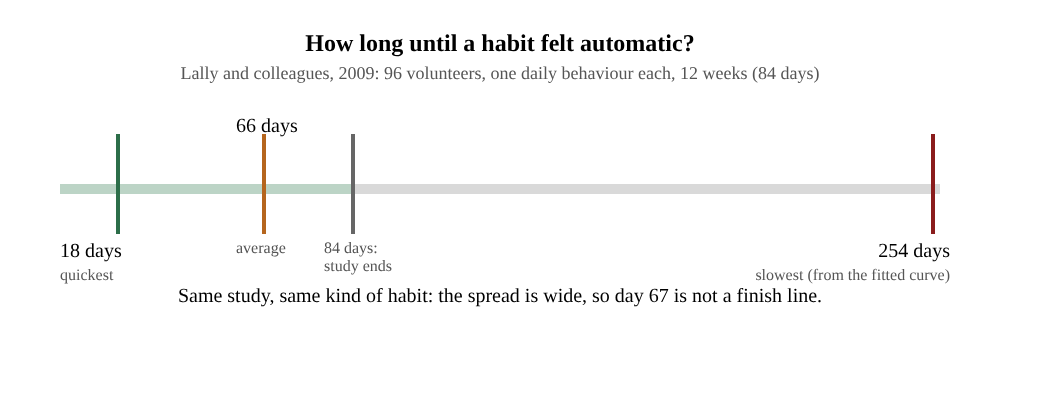
Two other findings matter more than the headline number:
- Consistency helped. People who did the behaviour more consistently had a better fit to the curve.
- One missed day did not wreck the process. Missing one opportunity to do the behaviour did not materially affect habit formation.
Read this as permission. If a habit is not automatic at day 30 or day 66, you are not failing. You are inside the normal spread.
What makes a habit form faster or slower
The study did not test most of what follows, so treat it as practical reasoning, not findings from the paper. The one thing it did point to is doing the behaviour in the same context each day.
- Size of the action. A two minute action is easier to repeat on a bad day than a forty minute one.
- A steady cue. Tying the action to something that already happens, like making coffee or brushing your teeth, gives it a trigger you do not have to remember.
- Same context. Same time, same place, same order. Fewer decisions each day.
- Daily repetition early on. The study had people act every day and found that consistency went with a better fit, so that is the pattern its numbers describe.
Sleep and movement are common first targets. The Routines and Habits course in the app covers How Habits Form, Sleep, the First Routine, and Move Every Day, and the health lessons teach what their sources say. For advice about your own body or health conditions, ask a doctor.
Why meaning keeps a habit going after the novelty fades
The first two weeks of a new habit run on novelty. After that you need a reason that still makes sense on a flat, tired Tuesday.
This is where the Stoics are useful. Epictetus began his Enchiridion with a split: "Some things are in our control and others not" (Carter translation). My post on things you can't control goes through it. Your result is not fully up to you. Whether you do today's small action is. A habit tied to that idea has a different feel. You are not chasing a streak number. You are practising being the sort of person who does what they said they would do.
Marcus Aurelius wrote in his notebook what to tell himself on mornings he rose unwillingly: "I am rising to the work of a human being" (Meditations 5.1, Long translation). That is a habit with a reason behind it, written by someone who did not always feel like it.
So before you pick the action, write one sentence on why it matters to you. Not "to be fit" in the abstract, but something tied to your roles and your values. That sentence is what you read when motivation is gone. I cannot promise it will make the habit stick, but a habit with no reason attached has nothing to fall back on.
A simple plan to build a habit over 66 days
Use 66 days as a trial length, not a target for finished. Here is a plan you can start tonight.
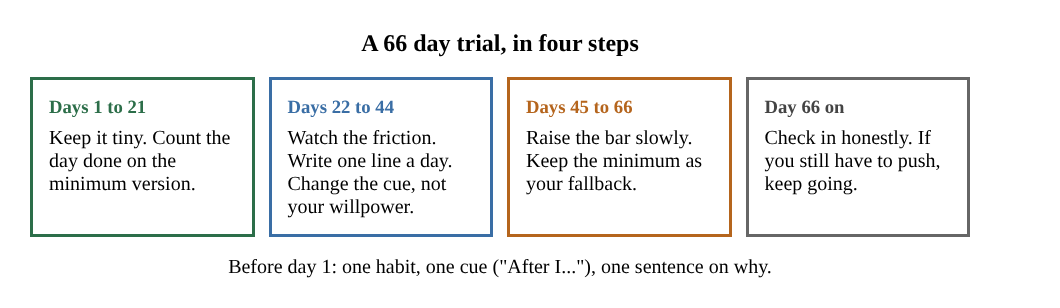
Before day 1
- Pick one habit. Make it small enough that you could do it on your worst day. Example: read one page, walk for ten minutes, or write three lines.
- Choose the cue. Use the format "After I [existing routine], I will [habit]." Example: "After I pour my morning coffee, I will write three lines."
- Write your reason in one sentence.
- Decide how you will track it. A paper calendar works. So does a notes file.
Days 1 to 21: keep it tiny
Do the minimum version only. The aim is repetition, not performance. If you want to do more, fine, but count the day as done on the minimum.
Days 22 to 44: watch the friction
This is where novelty fades. Each day, jot one line: what made it easy or hard? If the cue keeps failing, change the cue, not your willpower. Write down what you changed and what happened, so you adjust from evidence and not from guilt.
Days 45 to 66: raise the bar slowly
Once the action feels more automatic, you can add a little: a second page, five more minutes. Keep the minimum version as your fallback.
Day 66 and after
Check in honestly. Does it feel automatic, or do you still have to push? If you still push, keep going. The study's range says that is normal.
Using a daily practice as the habit
If you want a ready-made habit to try, the app's daily Stoic practice has three short steps. In the morning you get a question for the day and one of the four Stoic virtues to practise. During the day you get a short passage from Epictetus, Marcus Aurelius or Seneca and one thing to try. In the evening you answer the three questions Seneca learned from Sextius: What bad habit did I cure today? What fault did I resist? In what way am I better? Doing all three keeps the practice streak, and the whole thing takes about ten minutes. You can also keep notes on each day of the practice in one place.
What to do when you miss a day
You will miss one. The study found that a single missed opportunity did not materially affect the habit forming. What does the damage is the story you tell afterward: "I blew it, so why bother."
Try this instead:
- Do not make it up. Doubling the next day turns a small habit into a chore.
- Restart at the next cue. The same trigger, the minimum version.
- Look for the cause. Travel, a late night, a changed schedule? Write it down and plan for it.
- Watch for two in a row. A common personal rule is never to miss twice. It is a rule of thumb, not a finding from the study.
The Stoic evening review fits here. Ask what you resisted and where you improved, and answer in plain terms. For more exercises like it, see six Stoic exercises to try.
Frequently asked questions
Does it really take 66 days to form a habit?
66 days was the average in one 2009 study of 96 people, not a rule. Individual times ranged from 18 days to an estimated 254 days.
Is the 21 day habit rule true?
The research in this post does not support it. In the 2009 study the quickest person took 18 days and the average was 66.
What happens if I skip a day?
In the 2009 study, missing one opportunity did not materially affect how the habit formed. Return to your usual cue the next day with the minimum version.
What helps a habit stick?
In the study, people who did the behaviour more consistently fitted the habit curve better. Beyond that, a small action tied to a steady cue is practical advice, not a finding from the paper.
Can I build a habit from a daily Stoic practice?
Yes, you can use it as the habit you track. The practice in How to Find Your Meaning is three short steps a day, morning, daytime and evening, and takes about ten minutes.
Get started
Pick one small habit, write your reason in a sentence, and start tonight. If you want lessons on how habits form and a daily Stoic practice to carry out, How to Find Your Meaning is free with an account. You sign in with your email and an emailed code. You can read more on the about page, or see how to install it from the site to your phone or computer.
Find what your life is for.
Visit findyourmeaning.vlvd.net↗


Comments
No comments yet.
Sign in or make an account to comment.