AI Hype Cycle: What Two AI Winters Teach Founders
The AI hype cycle is the pattern where big promises about AI draw money and attention, results fall short of the promises, and funding drains away until a real advance starts the next round. The field has gone through this twice and the two crashes are known as the AI winters. If you plan to build a business on AI, the history tells you which ideas tend to survive a downturn. The first lesson of The Road to the Age of AI covers it in about nine minutes (sign in to open the course).
If you want to learn this history and then build on it, Age of AI Entrepreneur teaches how modern AI works and how to build, launch and grow a business with it, in short hands-on lessons that list their sources.
What the AI hype cycle is and how it works
A hype cycle has the same few stages every time. A new technique produces a striking demo. People extrapolate to a world where machines do most of the work. Money arrives. Then the technique meets messy real-world problems, and the gap between promise and product shows. Money leaves faster than it came.
The gap is the thing to watch. A technology can be real and still be oversold. The winters did not happen because AI research was fake. They happened because the claims ran ahead of what the methods could deliver.
The first AI winter: promises that outran the hardware
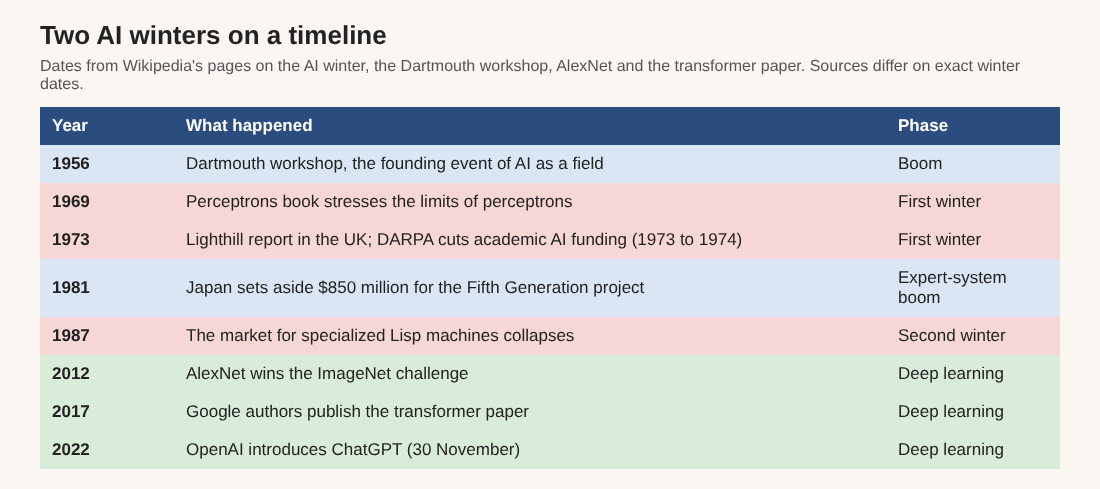
The field dates to the 1956 Dartmouth workshop, which is called the founding event of AI as a field. Early excitement ran high, and the claims for general machine intelligence ran well ahead of what the programs could do.
The claims did not hold. Early neural network work hit a wall: the 1969 book Perceptrons by Marvin Minsky and Seymour Papert emphasized the limits of what perceptrons could do, and research on them lost mainstream support.
Funders noticed. In the UK, the 1973 Lighthill Report criticized AI's "grandiose objectives", and UK research was largely dismantled. In the US, DARPA cut funding for academic AI in 1973 and 1974. This is usually called the first AI winter, though sources differ on its exact dates.
The founder lesson: a demo shows what is possible once, under good conditions. It does not show cost, reliability or scale.
The second AI winter: expert systems and the funding collapse
AI came back in the 1980s with a more practical idea: expert systems. Instead of general intelligence, you captured the rules a human specialist used in a narrow field, such as diagnosing a fault or configuring a computer order, and encoded them in software. Some of these systems did useful work, and companies bought them. Governments joined in too: in 1981 Japan's trade ministry set aside $850 million for its Fifth Generation Computer project.
Then the problems showed up. Expert systems were expensive to build because people wrote the rules by hand. They were brittle: step outside the narrow domain and they failed. They were costly to maintain as the world changed. A market for specialized AI hardware, the Lisp machines, collapsed in 1987 once cheaper workstations could run the same software. By the early 1990s many early expert systems were abandoned, and DARPA cancelled new AI spending in 1988. That is the second AI winter.
The founder lesson: a product that needs constant expert upkeep, and that breaks outside its narrow lane, has a hidden cost that grows with every customer.
The pattern behind both crashes
Put the two winters side by side and the same shape appears.
- The pitch described the destination, not the product. Funders heard "machines that think" when the actual deliverable was a narrow tool.
- A bottleneck was ignored. First it was compute and the size of real problems. Second it was the labor of writing and maintaining rules by hand.
- Demos were treated as evidence of reliability. A system that works on chosen examples is not one that works for paying customers every day.
- Money followed the story. When results lagged, the money left, and good work was caught in the same collapse as bad.
That last point matters for you. A downturn does not sort ideas by quality. Even strong projects can lose funding when the mood turns, so your business must stand without the mood.
Why deep learning broke the cycle, and what is different now
The ingredients that were missing earlier arrived together: large amounts of data, fast chips, and neural networks trained at scale. A turning point came in 2012, when the deep neural network AlexNet won the ImageNet image recognition challenge with a top-5 error rate of 15.3 percent, more than 10 percentage points ahead of the runner-up. In 2017 researchers at Google published the transformer architecture in the paper "Attention Is All You Need", and scaling it up led to the language models behind ChatGPT, released in November 2022.
Notice what changed: rules were no longer written by hand, because the system learned patterns from data. The course lessons Data, Chips and the Deep Learning Breakthrough and Transformers, Scale and ChatGPT walk through this step by step. If the terms are blurry, this founder's guide to AI, machine learning and deep learning sorts them out.
That does not mean the cycle is over. Researchers disagree about how far current methods will go, and the honest position is to hold that question open. Your job is to separate what today's tools do reliably from what people hope they will do.
Warning signs of hype in an AI product idea
Take your pitch and answer these five questions in writing.
- Remove the words "AI" from the pitch. Is there still a customer with a painful, specific problem? If not, you have a technology looking for a use.
- Name one customer and one task. "Replaces accountants" is a destination. "Drafts the weekly overdue-invoice reminder emails for a small agency" is a product.
- What happens when the model is wrong? If a mistake is costly and nobody checks the output, the idea depends on reliability you may not have.
- What does one request cost? Models are priced by tokens, and a product that looks cheap in a demo can look different at volume. The AI Product Stack course has a lesson on what a request costs.
- What is the hidden maintenance? Ask who updates prompts, data and rules as the world changes. This is the expert system trap in modern form.
Here is a worked example. A founder pitches: "An AI lawyer for everyone." Strip the label and the problem is vague. Narrow it: "A tool that reads a freelancer's client contract and flags three clauses about payment terms for a human to review." Now there is one customer, one task, and a person checking the result. The second version is smaller and far easier to test.
How to build an AI business that survives a downturn
Nobody can say whether another winter is coming. You can build so that your company does not depend on the story staying exciting.
- Start with a problem people already pay to solve. The Business Basics for Builders course starts with problems worth paying for, then moves to revenue, costs and unit economics.
- Test demand cheaply before you build. A landing page and a waitlist tell you more than a demo does.
- Measure quality. Build a small set of real examples and check your outputs against it every time you change something. The Evals course covers building an eval set and running AI in production.
- Keep costs tied to revenue. Know what each customer costs you to serve.
- Do not rest on the model alone. If your product is a thin layer over someone else's model, ask what is left when that model is cheap for everyone. The moats lesson in the Distribution and Moats course takes this on directly.
Before you ship, run through this AI product launch checklist too. None of this promises a business outcome. It only lowers the chance that a mood swing, not a real failure, takes your company down.
Frequently asked questions
What is the AI hype cycle?
It is the repeating pattern where an AI breakthrough sets off inflated expectations and heavy funding, results fall short, and money and interest drop until the next real advance. AI has gone through this at least twice.
What caused the first and second AI winters?
The first came in the 1970s when ambitious promises outran what the methods could deliver, and funders cut back. The second came from the late 1980s, after expert systems proved costly to maintain and brittle outside narrow domains.
Is the current AI boom just another hype cycle?
Researchers disagree about how far current methods will go, and reasonable people hold different views. What is clear is that today's models already do useful work, so the question for a founder is which tasks they handle reliably and at what cost.
How can a founder avoid building on hype?
Start from a specific customer problem, test demand before building, measure output quality with real examples, and know what each request costs you. Remove the word "AI" from your pitch and check that a real problem remains.
Get started
The fastest way to see where today's tools came from is to take the three short lessons in The Road to the Age of AI: Thinking Machines (Turing to the AI Winters), Data, Chips and the Deep Learning Breakthrough, and Transformers, Scale and ChatGPT. You sign in with your email and an emailed code.
Start Age of AI Entrepreneur: short hands-on lessons on how to build a business in the age of AI, with the sources listed in every lesson.
Building a business in the age of AI, from a first project to a company.
Visit aientrepreneur.vlvd.net↗
Comments
No comments yet.
Sign in or make an account to comment.